


Key Takeaways
- Bay suspension: Bristol City Council charges £38 per day to suspend a designated parking bay for one vehicle up to 5 metres long.
- No bay outside your door? A dispensation or coning request costs £38 per day per 5 metres, up to a maximum of £152 per day, and the council places and collects the cones.
- Timing: allow at least 3 working days for the council to process an application, and remember it won’t contact you to confirm approval.
- Size matters: many removal vehicles are longer than 5 metres, so measure the space you need before you apply.
- Clean Air Zone: non-compliant vans pay £9 a day and vehicles over 3.5 tonnes pay £100 a day to drive in Bristol’s Clean Air Zone.
Ask anyone who has moved house in Bristol what worried them most about moving day and you’ll often hear the same answer: “Where is the van going to park?” Narrow terraced streets, residents’ parking schemes, double yellow lines and steep hills all make it harder to get a removal vehicle close to the front door. The good news is that Bristol City Council has a straightforward process for reserving road space for a domestic removal, and with a few days’ planning you can make sure the van is waiting right where you need it.
In this guide we explain how parking bay suspensions and dispensations work in Bristol, what they cost, how long they take, how the Clean Air Zone affects removal vehicles, and the practical steps that keep moving day running smoothly. We’ve been helping people move around Bristol for over 22 years, so we’ve included the lessons we’ve learned on the city’s trickier streets along the way.
Why Removal Van Parking Matters So Much in Bristol
Parking can make or break a move. When a removal vehicle can park directly outside a property, the crew can load quickly and safely, carry heavy furniture short distances and keep an eye on the vehicle at all times. When it can’t, everything takes longer: items are carried further, furniture is at greater risk of knocks and scrapes, and the move may run into extra hours.
The challenge of Bristol’s streets
Much of Bristol was built long before anyone thought about seven-metre removal lorries. Rows of Victorian and Edwardian terraces, cars parked bumper to bumper on both sides of the road, one-way systems and steep hills are part of the city’s charm, but they also mean that a free stretch of kerb is rarely available by chance on a busy weekday or weekend morning.
Many central neighbourhoods also operate residents’ parking schemes and other parking restrictions. A removal van can’t simply park in a residents’ bay because it is moving someone into the street; under Rule 241 of the Highway Code, you must not park in spaces reserved for specific users, such as residents or Blue Badge holders, unless you’re entitled to do so.
What happens when parking isn’t planned
Without reserved space, the crew may have to park around the corner, wait for a space to open up or load from a spot that isn’t ideal. That can mean:
- longer carrying distances for sofas, wardrobes, white goods and boxes;
- more time on the job, which can increase the cost of an hourly move;
- a higher risk of damage to furniture, walls and door frames when items are carried further;
- frustration for neighbours if the street becomes blocked;
- the risk of a parking ticket if the vehicle has to stop somewhere restricted.

Pro Tip: Walk your street at the same time of day as your planned move a week or so beforehand. Note where cars usually park, where the yellow lines are, and whether there are any signs about bays or loading. Ten minutes of observation can save hours on the day.
Your Options: Suspensions, Dispensations and Coning
Bristol City Council offers two main ways to reserve road space for a domestic removal. Which one you need depends on whether there is a marked parking bay outside the property.
Parking bay suspensions
A parking bay suspension temporarily takes a marked bay out of normal use so that your removal vehicle can park there instead. According to the council, you can apply to suspend a residents’ bay, a shared-use bay, a pay and display bay, a limited waiting bay or a bay in one of the council’s car parks.
The council lists domestic removals as one of the reasons it will consider a suspension, alongside helping the movement of traffic, making an area safer, building work next to the space and special events such as weddings and funerals.
Dispensations and coning requests
If the road outside your home doesn’t have marked parking bays, a suspension isn’t the right tool. Instead you can apply for a parking dispensation or coning request. This allows cones to be placed on a road, or on yellow lines, to help with parking or traffic flow. The council gives “a domestic removal” as one of its examples of when a dispensation or coning request can be made.
The council says it approves these applications based on why you want the area restricted and where you want the restriction. Usefully for anyone moving house, the council places the traffic cones for you and collects them when the dispensation has finished.
Which option do you need?
Use this quick comparison to work out which application fits your street:
| Your street | What to apply for | Council cost |
|---|---|---|
| Marked residents’, shared-use, pay and display or limited waiting bays outside the property | Parking bay suspension | £38 per day per bay (one vehicle up to 5 metres) |
| No marked bays, for example an unmarked kerb or yellow lines | Dispensation or coning request | £38 per day per 5 metre length, up to £152 per day |
| A bay in a council car park | Parking bay suspension | £38 per day, plus VAT for off-street bays |
| Private road, driveway or private car park | Not a council matter; ask the landowner or managing agent | Set by the landowner, if anything |
How Much Does Removal Van Parking Cost in Bristol?
Bristol’s charges are published by the council and are simple to work out once you know how much space your removal vehicle needs.
Suspension costs
It costs £38 per day to suspend a designated parking bay for one vehicle up to 5 metres long. If your removal vehicle is longer than 5 metres, or you’re using two vehicles, you’ll usually need more than one bay. Off-street bay suspensions in council car parks are charged additional VAT.
Dispensation and coning costs
On a road where there isn’t already a parking bay, a dispensation or coning request costs £38 per day per 5 metre length, up to a maximum of £152 per day. The cap is helpful if you need a long stretch of road for a larger move with more than one vehicle.
Example costs for common moves
The table below shows how the council’s published rates work out for some typical scenarios. These are council fees only and don’t include any removal charges.
| Scenario | Space needed | Suspension (bays) | Dispensation (coning) |
|---|---|---|---|
| One small van, one day | Up to 5 m | 1 bay: £38 | 5 m: £38 |
| One vehicle longer than 5 m, one day | Up to 10 m | 2 bays: £76 | 10 m: £76 |
| Two vehicles, one day | Up to 15 m | 3 bays: £114 | 15 m: £114 |
| Large move needing 20 m or more, one day | 20 m+ | 4 or more bays: £152+ | Capped at £152 per day |
| One vehicle longer than 5 m, two days | Up to 10 m | 2 bays × 2 days: £152 | 10 m × 2 days: £152 |
Always check the current fees on the council’s website before you apply, as charges can change.
Good to know: If you’re moving between two Bristol addresses, you may need space at both ends. Budget for the collection address and the delivery address separately, and check whether each street has marked bays or not.
How to Apply for a Parking Suspension or Dispensation
Both applications are made online through Bristol City Council’s website. The process is similar for each.
Step 1: Confirm your moving date and timings
Before you apply, agree your moving date and the approximate start and finish times with your removal company. If your move might run over two days, for example if packing is done the day before, think about whether you need space on both days.
Step 2: Measure the space you need
Ask your removal company which vehicle or vehicles they are sending and how long they are. Then add a little extra room so the crew can open the rear doors and use the tail lift or ramp safely. We explain more about vehicle sizes in the next section.
Step 3: Gather the information the council asks for
The council says you’ll need:
- the registration numbers for all the vehicles involved;
- any images or documents that explain what you’re planning to do, which you can upload to the form;
- your account code and cost code, if you’re a council employee.
Because registration numbers are required, it’s worth asking your removal company for them as soon as your booking is confirmed.
Step 4: Apply at least 3 working days ahead
The council asks you to allow 3 working days for your application to be processed. Working days don’t include weekends or bank holidays, so a Saturday move needs an application earlier in the week before. In practice, we recommend applying as soon as your date is fixed rather than leaving it to the minimum.
Step 5: Don’t wait for a confirmation email
One detail catches many people out: the council says it won’t contact you to tell you your application has been approved. It will only contact you if it needs more information. Keep a copy of your application and payment details, and check the street in the days before your move for any signs or cones.
Pro Tip: Put a polite note through your neighbours’ doors a few days before the move explaining that a bay has been suspended or that cones will be out for your removal. Most neighbours are happy to help when they know in advance.
Choosing the Right Amount of Space for Your Removal Vehicle
The council’s charges are based on 5 metre lengths, so the size of your removal vehicle directly affects the cost and the number of bays you need.
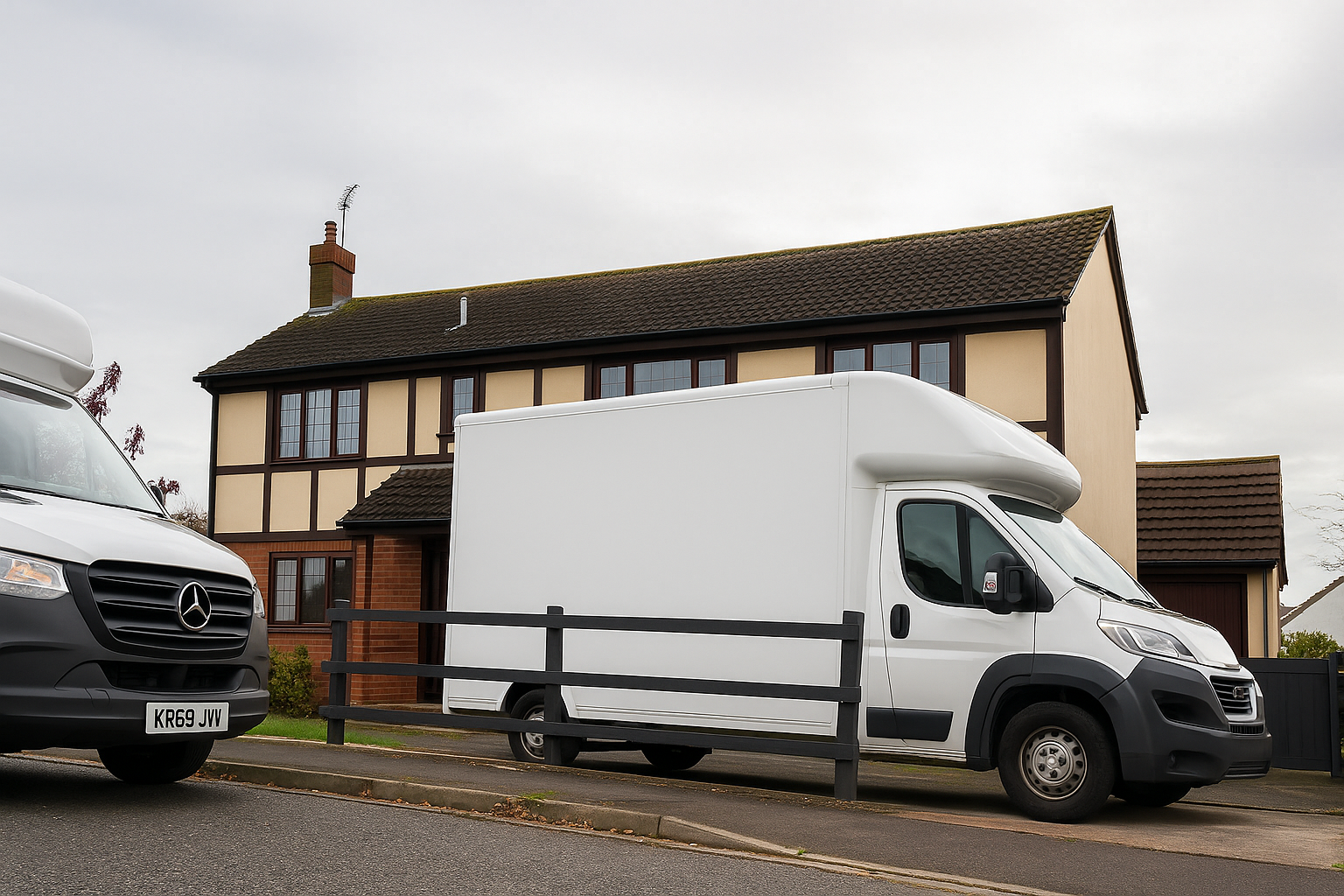
Typical removal vehicles
Our own fleet includes long-wheelbase Transit-type vans, Luton vans and 7.5-tonne lorries, and we choose the vehicle to suit the size of the move. Smaller moves and single-item collections often suit a van, while a full family home usually needs a Luton or a lorry, and sometimes more than one vehicle.
Many removal vehicles, including Luton vans and 7.5-tonne lorries, are longer than a single 5 metre bay. Even some long-wheelbase vans come close to that length. Always ask your removal company for the exact length of each vehicle rather than guessing.
Allow room for loading
Space behind the vehicle is just as important as the space it occupies. The crew needs room to lower a tail lift or ramp and to carry furniture safely to the rear doors. If you’re applying for a dispensation, consider requesting an extra 5 metre length if the budget allows; it can make loading much quicker.
If you’re using a smaller service
If you’re moving from a flat or only have a few items, a man and van service in Bristol may need just one standard bay. For a full house, our house removals in Bristol service will recommend the right vehicles and tell you how much road space to plan for.
Yellow Lines, Loading Rules and the Highway Code
It’s tempting to assume a removal van can stop anywhere for a few minutes to load. The rules are more nuanced than that, and getting them wrong can lead to a penalty or a dangerous situation.
Yellow lines and kerb markings
Rule 238 of the Highway Code says you must not wait or park on yellow lines during the times of operation shown on nearby time plates, or zone entry signs in a Controlled Parking Zone. Rule 247 adds that you shouldn’t load or unload where there are yellow markings on the kerb and upright signs advising that restrictions are in place. Loading may be permitted where parking is otherwise restricted, but you need to read the signs carefully.
This is exactly why a dispensation or coning request is so useful: it lets the council authorise the space for your removal rather than leaving the crew to interpret the signs on the day.
Obstruction and pavements
Rule 242 says you must not leave a vehicle in a dangerous position or where it causes unnecessary obstruction of the road. Rule 244 says you should not park partially or wholly on the pavement outside London and Scotland unless signs permit it, because it can obstruct pedestrians, wheelchair users and people with prams.
For heavier vehicles, Rule 246 says goods vehicles with a maximum laden weight of over 7.5 tonnes must not be parked on a verge, pavement or land between carriageways without police permission, except when it’s essential for loading and unloading, and even then the vehicle must not be left unattended.
Schools, junctions and narrow roads
Rule 243 lists places where you shouldn’t stop or park, including near a school entrance and close to junctions. If your home is near a school, think about avoiding the start and end of the school day, and mention it when you apply.
“The best moves we do are the ones where the parking was sorted days before we arrived. When the van is right outside the door, the whole day is calmer, safer and quicker for everyone.”
Bristol’s Clean Air Zone and Removal Vehicles
If your move takes you into central Bristol, you’ll also need to think about the Clean Air Zone (CAZ). It’s separate from parking, but it can affect the cost of moving day.
How the zone works
Bristol’s Clean Air Zone started on Monday 28 November 2022. It’s a Class D zone, which means older, more polluting private and commercial vehicles pay a daily charge to drive within it. No vehicles are banned, and charges don’t apply to a vehicle that is parked in the zone but doesn’t move.
Charges apply 24 hours a day, midnight to midnight, every day of the year. You only pay once for each day, however many times you enter or leave the zone, but if a journey crosses midnight you’ll need to pay two daily charges.
What it costs
According to Bristol City Council’s Clean Air Zone charges page:
| Vehicle type | Daily charge if non-compliant |
|---|---|
| Private petrol or diesel cars | £9 |
| Light goods vehicles (vans under 3.5 tonnes) | £9 |
| Heavy goods vehicles (over 3.5 tonnes) | £100 |
| Motorbikes | No charge |
As a guide, the council says charges don’t apply to Euro 4, 5 and 6 petrol vehicles (about 2006 or newer), Euro 6 diesel vehicles (about the end of 2015 or newer), and fully electric or hydrogen vehicles. You can check any vehicle on the government’s Drive in a clean air zone service.
What this means for your move
If you’re hiring a van yourself or a friend is helping with their car, check the registration before the day. If you’re using a removal company, ask whether their vehicles are compliant and whether any CAZ charge would be added. Remember it’s the driver’s responsibility to pay: you won’t be notified, and an unpaid charge leads to a Penalty Charge Notice of £120 on top of the charge, reduced to £60 if paid within 14 days.
Practical Moving Day Tips for Tight Bristol Streets
Even with a suspension or dispensation in place, a little preparation goes a long way on Bristol’s narrower roads.
Before the day
- Share access details: tell your removal company about steps, steep paths, narrow hallways, lifts or rear access lanes. A video quote over WhatsApp is a quick way to show us the property and the street.
- Check both addresses: parking at the delivery address is just as important as at the collection address. If you’re moving out of the city, for example on a removal to Bath, check the parking rules there too.
- Pack early: boxes that are packed, sealed and labelled load far more quickly. Our guide on how to pack for moving covers the essentials.
- Move your own car: if you have a driveway or a space outside, move your own car out of the way the night before.
On the day
- Be there early: check that the cones or signs are in place and the space is clear before the vehicle arrives.
- Keep a copy of your application: if anyone queries the space, you can show that it was booked for your removal.
- Keep doorways clear: a clear route from the front door to the vehicle helps the crew work safely with blankets, straps and sack trucks.
- Be considerate: keep pavements clear for pedestrians, and let the crew know about anyone who needs access, such as a neighbour with mobility needs.

If something goes wrong
Occasionally a car is parked in a suspended bay or the space isn’t available. Stay calm, don’t move cones yourself, and speak to your removal crew about the safest option. Make a note of what happened so you can raise it with the council afterwards if needed.
Pro Tip: Moving house involves dozens of small jobs. Once parking is booked, use our checklist of who to notify when you move so nothing else is left to the last minute.
Planning your move timeline around parking
Parking is just one part of a well-planned move. Here’s how it fits into a typical timeline:
| When | What to do |
|---|---|
| As soon as your date is confirmed | Book your removal company and ask for the vehicle sizes and registration numbers. |
| 1–2 weeks before | Walk the street, check for bays and yellow lines, and apply for a suspension or dispensation. |
| At least 3 working days before | The latest point to submit your council application, according to the council’s processing time. |
| A few days before | Let neighbours know, and check for signs or cones in the street. |
| The night before | Move your own vehicles, and clear the route from the door to the kerb. |
| Moving day | Arrive early, check the space, and keep your application details to hand. |
For a complete overview of everything else involved, read our step-by-step guide on how to move house.
Frequently Asked Questions
How much does it cost to suspend a parking bay in Bristol?
Bristol City Council charges £38 per day to suspend a designated parking bay for one vehicle up to 5 metres long. Off-street bays in council car parks are charged additional VAT.
How much notice do I need to give the council?
The council asks you to allow 3 working days for your application to be processed. We recommend applying as soon as your moving date is confirmed, especially for weekend moves.
Will the council confirm that my suspension has been approved?
No. The council says it won’t contact you to tell you your application has been approved; it will only get in touch if it needs more information. Keep a record of your application.
What if there are no parking bays on my street?
Apply for a dispensation or coning request instead. It costs £38 per day per 5 metre length, up to a maximum of £152 per day, and the council places and collects the cones.
Can a removal van park on double yellow lines to load?
It depends on the signs. The Highway Code says you must not wait or park on yellow lines during their times of operation, and you shouldn’t load or unload where there are yellow kerb markings and signs showing loading restrictions. A dispensation is the safest way to get permission for a domestic removal.
Do I need to pay the Clean Air Zone charge on moving day?
Only if a non-compliant vehicle is driven within the zone. Non-compliant vans under 3.5 tonnes pay £9 a day and heavier vehicles pay £100 a day. Check a vehicle on the GOV.UK Clean Air Zone service.
How many bays will my removal vehicle need?
Each bay suspension covers one vehicle up to 5 metres long. Many removal vehicles, including Luton vans and 7.5-tonne lorries, are longer than that, so ask your removal company for the exact length and allow room for loading at the rear.
Can my removal company arrange the parking for me?
Some removal companies can help or advise on applications, so it’s worth asking when you book. Either way, they’ll need to give you the vehicle registration numbers and lengths for the council’s form.
Make Moving Day in Bristol Easier
Sorting out parking a few days in advance is one of the simplest ways to make your move quicker, safer and less stressful. Check your street, measure the space you need, apply to Bristol City Council at least 3 working days ahead, and keep your neighbours in the loop.
Simply Removals Bristol has more than 22 years’ experience moving homes and businesses across Bristol and beyond. We’re fully insured, we offer free video quotes over WhatsApp, and our fleet ranges from long-wheelbase vans to 7.5-tonne lorries, so we can recommend the right vehicle for your street. Contact us today for a free, no-obligation quote and let us help you plan a smooth move.