


Let's be honest, when you're surrounded by packing boxes and endless to-do lists, updating your address can feel like the last thing you want to tackle. It's tempting to put it off, but this isn't just about making sure your subscriptions find their way to your new home.
Why You Can't Afford to Forget Your Change of Address
Skipping your address updates can create some serious headaches, with consequences that go far beyond a missed birthday card. We're talking about real risks to your finances and your identity.
Think about it: a final utility bill gets sent to your old place and, unnoticed, goes unpaid. Before you know it, it's with a debt collector, and a black mark appears on your credit file. Or what about a bank statement, a new credit card, or your driving licence renewal falling into the wrong hands? It's a goldmine for identity thieves. Research shows that victims of identity fraud can spend a staggering 30 to 50 hours on average just trying to sort out the mess.
We heard from one Bristol family who nearly had their new home plans derailed by this exact issue. A single forgotten credit card statement sent to their old flat resulted in a default on their credit report, right when they were applying for a small loan. It was a nightmare of stress and delays, all from one small admin slip.
This isn't about scaremongering; it's about being prepared. By treating your address changes as a crucial part of the move, you turn a mountain of a task into a series of manageable steps. It’s not just admin—it’s about protecting yourself.
This guide will walk you through everything, making sure nothing gets missed. From the essential safety net of a Royal Mail redirect to updating the DVLA, we'll cover every step to ensure your move is smooth and your personal information stays secure.
Your Pre-Move Timeline for Changing Addresses
Let's be honest, sorting out your address changes isn't the most exciting part of moving, but getting it right is crucial. This isn't just about one frantic day of phone calls. The secret is to treat it like a mini-project, spreading the tasks out over the month before you move. A phased approach stops the last-minute panic and makes sure nothing gets missed.
If you don't stay on top of it, the risks are very real – we're talking about everything from identity theft and missed payments to a potential drop in your credit score.
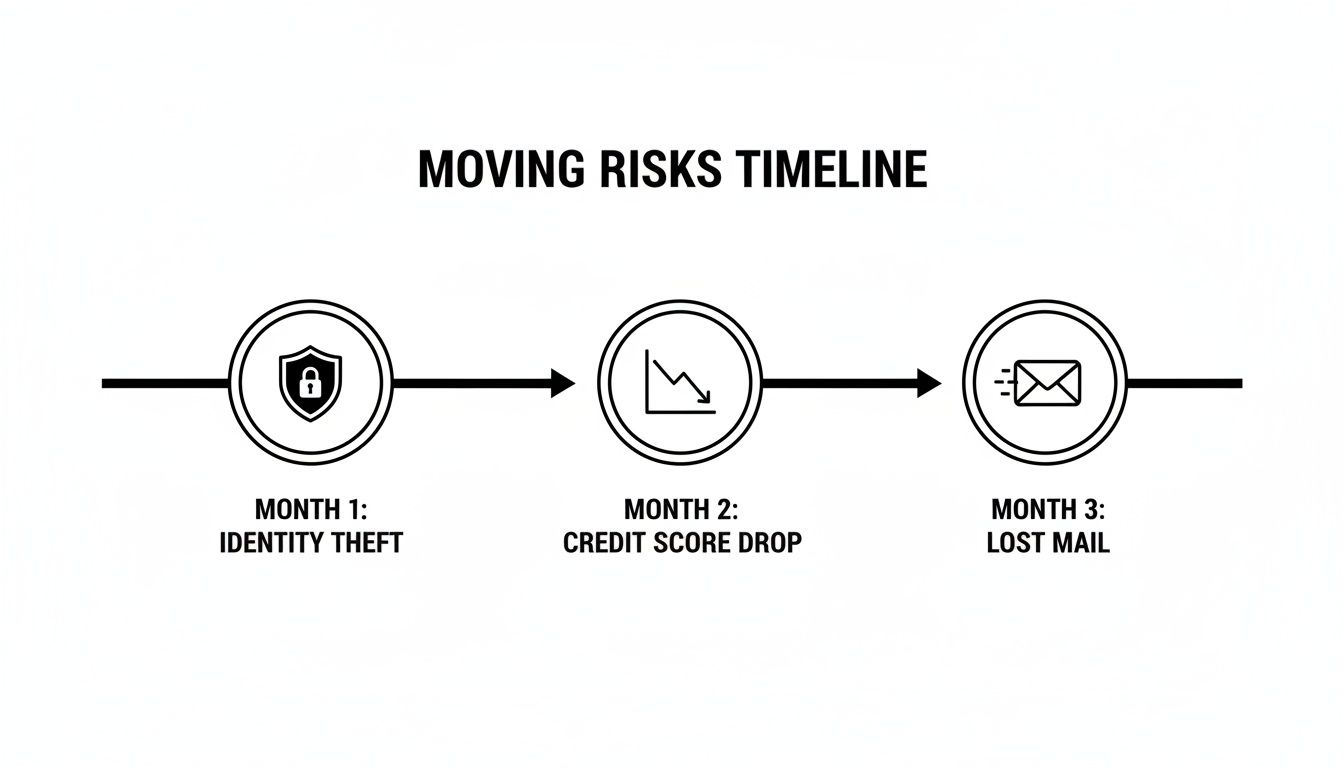
As you can see, these aren't just minor headaches; they can have a lasting impact if you let them slide.
This quick-reference table should help you prioritise who needs to know and when during that crucial final month.
Address Change Timeline At a Glance
| Timeframe Before Move | Who to Notify | Key Action |
|---|---|---|
| 4 Weeks | Royal Mail | Set up your post redirection. This is your essential safety net. |
| 4 Weeks | Landlord/Letting Agent | Give formal written notice to end your tenancy agreement. |
| 2 Weeks | Utility Companies | Schedule the switch-off/switch-on for gas, electricity, and water. |
| 2 Weeks | Broadband/TV Provider | Book your service transfer or a new installation for moving day. |
| 2 Weeks | Local Council | Close your old Council Tax account and pre-register for the new one. |
| 1 Week | Banks & Financial Providers | Update your address on all current accounts, credit cards, and loans. |
| 1 Week | Insurance Companies | Arrange for home insurance to start on your new property; update car policy. |
Now you've got the overview, let's break down exactly what you need to do at each stage.
Four Weeks Before You Move
With a month to go, it's time to tackle the big-ticket items. These are the foundational tasks that take a little longer to process or act as a vital safety net for everything that follows.
First on your list should be setting up a Royal Mail Redirection. Think of it as your ultimate backup plan. It catches any post still being sent to your old address and forwards it to your new one for 3, 6, or 12 months. Honestly, it's a non-negotiable step that buys you incredible peace of mind. It means even if you forget to notify someone, your important documents won't end up in the wrong hands. Get it sorted early, as it can take up to a week to kick in.
If you're renting, now is the time to give formal written notice to your current landlord or letting agent. Dig out your tenancy agreement to check the exact notice period required, but four weeks is pretty standard. This official heads-up gets the end-of-tenancy process rolling, including scheduling your final inspection and the return of your deposit.
Two Weeks Before You Move
As moving day creeps closer, your focus needs to shift to the services that turn a building into a home. A smooth transfer of utilities is the difference between a warm welcome and moving into a dark, cold house. It also stops you from paying for services at your old place after you’ve left.
This is your cue to get on the phone with all your utility providers. You need to book in the disconnection at your old address and the connection at your new one.
- Gas and Electricity: Call your current supplier with your moving date and new address. You’ll need to give them a final meter reading on the day you move.
- Water: For those of us in the South West, this means contacting providers like Wessex Water or Bristol Water. Let them know when you're moving out so they can close your account.
- Broadband and TV: Internet providers often need a couple of weeks' notice to arrange an engineer or transfer your service. Get a slot booked well in advance to avoid being offline when you most need it.
A classic mistake is just assuming your current broadband provider covers your new area. Always check first. If they don't, you'll need this two-week window to find a new company and get an installation booked for moving day.
This is also the perfect time to notify your local council about your Council Tax. You need to let them know you're leaving so they can close your current account and send a final bill. You can then pre-register with the council for your new property, whether that's Bristol City Council or Bath & North East Somerset Council, to get the new account set up and running.
The Final Week Before You Move
In these last seven days, the focus narrows to your financial and personal accounts. These updates are usually quicker to process but are absolutely critical for your security. The goal here is to ensure your financial life moves seamlessly with you.
Start by methodically going through your financial institutions. The good news is that most banks and credit card companies let you update your address instantly through their mobile app or online banking portal.
Key Financial Accounts to Update:
- Current and Savings Accounts: Log in to each banking app and change your primary residence.
- Credit Card Providers: This is essential for receiving new cards and statements securely.
- Pension Providers: Make sure your annual statements and important updates don't go astray.
- Loan and Mortgage Providers: From your student loan to your mortgage lender, keep them in the loop.
- Investment Platforms: Update any accounts you hold for stocks, shares, or ISAs.
Finally, get in touch with your insurers—this means car, home, life, and even pet insurance. Your home insurance is a big one; the policy for your old property needs to be cancelled, and a new one must be active for your new home from the day you get the keys. Your car insurance premium might also change based on your new postcode, so it's vital to update this to keep your policy valid.
By following these organised steps, you can turn a potentially chaotic part of moving into a straightforward process. If you're looking for more tips on what to do when moving, our comprehensive guide offers even more valuable insights.
Getting the Officials On Board: Government and Public Bodies
Some address changes are about making life easier, but others are legal must-dos. Sorting out your details with key government agencies isn't just a box-ticking exercise; it's a legal requirement. Get it wrong, and you could face hefty fines, a hit to your credit score, or a delay in accessing essential services.
Let's walk through the non-negotiable updates you need to make to official UK bodies, covering who to tell, why it's so important, and how to get it done without the headache.
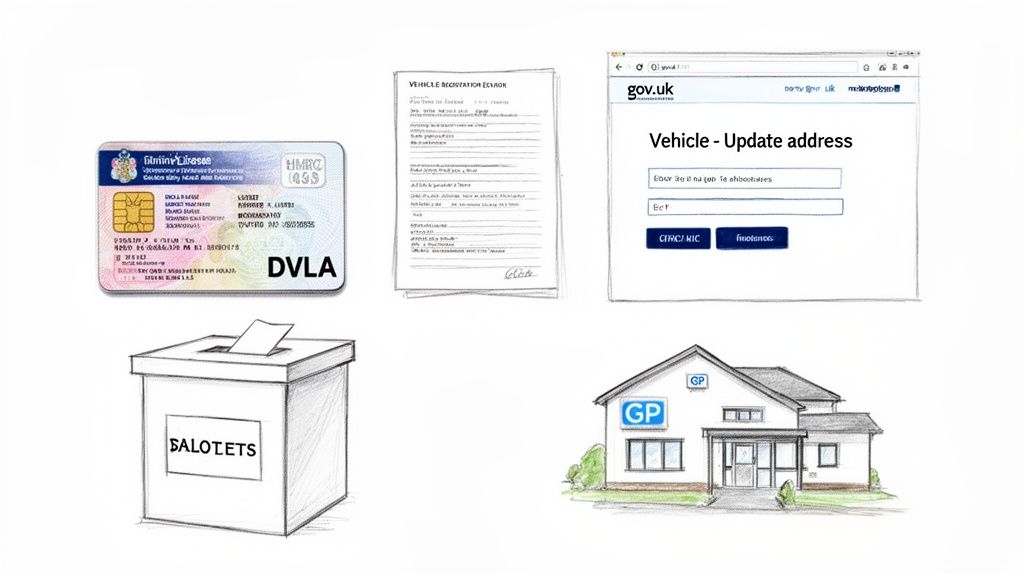
Driving Licence and Vehicle Registration (DVLA)
This one should be at the very top of your list. You are legally required to have the correct address on both your driving licence and your vehicle log book (the V5C).
The penalty for not doing this can be a real shock – you could be fined up to £1,000 if you’re pulled over and the police find your details are out of date. The good news is that it’s completely free to update online via the official GOV.UK website, and it's surprisingly quick.
To get it done, you'll need a few things handy:
- Your driving licence number
- Your National Insurance number
- Your passport number (if you have it)
- A list of the addresses you've lived at for the past three years
Remember, updating your V5C log book is a separate process, but it's just as vital. You can do this online too. Whatever you do, don't just scribble your new address on the old documents – it won’t count.
I see this mistake all the time: people assume updating their driving licence automatically sorts out their vehicle tax or V5C log book. It doesn't. They are separate systems. Make sure you update your licence and the details for each vehicle you own.
The Electoral Roll (And Why It Matters for Your Wallet)
Registering to vote at your new place might feel like something you can put off, but it has a surprisingly immediate impact on your finances. Why? Because credit reference agencies use the electoral roll to confirm who you are and where you live.
Being registered shows stability, which is a big tick in the box for lenders when you apply for a mortgage, loan, or even a new mobile phone contract. If you're not on the roll at your new address, it can leave a gap in your history, potentially knocking your credit score down a few points.
It genuinely takes about five minutes to register online at GOV.UK. All you need is your National Insurance number. It’s a tiny bit of admin that protects your right to vote and keeps your credit file healthy.
HM Revenue & Customs (HMRC)
Letting the taxman know you've moved is crucial. This is especially true if you're self-employed, receive any state benefits or tax credits, or are expecting a tax refund. If HMRC sends important letters – like a tax code change or a payment reminder – to your old address, you could be in for a world of hassle.
You need to update your details to ensure you're paying the right amount of tax and National Insurance. The easiest way is to log into your Government Gateway or Personal Tax Account online.
It's a quick job that saves you from a massive administrative headache later. The process is quite similar to managing your council tax online. For a heads-up on what's involved, have a look at our guide on how to sort your council tax when moving out.
Your Health and Local NHS Services
Your access to healthcare shouldn't skip a beat just because you've moved. A good first step is to let your old GP surgery know you're leaving. This gives them a chance to close your file and get your medical records ready for transfer.
Once you’re in your new home, make finding and registering with a local GP a priority. You can use the NHS website to see which surgeries in your new postcode are taking on patients. If you're moving to Bristol or Bath, the process is pretty standard, but it's always smart to do a little research on the local practices beforehand.
To register, you'll usually need to fill out a GMS1 form and show some proof of your new address, like a council tax bill or tenancy agreement. Getting this sorted early means you won't have any delays getting an appointment or a prescription when you really need one.
Sorting Out Your Personal and Household Accounts
Once you've dealt with the official bodies and sorted out your utilities, it’s time to move on to the web of personal accounts that make up modern life. It’s easy to think of these as less urgent, but forgetting them is how you end up with your online shopping being delivered to the new tenants at your old place. A surprisingly common and frustrating mistake.
This part of the moving admin is all about the services you use every day for entertainment, shopping, and family life. Think of it as a digital tidy-up that mirrors your physical move. The sheer number of accounts we all have can be staggering, so staying organised here really pays off.
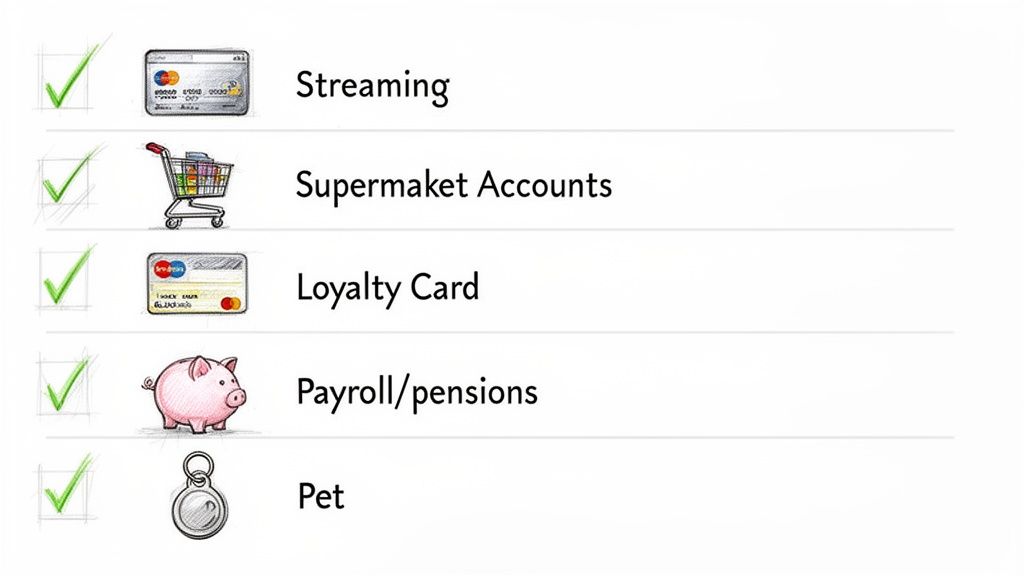
Subscriptions and Online Shopping
Let's start with the big ones you probably use most often. Streaming services and online retailers hold your address for billing and delivery, and one forgotten update here can cause a real headache.
I’ve heard this story a hundred times: a family moves from Clifton to Southville in Bristol. In the chaos of unpacking, they order a much-needed kettle from Amazon using one-click. Of course, the default address is still their old flat. The package gets delivered, signed for, and they're left trying to chase it across the city.
To sidestep that drama, make a quick hit-list of your go-to services:
- Online Retailers: Amazon, eBay, and any other sites you frequent need both your new delivery and billing addresses.
- Streaming Services: Netflix, Disney+, and Spotify must have your updated billing address to stop payments from failing.
- Subscription Boxes: Whether it’s a meal kit or a monthly magazine, make sure your next delivery is heading to the right door.
Loyalty Cards and Memberships
Don't let your loyalty points and memberships fall through the cracks. Supermarket schemes like Tesco Clubcard or Nectar often post out physical vouchers and statements. If they go to your old home, you're basically throwing money away.
Most of these are easy to update through an app or website. While you're at it, cast your mind over other memberships—your gym, local library, and any professional or social clubs you belong to.
Employment and Education Records
Your employer absolutely needs your new address for payroll, your P60, and any other official mail. A quick email to HR is usually all it takes, but it's a vital step for keeping your records straight and your payslips arriving on time.
If you have kids, let their school or nursery know as soon as you can. This ensures you get everything from newsletters to urgent alerts. For older children applying to universities, updating their UCAS profile is crucial so they don’t miss any correspondence about offers and interviews.
It’s easy to feel overwhelmed by the sheer number of these smaller accounts. I always recommend a simple spreadsheet with three columns: Account Name, Updated (Yes/No), and Date. It gives you a clear, at-a-glance view of what's done and what's left.
Protecting Your Pets and Property
Your furry family members need updating, too. If your pet is microchipped—and it should be—you must contact the database provider (like Petlog or Identibase) to change your registered address. This is non-negotiable. If your pet gets lost during the disorienting period of a move, an up-to-date microchip is their best ticket home.
Don't forget to give your vet your new contact details as well. And while you're taking care of the household, make sure to review your home insurance to ensure you have continuous cover at the new place. Your existing policy is priced based on your old property and postcode, so it must be updated to remain valid and properly protect your new home from day one. Getting these details right provides peace of mind for the whole family, two-legged and four-legged alike.
Your Printable Address Change Checklist for Bristol and Bath
To take some of the sting out of updating your address when you move, we’ve put together a resource specifically for movers in the South West. This isn’t just another list you'll find online; it's a downloadable and printable checklist designed to be your sidekick through the whole admin-heavy process.
We’ve broken it down into four straightforward categories: Government, Financial, Utilities, and Personal. This layout makes it easy to see what needs tackling first, letting you tick things off without that nagging feeling you’ve forgotten something important. For a wider view of your move, checking out an essential move guide can also help you get all your ducks in a row.
Tailored for Bristol and Bath Movers
What really makes this checklist handy is its local touch. We've done the digging for you, so you don't have to.
Inside, you'll find direct links to the right pages on the Bristol City Council and Bath & North East Somerset Council websites. That means you can get straight to sorting out your Council Tax instead of getting lost in a maze of government site menus. It’s one of those small things that genuinely saves a ton of time and hassle.
One of the biggest headaches I see local movers face is hunting down the right contact details for regional utility suppliers. Our checklist cuts through that by including the key info for providers like Wessex Water, turning a generic chore into a clear, actionable plan.
This checklist turns a pretty daunting task into a series of manageable steps. Think of it as your secret weapon for any move to, from, or within the brilliant Bristol and Bath area. It’s a simple way to track what you’ve done and what’s left, ensuring nothing crucial gets overlooked in the moving-day chaos.
For the full breakdown of who to tell and when, you can find our detailed guide to changing your address here. Go ahead and download it, print it out, and stick it on your fridge—it’s your roadmap to a much smoother transition.
Got Questions About Changing Your Address? We’ve Got Answers
Even with a perfectly organised checklist, a few nagging questions always seem to surface when you’re trying to sort out your address change. It’s easy to get bogged down in the details, but getting it right is crucial for a smooth move and for keeping your personal info safe. Let's clear up some of the most common queries we hear.
How Long Should I Keep Royal Mail Redirection For?
This is a big one. Is it really worth it, and for how long? You can choose between three, six, or twelve months.
From my experience, six months is the sweet spot for most people. That's long enough to catch those quarterly bills or biannual statements you’ve completely forgotten about. Think of it as your safety net for any mail that slips through the cracks.
But, if you run a business from home, are self-employed, or just want absolute certainty you won't miss a critical annual document (like a tax summary or insurance renewal), go for the full twelve months. It's a small price to pay for total peace of mind.
Is It Really a Big Deal If I Forget the DVLA?
Yes, it absolutely is. Forgetting to update the address on your driving licence and V5C logbook is much more than a simple admin error.
You could be hit with a fine of up to £1,000. And it's not some obscure rule; police can issue this fine on the spot during a routine traffic stop if they find your details are out of date. Considering it’s completely free to do online at the GOV.UK website, this should be at the very top of your to-do list.
Does Being on the Electoral Roll Actually Affect My Credit Score?
It really does, and often more than people realise. While it might feel like a minor detail in the chaos of moving, credit reference agencies and lenders lean on the electoral roll to prove you are who you say you are.
Being correctly registered at your new address signals stability, which is exactly what they want to see. A consistent address history makes a real difference when you apply for anything from a new phone contract to a mortgage. It’s a quick, free task that genuinely boosts your financial standing.
When you're ready to make your move as seamless as your admin, SimplyPro Removal & Storage Ltd offers professional, reliable services across Bristol and Bath to handle the heavy lifting. Get your free, no-obligation quote today.