


Moving home or office is a significant undertaking. Between packing boxes and coordinating logistics, it is easy to overlook one of the most critical tasks: notifying everyone about your new address. Failing to update key organisations can lead to missed bills, lost mail, identity theft risks, and major administrative headaches long after you’ve settled in. This comprehensive guide provides the definitive checklist of all the crucial addresses to change when moving, tailored for a smooth transition.
We've organised this list to be as actionable as possible, detailing who to notify, when to do it, and how to get it done efficiently. From government bodies like HMRC and your local council to your bank, GP, and subscription services, we'll cover every essential point of contact. This systematic approach ensures your important information and correspondence move with you, preventing any costly or stressful oversights during this busy period.
This list focuses specifically on the administrative task of updating your details, but a successful relocation involves many moving parts. For a holistic approach to your relocation, consider a comprehensive 7-step guide on moving house that covers all essential aspects beyond just address changes. By tackling these tasks methodically, you can ensure a seamless move, whether you are relocating within Bristol, Bath, or further afield. Let's tick every box and make sure nothing gets left behind.
1. Royal Mail – Address Change Service
Even the most organised mover can miss a few organisations when updating their contact details. Royal Mail’s Redirection service acts as an essential safety net, ensuring any post sent to your old address is automatically forwarded to your new one. This service catches everything from unexpected bills and legal notices to personal correspondence from people you forgot to notify, preventing sensitive information from falling into the wrong hands. It’s a crucial first step in any list of addresses to change when moving.
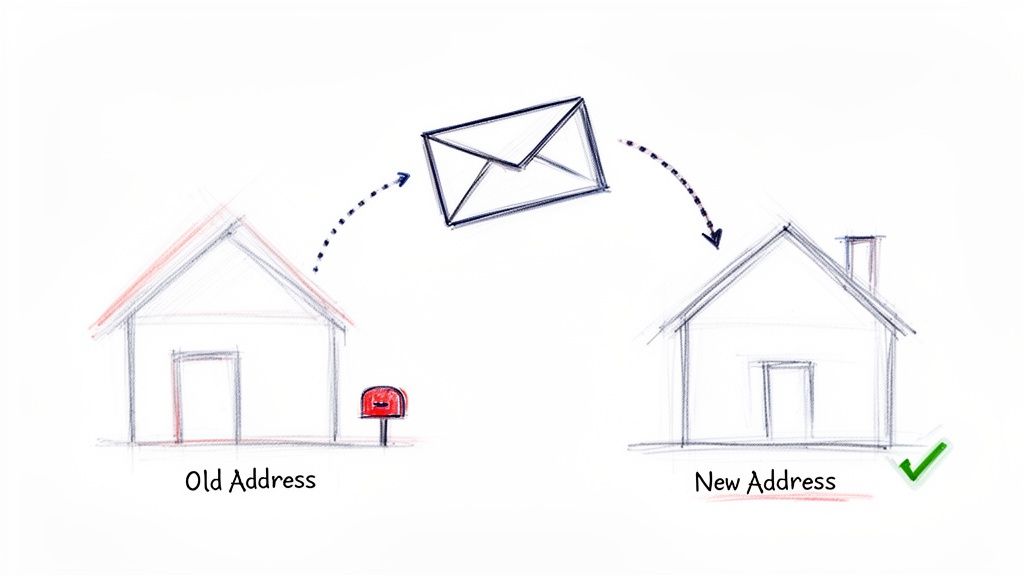
This service is a must for homeowners, renters, and businesses alike. For example, a business relocating its Bristol office to Bath can set up redirection to guarantee that client invoices and supplier communications are not missed during the transition period. The service is flexible, allowing you to redirect your mail for three, six, or twelve months, with options to extend for up to four years if needed.
How to Set Up Your Mail Redirection
The process is straightforward and can be completed in several ways to suit your preference. You have the flexibility to manage this important task well in advance of your moving day.
- Online: The quickest method is via the official Royal Mail website. You will need proof of your old and new addresses.
- In-Person: Visit a Post Office branch with the required identification and address details.
- By Post: You can request a paper application form to fill out and send back.
Actionable Tips for a Smooth Redirection
Key Insight: Think of mail redirection as your insurance policy against lost post. It’s not a substitute for updating your address directly with key organisations, but it protects you from the inevitable oversights.
To get the most out of the service, follow these best practices:
- Book in Advance: Arrange your redirection at least two weeks before your moving date to ensure it’s active from day one.
- Keep Your Confirmation: Save the confirmation email or letter as proof of your arrangement.
- Don't Let It Lapse: If you need the service for longer than initially planned, renew it before it expires to avoid any gaps in coverage.
- Update Directly: Continue to update your address with banks, the DVLA, and HMRC. Read our complete guide on who to notify when you move for a comprehensive checklist.
2. Bank and Financial Institutions
Notifying your bank, building society, credit card companies, and investment providers is one of the most critical addresses to change when moving. Financial institutions rely on your correct address for identity verification, fraud prevention, and sending sensitive documents like new cards, PINs, and annual statements. Failing to update this information promptly can lead to missed communications, temporary account freezes, or even failed security checks when making important transactions.
This step is vital for ensuring uninterrupted access to your finances. For instance, a homeowner moving from Bristol to Bath must inform their mortgage lender to ensure they receive their revised annual statements and any other important correspondence. Similarly, businesses relocating their offices need to update all corporate bank accounts to maintain smooth payment processing and avoid delays with client invoices or supplier payments.
How to Update Your Financial Address
Most modern banks have made this process incredibly efficient, often allowing you to update your details without needing to visit a branch. You will typically need your account details and proof of your new address.
- Online Banking/Mobile App: This is usually the fastest method. Log in to your secure portal and look for the "personal details" or "profile" section to change your address.
- By Phone: You can call your bank’s customer service line, but be prepared to answer several security questions to verify your identity.
- In-Branch: Visit your local branch with proof of identity (like a passport or driving licence) and proof of your new address (such as a utility bill or council tax statement).
Actionable Tips for a Secure Financial Transition
Key Insight: Treat your financial address update with the same urgency as securing your new home’s locks. An out-of-date address is a security risk that can expose your sensitive financial information.
Follow these best practices to ensure a seamless update across all your financial accounts:
- Update Promptly: Aim to notify all your financial providers within the first week of your move.
- Don't Forget Anyone: Create a list of all your accounts: current accounts, savings, credit cards, store cards, pensions, and investments.
- Keep a Record: Note down when and how you notified each institution for your own records.
- Verify the Change: Check your next bank statement to confirm that your new address has been correctly updated. If it hasn't changed within a month, follow up immediately.
3. Council Tax Office (Local Authority)
Notifying your local council about your move is a legal requirement, not just a financial formality. Your Council Tax bill is tied to your residential property, and you must inform the relevant authorities when you stop or start being responsible for a property. Failing to update this crucial address detail can lead to incorrect bills being sent to your old home, disputes over liability, and even financial penalties. This is a mandatory step in any list of addresses to change when moving.
This applies to everyone, whether you are a homeowner, tenant, or landlord. For instance, a tenant moving from a flat in Bristol City Council's area to a new home in Bath must inform both Bristol City Council that they are leaving and Bath & North East Somerset Council that they are moving in. Similarly, businesses relocating offices must notify the business rates department, which is a separate process from residential Council Tax.
How to Update Your Council Tax Details
Councils have made this process relatively simple, with most offering quick online portals. You must inform both your old and new council to ensure a seamless transition and accurate billing.
- Online: The fastest and most common method is through your local council's website. Search for "Council Tax moving home" on their site.
- By Phone: Most councils still offer a phone service for those who prefer to speak to an advisor.
- In-Person: You can visit a council office or one-stop shop, but an appointment may be required.
Actionable Tips for a Smooth Council Tax Transition
Key Insight: Treat your Council Tax notification as a time-sensitive legal obligation. You are legally required to notify the council within 21 days of your move, so don't put it off.
Follow these best practices to avoid any billing issues:
- Notify Both Councils: Remember to tell your old council you are leaving and your new council you are arriving.
- Have Details Ready: You will need your moving dates, new address, old address, and possibly your tenancy agreement or completion statement.
- Take Meter Readings: Have your final utility meter readings from your old property handy, as some councils ask for these.
- Keep Confirmation: Always save the confirmation email or reference number you receive as proof of your notification. For a full breakdown of essential moving-in tasks, check our complete moving in checklist for the UK.
4. Electoral Register (Voter Registration)
Updating your details on the electoral register is a legal requirement for all eligible UK residents when they move. This crucial step ensures you can exercise your right to vote in local and general elections at your new address. Beyond voting, credit reference agencies use the electoral roll to verify your identity and address, meaning being registered can positively impact your credit score and ability to get loans, mortgages, or mobile phone contracts. It's a fundamental part of the list of addresses to change when moving.
This applies to everyone, regardless of your living situation. For instance, an employee relocating from Bristol to Bath for an office move must update their registration independently, as it is a personal responsibility. Similarly, renters leaving a shared house must ensure their personal registration is moved to their new address to avoid any administrative or credit-related complications. Failing to register can also affect your eligibility for jury service selection.
How to Update Your Voter Registration
The process is quick, free, and can be completed online in about five minutes. It's often linked to your Council Tax registration, but it's wise to complete it separately to ensure it's done correctly.
- Online: The fastest way is through the official government portal at www.gov.uk/register-to-vote.
- By Post: You can also contact your local council's electoral registration office to request a paper form if you prefer.
- With Council Tax: Some councils, like Bristol City Council or Bath & North East Somerset Council, may offer to update the register when you sign up for Council Tax, but always double-check this has been completed.
Actionable Tips for a Smooth Registration
Key Insight: Think of your electoral registration as your civic and financial ID. Keeping it current is not just about voting; it’s about maintaining your financial footprint and fulfilling a legal duty.
To ensure your registration is updated without any hitches, follow these tips:
- Act Quickly: Register as soon as you move into your new property. Don't wait for an election to be announced.
- Have Details Ready: You will need your National Insurance number, date of birth, and previous address to complete the form. If you don't have a National Insurance number, you can use other forms of ID like your passport.
- Check for Confirmation: You should receive a letter or email from your local council confirming that you have been added to the electoral register.
- Allow for Processing Time: It can take a few weeks for the changes to appear on the official register, so complete the process well ahead of any deadlines.
5. Utility Companies (Electricity, Gas, Water, Internet)
Failing to notify your utility providers is one of the quickest ways to complicate a move, leading to incorrect bills and a lack of essential services at your new home. Informing your electricity, gas, water, and broadband suppliers is a critical task on your list of addresses to change when moving. This ensures a seamless switch-off at your old property and a warm, well-lit, and connected welcome at your new one, preventing any frustrating gaps in service.
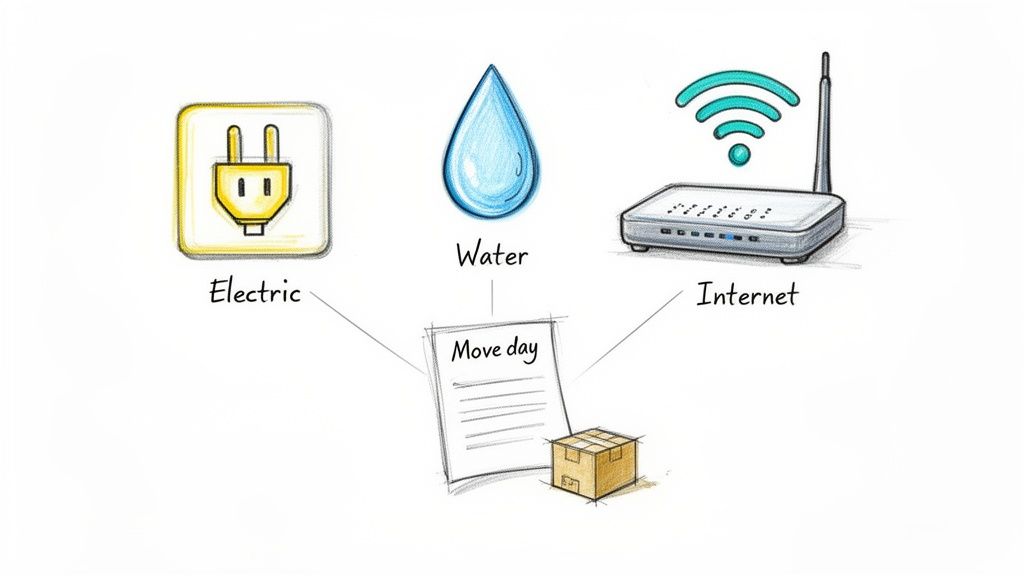
This step is vital for everyone, from renters settling final bills to businesses needing operational continuity. For instance, a business relocating from Bristol to Bath must coordinate electricity, gas, water, and high-speed internet activation to minimise downtime. Similarly, tenants must provide final meter readings to their landlord or letting agent to ensure their deposit is returned in full and without delay. If you run a business from your home, don't forget to update your business broadband bundles and phone services when moving.
How to Manage Your Utility Transfer
Each provider will have a specific process, but most now offer simple online portals to manage your move. This makes it easy to provide your new address and moving dates in advance.
- Online Account: The most efficient method is to log into your account on each provider's website and follow the "moving home" instructions.
- By Phone: Have your account number, new address, and move-out date ready when you call customer service.
- Check Local Suppliers: For water, your supplier is location-dependent. In Bristol, you'll contact Bristol Water, while Bath is served by Wessex Water.
Actionable Tips for a Smooth Utility Switch
Key Insight: Treat your move-out day as the final checkpoint for utilities. Taking dated photos of your meter readings provides indisputable evidence and protects you from being charged for the next occupant's usage.
Follow these best practices to avoid common pitfalls:
- Notify in Advance: Contact all providers at least four weeks before you move. Broadband providers in particular may need significant lead time to install services at your new address.
- Take Meter Readings: On your moving day, take final meter readings for gas and electricity. Photograph them with your phone as time-stamped proof.
- Confirm Final Bills: Request that your final bills are sent to your new address, not your old one where they could be lost.
- Keep Confirmation Details: Save all confirmation emails or reference numbers from your providers as proof of your instructions.
- Plan Your Connections: For a detailed timeline of when to contact each provider, consult our complete moving house checklist.
6. HMRC (HM Revenue & Customs) – Tax Records
Keeping HM Revenue & Customs informed of your new address is a non-negotiable step in your move. All official communication regarding your tax, National Insurance, tax credits, and Child Benefit will be sent to your registered address. Failing to update this information can lead to missed deadlines, penalty notices, or delays in receiving payments you are entitled to, making it a critical task on your list of addresses to change when moving.
This applies to a wide range of individuals and businesses. For instance, a self-employed graphic designer moving from Bristol to a new studio in Bath must update HMRC to ensure their Self Assessment communications are correctly received. Similarly, a family receiving Child Benefit or Tax Credits must inform HMRC immediately to avoid any disruption to their payments. Forgetting this step can create significant financial and administrative complications down the line.
How to Update Your HMRC Records
The process is designed to be user-friendly, and you can typically complete it online without needing to post any forms. This is one change you should make as soon as you have a confirmed moving date.
- Online: The most efficient method is to sign in to your Government Gateway account. You can update your details for Self Assessment, tax credits, and other services through your personal tax account.
- By Post: If you cannot make the change online, you can write to HMRC directly. Ensure you include your full name, old and new address, and your National Insurance number.
Actionable Tips for a Smooth HMRC Update
Key Insight: Updating HMRC is not just about receiving letters; it’s about maintaining your correct legal and financial record with the government. Treat it with the same priority as updating your bank details.
To ensure your tax records are seamlessly transferred, follow these recommendations:
- Act Promptly: Update your address with HMRC as soon as you have your new one, ideally before you move.
- Allow for Processing Time: It can take over a week for changes to be fully processed across all HMRC systems.
- Update Multiple Records: If you are self-employed, remember to update both your personal address for Self Assessment and any registered business addresses.
- Keep Confirmation: Save a screenshot or any confirmation email you receive as proof that you have notified them of your change of address.
7. Insurance Companies (Home, Contents, Car, Business)
Updating your address with insurance providers is not just an administrative task; it is a contractual obligation essential for maintaining valid coverage. Your postcode directly influences risk assessments for home, contents, and car insurance, meaning premiums and terms can change with your location. Failing to notify your insurer can lead to a rejected claim or even the cancellation of your policy, leaving you financially exposed at the worst possible time. It's a critical item on any list of addresses to change when moving.
This applies to all types of policies. For instance, a homeowner moving from a bustling Bristol city-centre flat to a quieter suburb in Bath might see their home insurance premiums decrease due to a lower crime rate in the new area. Similarly, a business relocating its premises must inform its commercial property and liability insurers to ensure continuous coverage for assets and operations. Renters also need to update their contents insurance to protect their belongings at the new property.
How to Update Your Insurance Policies
Most insurers offer simple ways to update your details, ensuring your coverage is transferred seamlessly to your new address. You should aim to do this before your move day.
- Online Portal: The most common method is logging into your insurer’s online customer portal and editing your personal details.
- Phone: You can speak directly with a customer service representative to update your address and discuss any changes to your policy.
- Post: While slower, sending a letter to your provider is also an option, though you should follow up to confirm receipt.
Actionable Tips for a Smooth Insurance Transition
Key Insight: Treat your insurance policies as dynamic contracts tied to your location. An address change is a material fact that directly impacts your insurer’s risk calculation, so prompt notification is non-negotiable.
To ensure your protection remains uninterrupted, follow these best practices:
- Notify Early: Inform all your insurance providers at least one to two weeks before your move. For car insurance, you typically need to update it on the day the vehicle is kept at the new address.
- Update All Policies: Don't forget any policy, from home and car to pet and life insurance. Create a list to ensure none are missed.
- Review Your Premiums: Your move might make you eligible for a lower premium. Don’t be afraid to ask if your new postcode reduces your rate.
- Request New Documents: Always ask for updated policy documents to be sent to your new address as confirmation of the change. This is your proof of continuous cover.
8. GP Practice and NHS Records (Health)
When you move, ensuring continuity of your healthcare is a top priority. Your NHS records, including your medical history and prescription details, are tied to your registered GP practice, which is determined by your postcode. Updating your address with the NHS by registering with a new local GP is essential for accessing appointments, receiving repeat prescriptions, and ensuring your medical records are available when you need them. Neglecting this is a common oversight when dealing with the many addresses to change when moving.
This step is critical for everyone, from individuals to entire families. For instance, a family with young children moving from Bristol to a new home in Bath should prioritise registering with a new practice to ensure school health checks and vaccination records are seamlessly transferred. Similarly, any employee relocating for work must update their GP details independently to maintain uninterrupted access to healthcare services in their new area.
How to Register with a New GP
The process is designed to be straightforward, but it requires proactive steps on your part. It’s best to initiate this process shortly after you have proof of your new address.
- Find a Local Practice: Use the official NHS Find a GP service to search for surgeries in your new postcode. The site provides details on whether they are accepting new patients.
- Complete Registration Forms: Most GP practices will require you to fill out a GMS1 form, which you can often download from their website or collect from the reception.
- Provide Identification: You will typically need to present proof of identity (like a passport or driving licence) and proof of your new address (such as a recent utility bill or tenancy agreement).
Actionable Tips for a Smooth Healthcare Transition
Key Insight: Your GP registration is the gateway to the local NHS network. Registering promptly prevents stressful delays when you need medical attention, from routine check-ups to urgent care needs.
To ensure your healthcare transition is seamless, follow these best practices:
- Register Early: Aim to register with a new GP practice within the first month of your move. Don't wait until you need an appointment.
- Request Records Transfer: When you register, your new practice will request your medical records from your previous GP. This process can take a few weeks, so factor in this delay.
- Stock Up on Prescriptions: Before you move, ensure you have at least a one-month supply of any regular medication to cover the transition period.
- Notify Other Providers: Remember to separately inform your dentist, optician, and any other specialists you see about your change of address.
9. Employer and Payroll (for Employees and Self-Employed)
Among the many addresses to change when moving, your employment details are a high priority. Informing your employer is not just a courtesy; it is essential for receiving your salary, tax documents like P60s, and important company communications without interruption. An incorrect address can lead to payroll delays, tax code errors with HMRC, and misdirected sensitive personal information. It’s a simple update that prevents significant financial and administrative headaches.
For employees, this ensures accurate PAYE and National Insurance contributions are reported to HMRC. A local business in Bath, for instance, requires its employees to update their address via an internal HR portal to guarantee their monthly payslips and pension statements are sent to the correct location. For self-employed individuals, keeping your business address current is vital for invoicing, client correspondence, and maintaining accurate records for your Self Assessment tax return.
How to Update Your Employment Address
The method for updating your details will vary depending on your employment status, but the process is generally straightforward and should be handled proactively.
- For Employees: Contact your HR or payroll department directly. Many companies now use online self-service portals where you can update your personal details instantly.
- For Self-Employed: You must update your address on your Self Assessment records with HMRC. If you operate as a limited company, you also need to update your details with Companies House.
Actionable Tips for a Smooth Update
Key Insight: Your home address is directly linked to your tax code. A delay in updating it with your employer can lead to HMRC assigning an emergency tax code, resulting in incorrect deductions from your pay.
Follow these best practices to ensure a seamless transition for your employment records:
- Notify in Advance: Inform your payroll department or update your records at least two weeks before your move.
- Get Confirmation: Always ask for written or email confirmation that your details have been updated to keep for your records.
- Update Emergency Contacts: Use this opportunity to also review and update your emergency contact information held by your employer.
- Self-Employed Checklist: If you are self-employed, remember to update both your personal address with HMRC and your registered business address with Companies House separately.
10. Educational Institutions (Schools, Universities, Student Finance)
For families with children or individuals in higher education, updating educational institutions is a critical task on your list of addresses to change when moving. Failure to do so can lead to missed communication regarding admissions, exam results, tuition fees, and vital funding information. Ensuring schools, universities, and student finance bodies have your correct address guarantees continuity of education and financial support.
This is essential for anyone connected to the education system. For instance, a University of Bristol student moving from halls of residence to a private flat in Clifton must inform both the university and Student Finance England to ensure their maintenance loan and any academic correspondence are sent to the right place. Similarly, a family moving from Bath to a new home in Keynsham must notify their children's current and future schools to facilitate a smooth transfer of records and secure a new school place.
How to Update Your Educational Address
The process varies depending on the institution, but it is typically managed through dedicated administrative departments or online portals. Swift action is necessary to prevent any disruption.
- Schools: Contact the school’s administrative office directly via phone or email to update your family’s details. You will likely need to provide proof of your new address.
- Universities: Log in to your university's student portal to change your contact information. You should also inform your specific department or faculty administrator.
- Student Finance: The easiest way is to log in to your online account with Student Finance England (or the equivalent body for Scotland, Wales, or Northern Ireland) and update your address there.
Actionable Tips for a Smooth Transition
Key Insight: Treat educational and funding bodies with the same priority as your bank. Delays in communication can have immediate financial and academic consequences, so prompt updates are non-negotiable.
To ensure all educational correspondence reaches you without interruption, follow these tips:
- Act Immediately: Update your details with Student Finance as soon as your new address is confirmed. Delays can affect your loan payments.
- Notify All Parties: Remember to inform both the academic institution (school/university) and the funding provider (Student Finance).
- Confirm the Change: After updating your details online or by phone, check back a few days later to ensure the change has been processed correctly.
- Consider Regional Differences: If your move is between UK nations (e.g., England to Wales), you may need to engage with a new student finance body. Research this well in advance.
10-Point Address Change Comparison
| Item | 🔄 Implementation complexity | ⚡ Resource requirements | ⭐ Expected outcomes | 📊 Ideal use cases | 💡 Key advantages/tips |
|---|---|---|---|---|---|
| Royal Mail – Address Change Service | 🔄 Low — simple online/phone setup | ⚡ Low — small fee, few minutes to complete | ⭐ High — forwards standard mail reliably for chosen period | 📊 Homeowners, renters, businesses needing mail forwarding during move | 💡 Set up ~2 weeks before moving; renew before expiry |
| Bank and Financial Institutions | 🔄 Moderate — multiple separate notifications | ⚡ Low–Moderate — ID, online banking or branch visits | ⭐ High — prevents account holds, missed statements, fraud | 📊 Anyone with bank accounts, mortgages, credit cards | 💡 Update within first week; keep confirmation records |
| Council Tax Office (Local Authority) | 🔄 Moderate — council-specific forms/systems; mandatory | ⚡ Low — online/phone/post; proof may be required | ⭐ High — correct billing and liability, avoids penalties | 📊 All UK residential property occupiers | 💡 Notify within 21 days; use online where available |
| Electoral Register (Voter Registration) | 🔄 Low — quick online registration (often linked to council tax) | ⚡ Low — minutes; NIN/passport helpful for verification | ⭐ High — maintains voting eligibility and jury records | 📊 Eligible UK voters and residents needing voting access | 💡 Register immediately; allow 2–3 weeks to propagate |
| Utility Companies (Electricity, Gas, Water, Internet) | 🔄 Moderate–High — multiple providers, meter handovers, lead times | ⚡ Moderate — meter readings, possible connection fees, coordination time | ⭐ High — continuity of supply and accurate final bills | 📊 Movers (especially businesses) who need uninterrupted utilities | 💡 Notify 2–4 weeks prior; take and photograph final meter readings |
| HMRC (Tax Records) | 🔄 Moderate — separate updates per tax account may be needed | ⚡ Low — online Personal Tax Account; allow processing time | ⭐ High — ensures tax notices and Self Assessment reach you | 📊 Taxpayers, self-employed, benefit recipients | 💡 Update immediately; expect 10–14 days to fully propagate |
| Insurance Companies (Home, Car, Business) | 🔄 Moderate — risk reassessment may require policy amendments | ⚡ Low–Moderate — contact provider, may incur fees or premium changes | ⭐ High — maintains valid coverage and claim eligibility | 📊 Policyholders whose premiums/cover depend on location | 💡 Notify within 7 days; request updated policy documents |
| GP Practice and NHS Records (Health) | 🔄 Moderate — register with new practice; records transfer time | ⚡ Low — online/ID; transfer may take weeks | ⭐ High — continuity of care and prescription access | 📊 Families, long-term patients, those on repeat prescriptions | 💡 Register ASAP after moving; request medical records transfer |
| Employer and Payroll (Employees/Self-Employed) | 🔄 Low — HR/payroll update; self-employed may need Companies House/HMRC updates | ⚡ Low — email/HR portal; provide confirmation | ⭐ High — accurate pay, tax coding, P45/P60 delivery | 📊 Employees and business owners needing correct payroll records | 💡 Notify payroll ~2 weeks before move; confirm in writing |
| Educational Institutions (Schools, Universities, Student Finance) | 🔄 Moderate — multiple bodies (school/university/Student Finance) | ⚡ Low–Moderate — online portals, documentation for funding changes | ⭐ High — preserves funding, academic records, exam communications | 📊 Students, parents, those receiving loans/grants | 💡 Update Student Finance immediately; allow 2–3 weeks for processing |
Making Your New Address Official
Navigating the administrative maze of a house move can feel just as daunting as packing the last box. Throughout this guide, we've systematically broken down the essential addresses to change when moving, transforming a monumental task into a manageable checklist. From redirecting your post with Royal Mail to updating your local council tax in Bristol or Bath, each step is a crucial thread in the fabric of a smooth transition.
The process is far more than just updating a postcode; it's about safeguarding your identity, ensuring financial continuity, and maintaining your civic responsibilities. Neglecting to inform your bank could lead to missed statements and security risks, while forgetting HMRC could result in tax complications. Similarly, failing to update your GP records could cause critical delays in healthcare access. Each organisation on our list, from your utility providers to your car insurance company, plays a pivotal role in your day-to-day life, and keeping them informed is non-negotiable for a seamless move.
Your Final Administrative Checklist
As you approach the finish line, it’s helpful to consolidate your efforts. Think of this conclusion not as an end, but as a final verification stage to ensure no detail has been overlooked. Before you finally put your feet up in your new home, run through this summary of key takeaways:
- Prioritise by Impact: The most critical updates are those with financial or legal implications. Focus first on your bank, HMRC, DVLA, and insurance providers. These changes protect your assets and ensure you remain compliant with UK law.
- Leverage Online Portals: Most organisations, including local councils like Bristol City Council and Bath & North East Somerset Council, now offer user-friendly online portals. This is the fastest way to submit your change of address, often providing instant confirmation and saving you time on hold.
- Create a Master Document: Keep a simple spreadsheet or document with a list of every company you've contacted, the date you notified them, and any confirmation reference numbers. This 'moving bible' will be invaluable if any post goes astray or a service isn't transferred correctly.
- Don't Forget the Digital Footprint: In addition to physical mail, consider your online life. Update your billing and shipping addresses on accounts like Amazon, food delivery apps, and other e-commerce sites to prevent misdirected parcels. This is a modern, yet essential, part of changing your address.
Key Insight: The most successful moves are those where administrative tasks are given the same attention as the physical logistics. A well-managed list of addresses to change when moving is the invisible foundation of settling in quickly and without stress.
By methodically working through this list, you are not just ticking boxes; you are actively building the administrative framework of your new life. You're ensuring your vote counts at your new address, your tax records are accurate, and your access to essential services continues without a hitch. This diligence pays dividends, freeing you from the future headache of chasing lost mail or rectifying administrative errors. You’ve handled the paperwork with precision; now you can fully embrace the excitement of your new beginning, confident that your personal and financial affairs are perfectly in order and officially tied to your new front door.
Now that you’ve mastered the administrative side of your move, let SimplyPro Removal & Storage Ltd handle the physical logistics with the same level of care and expertise. We ensure your belongings arrive safely at your new Bristol or Bath home, allowing you to focus on settling in, not stressing out. Visit SimplyPro Removal & Storage Ltd for a free quote and make your move as seamless as your paperwork.