


Planning a move is exciting, but let's be honest—the first question on everyone's mind is, "How much is this going to cost?" When you're budgeting, a good starting point for a typical 3-bedroom house move in the UK is somewhere between £900 and £1,800.
Of course, that’s a broad range. The final price tag depends heavily on how far you’re going and exactly what level of service you need.
Your Guide to UK Removal Costs

Getting to grips with the costs of hiring a professional removal company is the first step towards a smooth, stress-free move. The numbers might seem high at first, but it's important to remember what they cover.
You’re not just paying for a van and a driver. You’re investing in the labour, logistics, and expertise needed to get everything you own safely from your old front door to your new one. Think of it less like a simple delivery and more like a full-scale logistical operation, managed by professionals.
To make sense of the quotes you’ll receive, it helps to understand the two main types of moves.
- Local Moves (under 50 miles): These are shorter, less complex, and generally easier on the wallet. A local job, like moving between Bristol and Bath, is often priced by the hour. You pay for the time the crew spends loading, driving, and unloading. Simple as that.
- Long-Distance Moves (over 50 miles): When you're crossing counties or heading to the other end of the country, the pricing model changes. These moves are almost always quoted as a fixed price. This figure bundles in everything—fuel for the long haul, the crew's extended time, and any potential overnight expenses.
Estimated UK Moving Costs by Property Size
It's no secret that costs have been on the rise. Recent industry data shows the average cost for a 3-bedroom house move has now climbed to around £1,300. This jump is mainly down to higher operational costs and labour expenses across the board. You can explore more on UK moving cost trends here. This is exactly why getting a few accurate, up-to-date quotes is more important than ever.
To give you a clearer idea of what to expect, the table below breaks down some typical costs based on the size of your home.
| Property Size | Average Cost for a Local Move | Average Cost for a Long-Distance Move |
|---|---|---|
| 1-Bedroom Flat | £400 – £700 | £700 – £1,100 |
| 2-Bedroom House | £650 – £950 | £950 – £1,400 |
| 3-Bedroom House | £900 – £1,300 | £1,300 – £1,800 |
| 4-Bedroom House | £1,200 – £1,700 | £1,700 – £2,500+ |
| 5-Bedroom House | £1,600 – £2,200+ | £2,200 – £3,500+ |
Remember, these are just estimates to help you budget. The final cost will be shaped by the unique details of your move, which we’ll dive into next.
How to Read Your Moving Quote
Getting a moving quote can feel a bit like deciphering a secret code. You see the final number, but what does it actually represent? Let's pull back the curtain and break down the different parts, so you know exactly where your money is going and how we calculate the average cost of moving companies for a job like yours.
Think of it like an itemised receipt from a restaurant. The main course is the labour from the moving crew and the transport itself – these are the core of your quote. Then you have optional extras, like our professional packing service, which are the side dishes. Finally, you might need special handling for a grand piano or a stint in storage, which are the 'à la carte' items on the menu.
Every single part is carefully calculated to give you a clear picture of the resources needed to get you moved safely and smoothly.
The Two Ways We Price a Move
When we send you a quote, it will be based on one of two pricing models. The one we use depends entirely on the type of move you're planning. Getting your head around this is the first step to understanding your estimate.
-
By the Hour (Best for Local Moves): If you're just moving across Bristol or maybe to a nearby town like Bath (typically any move under 50 miles), we'll usually charge an hourly rate. This rate bundles the cost of the professional crew and the removal lorry. The clock starts ticking when our team arrives at your door and stops when the last item is safely inside your new home. It’s a simple, transparent system that rewards a well-prepared move.
-
Fixed Price (The Standard for Long-Distance Moves): Moving to the other end of the country? An hourly rate just wouldn't work. For these long-haul jobs, we provide a fixed price. This is a solid, all-in quote that covers the entire project, including the fuel for the long journey and all the crew's time. It gives you complete certainty over the cost, which is a massive help when you're budgeting for a big life change.
What's Included in the Basic Price?
No matter which pricing model we use, the core of your quote is built on a few essential services. These are the non-negotiables that make a professional move possible.
- The Crew's Time (Labour): This covers the cost of our experienced, professional movers. We'll assign the right-sized team for your home – a one-bedroom flat might just need a two-person team, but a large four-bedroom house will likely need four or more to get the job done efficiently.
- The Lorry and Fuel (Transport): This is the cost for the removal vehicle itself, the fuel to get from A to B, and the mileage. On local moves, this is often wrapped into the hourly rate. For long-distance moves, it’s a more significant, itemised part of your fixed price.
- Essential Insurance: Every quote from a reputable mover will include standard liability insurance. This provides a baseline level of protection for your possessions while they're in our care. We always recommend you ask about the specifics and discuss extra cover if you have particularly valuable items.
Making sure you understand these elements is key to a stress-free experience. It’s a bit like how savvy travellers check the details of the UK ETA visa cost and hidden fees to avoid nasty surprises at the border. A clear, transparent quote means no unexpected charges on moving day.
Remember This: A detailed, itemised quote is the hallmark of a professional removals company. It should spell out the costs for labour, transport, and any optional services like packing, leaving you with no questions.
If a quote is just a single, unexplained number, treat it as a red flag. A good mover wants you to be confident in what you’re paying for. By knowing what to look for, you can compare quotes like a pro and choose a company that offers real transparency and value.
Key Factors That Influence Your Final Moving Cost
Ever wondered why two families, both moving from a 3-bedroom house the exact same distance, can get quotes that are hundreds of pounds apart? The answer is always in the details. The average cost of moving companies isn't a fixed menu price; it's a dynamic figure that shifts based on several key variables specific to your move.
Think of it like booking a flight. The base fare gets you from A to B, but the final bill changes depending on how much luggage you check in, whether you want extra legroom, or if you’re flying at Christmas. Your moving quote works in exactly the same way.
Getting your head around these factors is the key to managing your budget and making sure the quote you receive truly reflects the job at hand.
This infographic gives you a quick visual breakdown of the core components that make up a final moving quote.
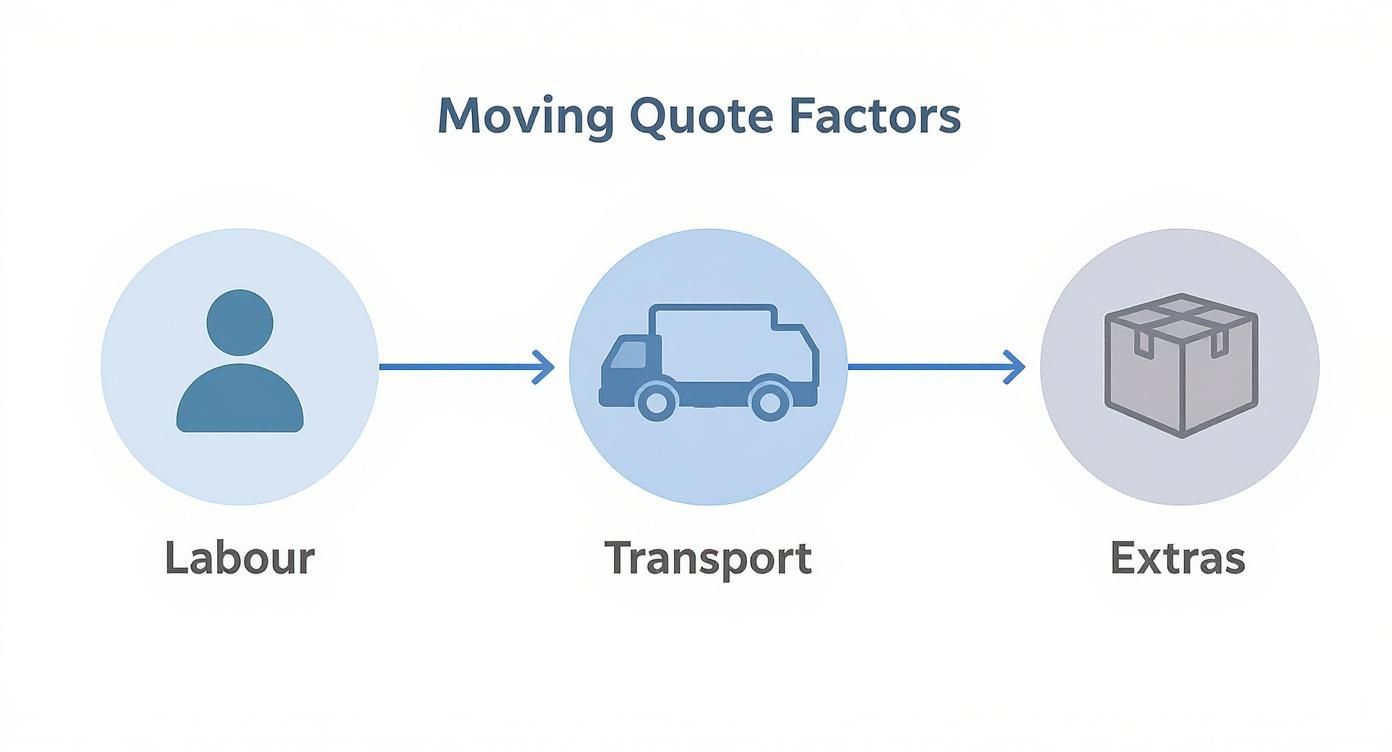
As you can see, the final figure is a blend of the crew's time, the transport logistics, and any extra help you need along the way.
The Volume of Your Belongings
The single biggest driver of your moving cost is, quite simply, how much stuff you have. More belongings mean more time, more labour, and often, a bigger lorry.
Picture the removals lorry as a giant container you're paying to fill. Someone living in a minimalist one-bedroom flat will naturally use far less space—and therefore have a lower cost—than a family moving from a four-bedroom house with a packed garage and a garden shed.
This is precisely why a pre-move survey, whether it's done in person or over a video call, is absolutely non-negotiable for an accurate quote. It’s our chance to properly assess everything you're moving and calculate the cubic footage required, which takes all the guesswork out of the equation.
The Distance of the Move
It might sound obvious, but the journey between your old front door and your new one is a fundamental part of the cost. A local move across Bristol is a completely different logistical puzzle than a long-haul relocation to Manchester.
- Fuel Costs: Longer journeys naturally burn more fuel, a major operational expense for any removals firm.
- Labour Time: A long-distance move means our crew is dedicated solely to your job for a much longer stretch—often the entire day, or sometimes even requiring an overnight stop. That extended time is all factored into a fixed-price quote.
Together, volume and distance form the bedrock of your moving cost. But they are far from the only things that can tweak the final price up or down.
Property Access and Potential Challenges
How straightforward is the path from your front room to our lorry? Any obstacle that slows the crew down can add time and, therefore, cost to the job, particularly if you’re on an hourly rate for a local move.
Think about common access hurdles like these:
- Stairs and Lifts: Hauling heavy furniture and endless boxes up and down multiple flights of stairs is physically demanding and takes more time. Even with a lift, its size and speed can affect how efficiently we can work.
- Long Carries: If the lorry can't park right outside your property, the crew might be faced with a long walk from your door to the van. This "long carry" can add a surprising amount of time to both loading and unloading.
- Parking Restrictions: In bustling areas like central Bristol or Bath, parking permits are often essential. The cost of these permits, or the risk of fines from parking on yellow lines, has to be factored into the quote.
Being completely open about these potential snags during your survey is vital. It lets us plan ahead, bring the right equipment, and give you a quote that won’t come with any nasty surprises on the day.
The Timing of Your Move
When you move can have a bigger impact on the price than most people realise. Just like the travel industry, removals has its own peak seasons where demand skyrockets—and prices follow.
The most expensive times to move are almost always:
- Fridays and Weekends: It's the most popular choice, as everyone wants the weekend to get unpacked.
- The End of the Month: This is when most tenancy agreements and property completions happen, creating a bottleneck.
- Summer Months and School Holidays: These periods are prime time for families looking to relocate with minimal disruption.
If your schedule has some wiggle room, booking a mid-week, mid-month move outside of the summer rush is one of the easiest ways to get a more competitive price. For a deeper look at how these numbers stack up, our guide offers a complete breakdown of the cost to move house.
Optional Services and Add-Ons
A standard quote covers the loading, transport, and unloading of your belongings. But most professional movers offer a suite of extra services designed to make your life a whole lot easier. Naturally, these will increase the final cost.
Some of the most common add-ons include:
- Professional Packing Service: Why spend weeks living out of boxes? Our team can come in and pack your entire home, saving you dozens of hours of stress. We can do a full pack or just focus on fragile items like kitchenware.
- Furniture Dismantling and Reassembly: For bulky items like beds, wardrobes, and dining tables, having the crew professionally take them apart and put them back together at the other end is a massive help.
- Specialist Item Handling: Moving a grand piano, a priceless antique, or a heavy sculpture requires special equipment, techniques, and expertise. These items always carry an extra charge to guarantee they're moved safely.
- Enhanced Insurance Coverage: While standard liability insurance is included, you may want to purchase extra cover for high-value collections or individual items to ensure they are fully protected for their replacement value.
- Temporary Storage: If there's a gap between moving out of your old place and getting the keys to the new one, using your moving company’s storage facility is a seamless, hassle-free solution.
Putting It All Together with Real-World Scenarios
Knowing the theory behind moving costs is useful, but seeing how it all plays out in the real world is where the lightbulb really goes on. The average cost of moving companies isn't just a number pulled from a spreadsheet; it’s a story about a family's needs, a home's quirks, and the logistics of getting from A to B.
To bring this to life, let's walk through three common, yet very different, moving scenarios. Each one shows how specific circumstances shape the final price, which should help you get a much better feel for what your own move might involve.
Scenario 1: The City Centre Flat Move
First up, meet Alex. He’s a young professional moving from a one-bedroom, third-floor flat in central Bristol to a similar place in Bath. It’s a short distance, but the logistics are what make this move interesting.
Alex's situation has all the classic challenges of an urban move:
- Access Issues: His current flat is a walk-up with no lift. That means every single box and piece of furniture has to be carefully carried down three flights of stairs by the crew.
- Parking Restrictions: The street outside is permit-only. This isn't a problem for a good removals company, but it does mean they need to arrange and pay for a parking suspension for the day.
- Minimal Volume: On the plus side, Alex has had a good clear-out, so the total amount of stuff is quite small, making the load itself fairly straightforward.
Because of the short distance and the access issues that could make the job longer, an hourly rate makes the most sense here. The team has to account for the extra time the stairs will add.
Quote Snapshot for Alex:
- Service: 2-person crew & Luton van at an hourly rate.
- Estimated Time: 5-6 hours (including travel).
- Additional Charges: Parking permit suspension fee.
- Estimated Total Cost: £450 – £600.
Scenario 2: The Suburban Family Relocation
Now, let’s look at the Sharma family. They're moving from a 3-bedroom semi-detached house in a Bristol suburb to a bigger 4-bedroom home about 15 miles away. With two young children, their top priority is making the whole process as smooth and stress-free as possible.
Here, the focus shifts from tricky access to volume and convenience:
- Full Packing Service: To save themselves weeks of evenings surrounded by boxes, they've opted for a full professional packing service the day before the move.
- Furniture Assembly: They’ve asked the team to handle dismantling and reassembling the kids' bunk beds, two large wardrobes, and their dining table.
- Standard Access: Thankfully, both properties have good access with driveways, so no parking or long-carry issues to worry about.
For the Sharmas, a fixed-price quote is the way to go. It gives them total peace of mind, bundling the packing, moving, and furniture work into one clear, upfront cost.
Sample Cost Breakdown for a Suburban Family Move
This is a very typical family move, and an itemised quote helps show exactly where the money goes.
| Service or Charge | Description of Service | Estimated Cost |
|---|---|---|
| Labour & Transport | 4-person crew and 7.5-tonne lorry for move day. | £950 |
| Full Packing Service | 2-person crew for one full day of packing. | £450 |
| Packing Materials | All boxes, tape, bubble wrap, and wardrobe cartons. | £150 |
| Dismantling/Reassembly | Specialist work on wardrobes, beds, and a table. | £120 |
| Total Estimated Cost | (Excluding VAT) | £1,670 |
This breakdown clearly shows why their quote is higher than a more basic move; the added convenience of the full packing service and furniture assembly is a significant, and for them, worthwhile part of the cost.
Scenario 3: The Long-Distance Downsize
Finally, we have David and Sarah, a retired couple downsizing from their 4-bedroom house in Bath to a 2-bedroom bungalow up in York—a journey of over 250 miles.
Their priorities are completely different again. It’s all about the safe, secure transport of treasured possessions over a very long distance.
- Significant Distance: This is a proper long-haul move. The fuel costs are higher, and it's a full day's work for the crew just on the road.
- Specialist Item: They own a beautiful antique grandfather clock that requires specialist handling and crating to ensure it arrives in one piece.
- Flexible Packing: They’re happy to pack most of their belongings themselves but have wisely paid for a fragile-only packing service for all their delicate china and glassware.
For a long-distance job like this, a fixed price is non-negotiable. Their quote wraps in the higher fuel costs, the crew's full day of labour, and the specialist care for their clock. The final figure is a direct reflection of the complexities involved in a cross-country move.
Quote Snapshot for David and Sarah:
- Service: Fixed price for a long-distance move.
- Inclusions: Fragile packing, specialist crating for the clock.
- Estimated Total Cost: £2,200 – £2,800.
As you can see, there’s no single answer to the question, "what's the average cost of moving companies?" Your quote is as unique as your move. It's a tailored price based on your home, your belongings, and where you're headed.
For a more personalised estimate, you can use our simple UK moving cost calculator for 2025 to get a much clearer picture of your own costs.
How to Get Accurate and Trustworthy Moving Quotes
Getting a moving quote you can actually rely on is the single most important part of planning your budget. A vague guess over the phone is a recipe for disaster and almost always leads to nasty surprises and extra charges on moving day. What you need is a firm, detailed quote that truly reflects everything involved in your move.
Think of it like getting a car repaired. You wouldn't trust a mechanic who gives you a price without lifting the bonnet, would you? The same logic applies to moving. A professional removal company needs to see exactly what they're dealing with before they can give you a solid price.
Before you even get that far, it's wise to understand the paperwork you'll receive. Grasping the difference between a freight quote and an estimate is key, as one is a fixed price and the other can change. Always push for a firm quote.
The Power of a Proper Survey
There's only one way to get an accurate quote: a thorough pre-move survey. This is non-negotiable and a huge indicator that you're dealing with a professional outfit.
There are two main ways to get this done:
- In-Person Survey: A surveyor from the company pops round to your home to see everything for themselves. They'll walk through every room, make a note of any large or tricky items, check out the access for their vehicle, and have a proper chat about what you need.
- Video Survey: This is the modern, super-convenient alternative. You simply use your smartphone or tablet to give the surveyor a virtual tour of your home via a video call. It's just as detailed as an in-person visit but fits much more easily into a busy schedule.
A simple online form that just asks for the number of bedrooms is never enough. It can't account for that narrow staircase, the hefty antique wardrobe you inherited, or the nightmare parking situation on your street. Without a proper survey, any price you're given is pure guesswork.
Red Flags to Watch Out For
Finding a good quote isn't just about collecting numbers; it's also about knowing how to spot trouble. That rock-bottom price that seems too good to be true? It usually is. Here’s how to protect yourself from rogue operators.
Keep an eye out for these warning signs:
- No Survey Offered: If a company gives you a "firm" price without seeing your belongings, run a mile. This is the biggest red flag and almost guarantees arguments over extra fees later.
- Large Cash Deposit Demanded: Professional movers don't ask for big stacks of cash upfront. A small booking fee is standard, but a large cash deposit is highly unusual and very risky for you.
- Vague or Unprofessional Communication: How does the company present itself? Are their emails full of typos? Do they answer the phone with a simple "hello"? Sloppy communication is often a sign of sloppy service to come.
At the end of the day, a trustworthy quote comes from transparency. A professional company will always invest the time to understand your move inside and out before giving you a price. It's all about making sure there are no surprises for anyone on the day.
Choosing the right mover is about more than just finding the cheapest option—it’s about getting confidence and peace of mind. For more tips, have a read of our article on what to look for in a removal company to help you vet your options.
Smart Strategies to Reduce Your Moving Costs

While understanding the average cost of moving companies gives you a great starting point for your budget, that figure isn't set in stone. Far from it. With some smart planning, you can actively nudge that final number down, and a few good decisions in the weeks before your move can add up to some serious savings.
The trick is to think like we do. A removal company’s quote boils down to two things: the volume of your belongings and the time it takes to move them. Anything you can do to reduce either of those will directly lower your bill. It’s all about being proactive before our lorry pulls up to your door.
Lighten the Load by Decluttering
Honestly, the single best way to cut costs is to move less stuff. It sounds obvious, but fewer belongings mean less time loading and unloading, and you might even get away with a smaller vehicle.
Try to start decluttering at least 4-6 weeks before you plan to move. Go room by room and be ruthless. If you don't need it, use it, or love it, it's time for it to go. This has a fantastic double-whammy effect: you lower your removal bill and can often make a bit of cash selling items online or at a car boot sale.
The aim of the game is to shrink the total volume of your possessions. Every single box you don’t have to move is one less thing the crew has to lift, carry, and load. That directly translates into time and money saved, especially on a local move that's billed by the hour.
Be Flexible with Your Moving Date
Timing is a huge factor in the removals world. Demand goes through the roof on Fridays, weekends, and at the end of the month, and prices naturally follow suit. If your schedule has any wiggle room, you can really make it work for you.
- Book a Mid-Week Move: Moving on a Tuesday, Wednesday, or Thursday is almost always cheaper.
- Avoid Peak Season: If you can, steer clear of the summer months and school holidays when everyone else is trying to move.
Just by booking your move for an off-peak day, you could see a 15-20% saving compared to a prime Friday slot. It's one of the simplest ways to get a better price without sacrificing the quality of service.
Tackle Some of the Prep Work Yourself
A full-service move where we handle everything is wonderfully convenient, but if you're looking to manage your budget, taking on some of the prep work yourself is a brilliant option. Just think about which jobs you're comfortable doing.
For example, dismantling flat-pack furniture like beds, wardrobes, and desks before the team arrives can save a surprising amount of time on the day. You could also look into sourcing your own packing materials, though it's always worth weighing up the potential savings against the quality and convenience of the professional-grade boxes we can provide.
Your Moving Cost Questions, Answered
Let's tackle some of the common questions we hear from people planning their move. Getting these details right can make a real difference to your budget and your peace of mind on the big day.
Think of this as the final piece of the puzzle, giving you the confidence to navigate the quoting process like a pro.
Is It Really Cheaper to Move on a Weekday?
Yes, it almost always is. Think of it like booking a holiday – Friday and weekend slots are in high demand, so they naturally come at a premium. Most people try to schedule their move around the work week, which sends prices soaring for those popular end-of-week dates.
If you can be flexible, booking your move for a Tuesday, Wednesday, or Thursday can often result in some decent savings. It’s one of the easiest ways to trim down the final bill.
How Far in Advance Should I Book a Removal Company?
We always advise booking at least 4-6 weeks ahead of your moving date, especially if you’re planning a move during the peak summer months or at the end of the month when tenancy agreements typically turn over.
Booking early isn't just about getting a better price; it's about securing a slot with a quality company you trust. Leaving it to the last minute can mean you're left with fewer options, higher prices, and a whole lot of unnecessary stress.
The bottom line: A well-planned move is almost always a more affordable move. Locking in your date several weeks in advance is one of the smartest things you can do for your budget and your sanity.
Does the Moving Quote Include VAT?
This is a crucial detail to check. Any professional and transparent removal company should make it crystal clear on their quote whether VAT is included in the final price. There should be no ambiguity.
If the quote doesn't explicitly state "VAT included" or show a separate line item for it, don't just assume. Ask them to clarify in writing before you sign anything. A trustworthy mover wants you to be fully informed, not surprised by hidden costs later on.
Ready to find out exactly what your Bristol or Bath move will cost? The team at SimplyPro Removal & Storage Ltd is ready to provide a clear, no-obligation quote to get you started.