


Key Takeaways
- Two councils, two sets of rules: a Bristol to Bath move means dealing with Bristol City Council at one end and Bath & North East Somerset Council (B&NES) at the other. Parking suspensions, permits and council tax are handled separately by each.
- Book Bath parking early: B&NES charges extra for short-notice parking bay suspensions and wants payment four working days before the suspension starts, so apply as soon as you have a date.
- Time the drive around Bath’s busy hours: rush hour on the A4, school runs and events such as the Bath Christmas Market (26 November to 13 December 2026) can add a lot of time to a short journey.
- Know the access rules: several streets in central Bath are closed to most vehicles from 10am, and Bath’s Clean Air Zone charges older vans and lorries.
- Survey the Bath end properly: Georgian townhouses, basement flats and steep hillside streets affect how many people, which vehicles and how much time your move needs, which is what really shapes the cost.
On a map, Bristol to Bath looks like the easiest move in the West Country. The two cities are only around a dozen miles apart, and plenty of people commute between them every day. But anyone who has moved house between the two will tell you the distance is the simple bit. The tricky parts are the parking, the access, the timing and the buildings at the Bath end.
Whether you’re swapping a flat in Clifton for a townhouse near the Circus or a family home in Fishponds for a semi in Larkhall, this guide covers when to move, which way to go, how parking suspensions work in each council area, what the Clean Air Zone and Bath’s restricted streets mean for removal vehicles, and what actually shapes the cost of the move. We’ve been moving homes around Bristol and Bath for more than 22 years, and most of what follows comes from what we see on the ground every week.
Why a Bristol to Bath Move Needs Its Own Plan
It’s tempting to treat a Bristol to Bath move like a local move with a slightly longer drive in the middle. In practice it’s closer to two local moves stitched together, each with its own council, its own parking rules and its own type of housing. Planning it that way from the start saves a lot of last-minute phone calls.
Short distance, two different councils
Bristol is a unitary authority run by Bristol City Council. Bath sits within Bath & North East Somerset, which has its own council. That matters because nearly everything that touches the street outside your home is handled locally. If you need a parking bay suspended outside your Bristol property, you apply to Bristol City Council. If you need one outside your new home in Bath, you apply to B&NES. The two councils have different fees, different notice periods and different application processes, and one won’t arrange anything on behalf of the other.
Different housing stock at each end
Bristol has a huge mix of housing, from Victorian terraces in Bishopston and Totterdown to modern flats on the Harbourside. Bath has its own character. Much of the central city is Georgian, built from Bath stone, with tall townhouses, long staircases, basement flats and narrow pavements. Around the edges you’ll find steep streets climbing up towards Lansdown, Widcombe and Combe Down, and larger new-build estates on the outskirts.
Choosing the Right Day and Time for the Move
Timing has a bigger effect on a Bristol to Bath move than on most local moves, because the route crosses some of the busiest roads in the area and ends in a city that gets very crowded at certain times of year. A bit of thought about the date and start time can make the day noticeably smoother.
Weekdays, weekends and completion days
If you’re buying, your moving date is usually fixed by completion, and completion tends to fall on a weekday, often a Friday. Keys are normally released once the money has moved between solicitors, which can be anywhere from late morning to mid-afternoon. If you’re renting, you usually have more choice of date, and weekend moves are available subject to availability, so book a Saturday as early as you can.
Rush hour and the school run
The roads between Bristol and Bath get busy in both directions during the morning and evening peaks, and the routes into central Bath can be slow when schools are starting and finishing. A move that loads in Bristol early, leaves after the morning rush has eased and arrives in Bath late morning often runs better than one that tries to cross between the two cities at 8.30am or 5pm.
Bath’s busy seasons and events
Bath is a major visitor destination, and some periods are much busier than others. The biggest at this time of year is the Bath Christmas Market, which B&NES has confirmed runs from Thursday 26 November to Sunday 13 December 2026 around the Abbey and the city centre streets. During the market the council puts safety barriers and extra traffic controls around Bath Abbey, and the city centre is far busier than usual, especially at weekends.
The same applies to other big events in the city, so check what’s on in Bath for your chosen date before you lock it in.
Good to know: If you’re moving into central Bath in late November or early December, plan your route and start time around the Christmas Market rather than hoping for the best. A quiet Tuesday morning and a busy Saturday afternoon are two completely different moves.
Routes Between Bristol and Bath
There’s no single best route from Bristol to Bath. The right one depends on where in Bristol you’re starting, where in Bath you’re going and what size vehicle is doing the move. Experienced crews will pick the route on the day based on traffic, but it helps to understand the options.
The A4 through Keynsham and Saltford
The A4 is the most direct link between the two city centres. From east and south Bristol, it runs out through Brislington, past Keynsham and Saltford, and into Bath along the western side of the city. It’s a natural choice for moves from places like Bedminster, Knowle, Brislington and the city centre, and for destinations in western and central Bath. The downside is that it carries a lot of commuter traffic, so timing matters.
The A431 through Hanham, Bitton and Kelston
The A431 runs from east Bristol through Hanham, Willsbridge and Bitton, then past Kelston into the north-west side of Bath. It can work well for moves starting in Kingswood, Hanham or St George, and for homes in Weston or the Lansdown side of Bath. It’s a more rural road in places, with bends and narrower sections, so it suits some vehicles and journeys better than others.
The M4 and A46 for north and east Bath
For moves from north Bristol, such as Bradley Stoke, Filton, Stoke Gifford or Emersons Green, it’s often quicker to use the ring road and the M4, then come off at the A46 and drop down into Bath from the north. This approach makes sense for homes in Larkhall, Fairfield Park, Swainswick, Batheaston and the London Road side of the city. The A46 descent into Bath is steep, so it’s another reason to use a well-maintained vehicle and an experienced driver.
Parking at Both Ends: Bristol and Bath Rules Compared
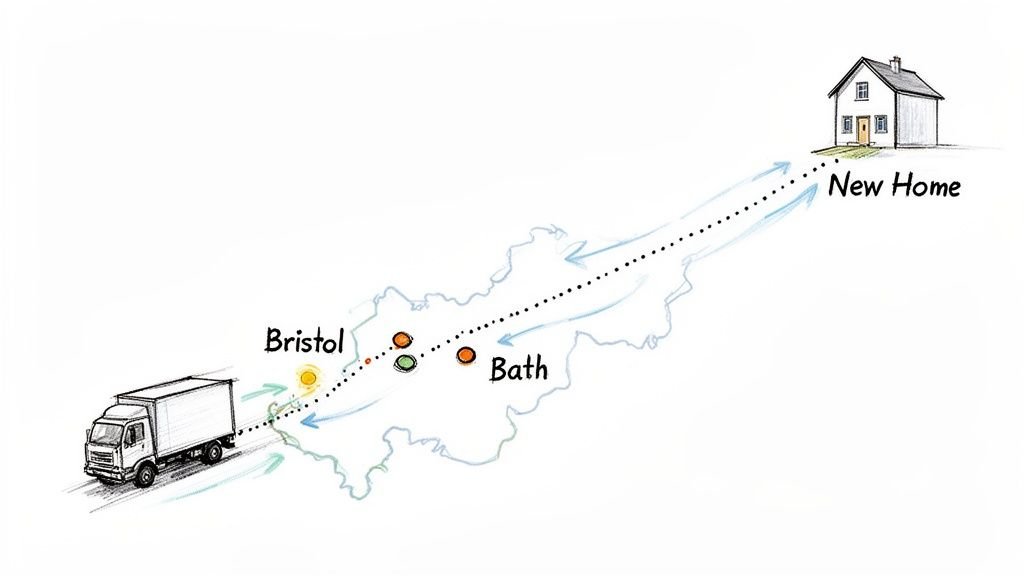
Parking is the single biggest thing that can slow down a Bristol to Bath move. If the van has to park around the corner, every box and every piece of furniture has to be carried further, and the day gets longer. The answer at both ends is usually a parking bay suspension, but the rules are different in each council area.
Suspending a parking bay in Bristol
Bristol City Council lets you apply to suspend a residents’ bay, shared-use bay, pay and display bay or limited waiting bay for a domestic removal. According to the council’s parking suspension page, it currently costs £38 per day to suspend a designated bay for one vehicle up to 5 metres long, and you need to allow three working days for your application to be processed. The council says it won’t contact you to confirm approval, only if it needs more information, so keep a copy of your application.
Remember that a removal lorry is longer than 5 metres, so you may need more than one bay. We’ve written a full guide to removal van parking in Bristol that explains how suspensions work on the Bristol side in more detail.
Suspending a parking bay in Bath
In Bath, parking bay suspensions are handled by B&NES Parking Services. The council’s parking bay suspensions page says you can apply if you’re moving home, and that long-wheelbase vehicles and lorries need two or more spaces. At the time of writing, the first space carries a standing charge of £60.10, with an extra daily charge for each additional space that’s higher in the Central Zone and Zone 1 than in other areas.
There are also short-notice charges. A new request made within two to five working days of the start date carries an extra £150.26, and one made within six to nine working days carries an extra £90.15. There’s a lower short-notice charge of £60.10 for residential house moves only, covering up to two bays for one day, when the request is made within two to nine working days. The council also says payment must be received four working days before the suspension starts, and it reviews each application before asking for payment.
What a suspension does and doesn’t guarantee
One point catches people out in Bath. B&NES states clearly that a suspension doesn’t guarantee the space will be empty, and that it has no power to remove vehicles parked in a suspended bay. In practice, most drivers respect the signs, but it’s worth having a plan B, such as a nearby loading area or a slightly longer carry, just in case. If there’s a problem on the day, the council’s parking page lists the numbers to call.
| What you need to know | Bristol (Bristol City Council) | Bath (B&NES Council) |
|---|---|---|
| Can you suspend a bay for a house move? | Yes, domestic removals are listed as a valid reason | Yes, moving home is listed as a valid reason |
| Basic cost | £38 per day for one vehicle up to 5 metres | £60.10 standing charge for the first space, plus a daily charge for each extra space |
| Spaces for larger vehicles | Vehicles longer than 5 metres may need more than one bay | Long-wheelbase vans and lorries need two or more spaces |
| Notice needed | Allow 3 working days for processing | Short-notice charges apply to requests made within 2 to 9 working days |
| Approval and payment | Council only contacts you if it needs more information | Council reviews the application, then asks for payment, which must arrive 4 working days before |
Fees and rules can change, so always check both council pages when you book. The figures above were taken from the councils’ own websites on the day this guide was written.
Residents’ parking zones and permits in Bath
Large parts of Bath are covered by residents’ parking zones. If your new home is in one, you may need a residents’ permit to park your own car on the street. The B&NES residents’ parking permit page explains that you must have your vehicle registered with the DVLA at the address within the zone and live there at least four nights a week. In the central zone, only one permit is available per property, and new developments or conversions that created extra parking need after a zone was introduced may not be eligible at all.
The council recommends checking eligibility before you buy or rent in a controlled zone, especially a new build, a shared property or a conversion. To apply, you’ll usually need your vehicle registration, your address and a council tax reference number.
Clean Air Zones and Bath’s Restricted Streets
Both Bristol and Bath have Clean Air Zones, and Bath also has permanent vehicle restrictions in parts of the city centre. Neither should stop your move, but they do affect which vehicles can go where, and when.
Bath’s Clean Air Zone: who pays
Bath’s Clean Air Zone covers the city centre and operates every day of the year. Private cars and motorbikes are not charged in Bath, whatever their emissions. However, the council’s Clean Air Zone charges page confirms that older commercial vehicles are. Non-compliant vans and light goods vehicles under 3.5 tonnes are charged £9 a day, and non-compliant lorries over 3.5 tonnes are charged £100 a day. In general, that means older diesel vehicles below Euro 6 (Euro VI for lorries) and older petrol vehicles below Euro 4.
For you as a customer, the practical point is simple. If you’re hiring a van to do some of the move yourself, check it on the GOV.UK vehicle checker before you drive into Bath. If you’re using a removal company, it’s perfectly reasonable to ask whether their vehicles are compliant and whether any charge would be passed on to you. A good remover will give you a straight answer.
How Bristol’s zone differs
Bristol’s Clean Air Zone is a different type. It covers central Bristol and charges non-compliant private cars as well as vans and lorries. Bristol City Council lists a daily charge of £9 for non-compliant cars and light goods vehicles, and £100 for heavy goods vehicles. If you’re leaving a city centre flat in Bristol and driving your own older car to Bath, it’s worth checking it on the government’s checker for both cities.
Bath’s City Centre Security restrictions
Since 1 January 2022, some streets in central Bath have been permanently restricted to most vehicles as part of the Bath City Centre Security scheme. According to the B&NES access restrictions page, motor vehicle access is restricted seven days a week from 10am to 6pm in streets including Stall Street, Westgate Street, Cheap Street, Upper and Lower Borough Walls, Bath Street, Abbey Green and Saw Close, and from 10am to 10pm in York Street.
Removal vans aren’t on the list of exempt vehicles, so if you’re moving into or out of a property in this area, the move needs to be planned around the restricted hours or arranged with the council in advance. The council’s page explains how to check whether you need special permission and how to apply. Most homes in Bath are well outside this small area, but if your new flat is above a shop in the heart of the city, it’s something to raise early.
Tip: If your new address is anywhere near Bath Abbey, the Roman Baths or Southgate, mention it when you ask for a quote. Access restrictions in this part of the city can decide whether the move starts at 7am or needs special permission.
Moving Into Bath Properties: Townhouses, Basements and Hills
Bath’s buildings are one of the reasons people want to live there, and they’re also the main reason Bath moves need careful planning. Here’s what to think about before moving day.
Georgian townhouses and long staircases
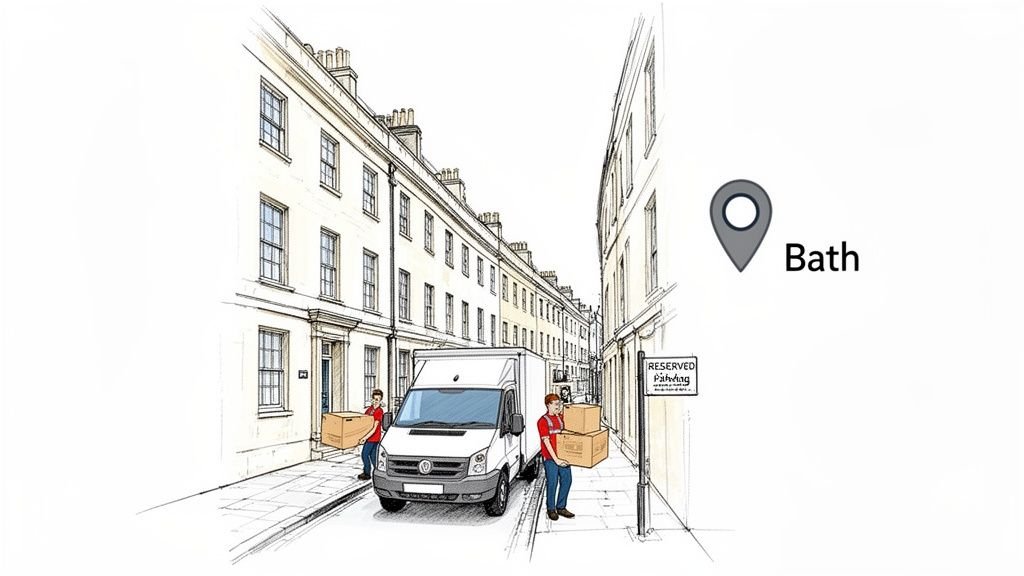
Many central Bath homes are tall Georgian houses split over four or five floors, or divided into flats with a shared stone staircase. The stairs are often beautiful, but they can be narrow at the turns, and the banisters and walls are usually original features you don’t want scuffed. Carrying a wardrobe to the top floor takes far longer than carrying it into a ground-floor flat in Bristol, and that has to be planned into the day.
We protect banisters, door frames and floors, and we bring blankets, straps and sack trucks so heavy items can be moved safely. Large pieces such as beds, wardrobes and dining tables often need to be taken apart in Bristol and put back together in Bath, which our crews do as part of the move. If you’d like help with more complex flat-pack or fitted furniture, our furniture fitting service can help.
Basement flats and narrow entrances
Basement and garden flats are common in Bath. They’re usually reached by steep external steps down from the pavement, sometimes with a narrow gate or a low doorway at the bottom. Sofas and large fridge freezers are the items most likely to cause problems. Measure the narrowest point of the route, including any turns on the steps and the internal doorways, and compare it with your largest items before moving day. If something won’t fit, it’s much better to know in advance than to discover it on the pavement.
Steep streets and hillside homes
Bath sits in a valley, and many of its residential areas are built on the slopes. Streets around Lansdown, Camden, Widcombe, Bear Flat and Combe Down can be steep, with parking on one side and limited room to turn. A heavy lorry may not be the best choice for a narrow hillside street, and the crew may need to park further away or use a smaller vehicle. These are exactly the details a video survey picks up, so film the street outside as well as the inside of the house.
Measuring and planning room by room
Before moving day, it helps to have a simple plan of where each large item will go in the Bath property. Label boxes with the room name, and if the house has several floors, add the floor number too. A box marked “Bedroom 2, top floor” saves the crew asking questions and saves you carrying it up two flights later. Quality boxes and tape make a difference here as well; our removal packaging range includes strong boxes, tape and wrapping materials for exactly this kind of move.
What Shapes the Cost of a Bristol to Bath Move
We don’t publish set prices, because no two Bristol to Bath moves are the same. A studio flat with lift access at both ends and a five-bedroom townhouse with a basement are completely different jobs. What we can do is explain what affects the price, so you know what to mention when you ask for a quote.
The volume of belongings
The amount you’re moving decides the size of vehicle, the number of trips and the number of people needed. The best way to keep this down is to have a proper clear-out before you pack. Anything you won’t use in Bath, from old garden furniture to the spare-room bed nobody sleeps in, costs time and space to move. If you have a lot to get rid of, our house clearance service can help clear unwanted items before the move.
Access at both ends
Access is often the biggest variable on a Bristol to Bath move. Stairs, long carries from the van, basement flats, steep streets and restricted parking all add time. A ground-floor flat with a driveway is quick to load or unload; a fourth-floor flat in a Georgian building with parking around the corner is not. Being honest about access at the quote stage helps avoid surprises on the day.
Extras: packing, dismantling and storage
Some people like to pack everything themselves; others prefer us to pack fragile items or the whole house. Dismantling and reassembling furniture, protecting delicate pieces and arranging storage all affect the overall cost. On top of the removal itself, there are also council fees you may need to pay directly, such as parking bay suspensions in Bristol and Bath.
| Cost factor | Why it matters on a Bristol to Bath move | What you can do |
|---|---|---|
| Volume of belongings | Decides the vehicle size, number of trips and crew size | Declutter before packing and be clear about what’s going |
| Access at the Bath end | Stairs, basements and steep streets add time | Film the stairs, entrance and street in your video survey |
| Parking at both ends | Long carries slow the whole day | Apply for suspensions early with both councils |
| Day and time | Fridays, Saturdays and busy event periods book up first | Ask about midweek dates if you’re flexible |
| Packing and furniture work | Packing, dismantling and reassembly take extra time | Decide early what you’ll pack yourself |
| Storage | Needed if your completion dates don’t line up | Mention any gap between moving out and moving in |
Storage if your chain dates don’t line up
If you have to leave your Bristol home before you can move into Bath, storage bridges the gap. It’s also useful if you’re downsizing from a large Bristol house into a smaller Bath flat and haven’t decided what to keep, or if you’re renovating the Bath property before moving in. Our storage in Bristol is monitored by 24/7 CCTV, and because we handle the removal and the storage, your belongings can go straight from your old home into storage and then on to Bath when you’re ready.
Good to know: Take meter readings and photos at both properties on moving day. It takes two minutes and makes the final bills and any deposit discussions much easier.
Settling In: The Admin After a Bristol to Bath Move
Once the boxes are in, there’s still a bit of paperwork to sort. Because you’re changing council areas, a few things need to be updated with two different organisations.
Council tax at both ends
Tell Bristol City Council that you’re moving out, so you stop paying for your old home from the right date, and tell B&NES that you’re moving in. Both councils have online forms for this. Bristol’s council tax pages let you report a move into, within or out of the city, and B&NES has a “tell us about a move” form for anyone moving into, out of or within the area. It’s also worth checking the council tax band of your new Bath home before you move, so the first bill isn’t a surprise.
Parking permits and your vehicle
If you had a residents’ parking permit in Bristol, it won’t work in Bath. Cancel or let the Bristol permit lapse, then apply for a B&NES permit if your new street is in a residents’ parking zone. You’ll need your vehicle registered at your new address, so update your driving licence and vehicle log book (V5C) with the DVLA as soon as you can.
Everything else on the list
Beyond the councils, the usual change-of-address list applies: register to vote at your new address, update HMRC, set up a Royal Mail redirection, and register with a new GP practice in Bath. Banks, insurers, employers, utility suppliers and broadband providers all need to know too. We’ve put together a longer guide to moving to the Bath area that covers neighbourhoods and settling in.
Frequently Asked Questions
Do I need a parking suspension for a move into Bath?
If there’s no driveway or off-street space for the van, a parking bay suspension from B&NES is usually the best way to make sure the van can park close to the door. Apply as early as possible, as short-notice charges apply to requests made within two to nine working days, and payment is needed four working days before.
Will a removal van have to pay Bath’s Clean Air Zone charge?
Only if it’s non-compliant. Bath’s zone charges older vans £9 a day and older lorries £100 a day, while private cars aren’t charged. Ask your removal company whether their vehicles are compliant. If you’re hiring a van yourself, check it on the GOV.UK vehicle checker first.
Can a removal van get into the streets around Bath Abbey?
Some streets in central Bath, including Stall Street, Westgate Street and Cheap Street, are restricted to most vehicles from 10am to 6pm every day, and York Street from 10am to 10pm. Moves in this area need to be planned around those hours or arranged with the council in advance.
Is it a good idea to move to Bath during the Christmas Market?
It can be done, but it needs more planning if your new home is in or near the city centre. The 2026 market runs from 26 November to 13 December. A weekday, an early start and a confirmed parking suspension all help. If your dates are flexible, moving before or after the market is usually easier.
How much does a Bristol to Bath removal cost?
It depends on how much you’re moving, access at both ends, the date and any extras such as packing, dismantling or storage. We don’t publish fixed prices because every move is different. The quickest way to get an accurate figure is a video survey of both properties.
Can you store my belongings if my Bath property isn’t ready?
Yes. We can collect from your Bristol home, keep your belongings in our CCTV-monitored storage and deliver them to Bath when you’re ready to move in. Let us know about any gap in your dates when you ask for a quote.
How do I get a quote for a move from Bristol to Bath?
Film each room, cupboards, the loft and the route to the street, then send it to us on WhatsApp through our video quote page. Tell us both addresses, your preferred dates and anything we should know about access at the Bath end.
Get a Clear Quote for Your Bristol to Bath Move
A smooth Bristol to Bath move comes down to a handful of things: picking the right day and start time, sorting parking with both councils early, knowing which streets and charges affect your route, and planning properly for the stairs, basements and hills at the Bath end. Get those right and the short drive between the two cities really can be the easy part. For more about how we work in the city, take a look at our removals in Bath page.
Simply Removals Bristol has more than 22 years’ experience moving homes between Bristol, Bath and the surrounding area. We’re fully insured, we use long-wheelbase vans, Luton vans and 7.5 tonne lorries, and our crews bring blankets, straps and sack trucks and take care of dismantling and reassembly. Send us a video quote request with your dates and both addresses, and we’ll help you plan a move that works around Bath’s streets, rules and timings.