

So, you're thinking about removing a chimney. It’s a common project for homeowners looking to either reclaim some precious living space or tackle nagging structural problems. But what’s it actually going to cost?
On average, you can expect the cost of chimney removal in the UK to be somewhere between £1,200 and £4,000. That's a broad range, of course, because every chimney and every home is different. This initial figure, however, gives you a solid ballpark for what to budget.
Your Quick Guide to Chimney Removal Costs
Taking out a chimney isn't a simple weekend job. It's a proper structural change to your home that needs careful planning and a professional touch. People decide to do it for a few key reasons, and each one plays a part in the final price tag.
Common Reasons for Chimney Removal
Why bother removing a chimney in the first place? Usually, it comes down to practical benefits that can make a real difference to your home.
- Reclaiming Living Space: Let's face it, a chunky chimney breast can gobble up a surprising amount of floor space. Getting rid of it can completely open up a room, giving you more freedom with furniture or even creating enough space for a small desk.
- Addressing Structural Concerns: Older chimneys have seen a lot of weather. Over time, this can lead to leaning stacks, crumbling brickwork, or damp seeping into your walls. In these situations, removal is less of a choice and more of a necessity to keep your home safe and sound.
- Improving Energy Efficiency: An old, unused chimney is essentially a big hole in your roof. It's a major source of heat loss and can create chilly draughts, which you'll definitely notice on your energy bills. Removing it and properly insulating the gap makes for a much warmer, more efficient home.
Understanding the Financial Snapshot
To get a feel for the numbers, it helps to look at typical project costs. Most chimney removals in the UK land somewhere between £1,200 and £3,500. If you're planning to remove the entire chimney from the roof stack right down through the house, you're likely looking at £2,500 to £3,500. A job of that size usually takes our teams around three to five days. For a more detailed look at how costs can vary, resources like the guide from Evershield Roofing offer some great insights.
You might get quotes ranging from £1,500 to nearly £4,000 and wonder why they're so different. It's not guesswork. The price is tied directly to the specifics of your property—things like how big the chimney is, whether it's supporting part of the house, and if new steel beams are needed to hold everything up once it's gone.
This overview should give you a clearer picture of the initial costs. As we go through this guide, we’ll break down exactly what goes into the final chimney removal cost, from scaffolding and labour to why you’ll need a structural engineer. Armed with this knowledge, you'll be able to properly understand any quotes you receive and plan your project with confidence.
Deconstructing Your Chimney Removal Quote
Getting a quote for chimney removal can feel a bit like being handed a single, big number with little explanation. But what are you actually paying for? Breaking down the estimate is the key to comparing different quotes fairly and making sure you’re getting good value for what is a pretty complex job.
Let's pull back the curtain on the typical costs you’ll find on a detailed quote.
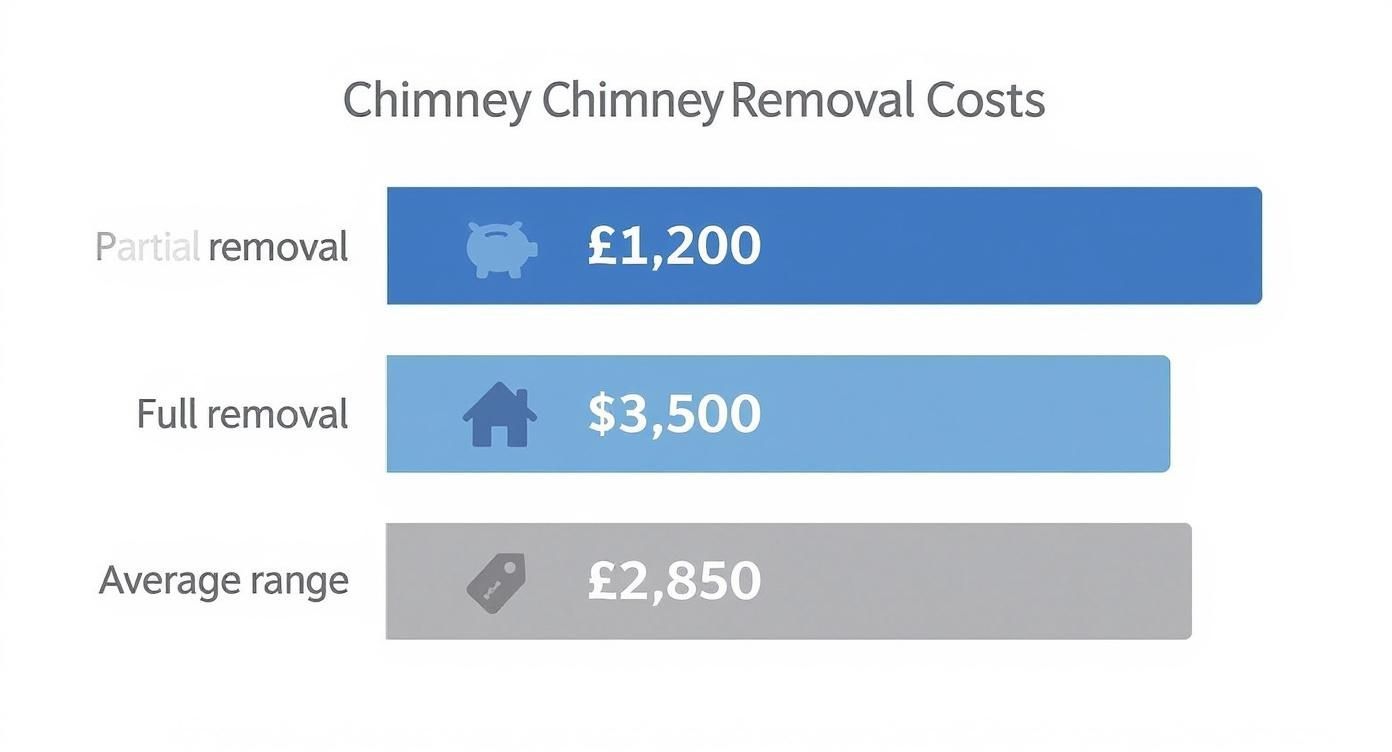
As you can see, a full removal is a much bigger investment than just taking down the stack. That difference comes down to the extra labour and structural work needed to do the job safely.
The Cost of Skilled Labour
The lion's share of your quote will almost always be the labour. This isn't just about having bodies on-site; it’s about paying for the skill and experience of tradespeople who know precisely how to take a part of your house apart without causing chaos.
In the UK, you can expect daily rates for builders and roofers to be somewhere between £220 and £300. For a job that takes a few days, you can see how this quickly becomes the main expense. It covers the careful demolition, installing new supports, and the fiddly work of patching up the roof and walls afterwards.
Essential Structural Expertise
Now, this part is crucial. If your chimney is a load-bearing part of the house (meaning it helps hold things up), you absolutely need a structural engineer. This isn’t an optional extra; it's a fundamental safety requirement.
A structural engineer is the person who does the maths. They provide the exact calculations for the new support, which is usually a Rolled Steel Joist (RSJ), and give you a report that proves your home’s structural integrity will be maintained. Budget around £400 to £1,000 for their services – it’s a small price for total peace of mind.
Trying to skip this step to save a few quid is a massive mistake. It's a false economy that could lead to serious structural damage and costs that would dwarf the original quote. Think of the engineer's report as the blueprint for a safe removal.
Material and Equipment Hire
Beyond the people doing the work, the job requires a fair bit of kit and materials. These are often listed as separate items on your quote, so you can see exactly where your money is going.
Here are the usual suspects:
- Structural Supports: This is the steel beam (RSJ) itself. The price depends on its size and length but typically lands in the £150-£400 range.
- Scaffolding Hire: You can't safely work on a roof without it. Hiring scaffolding can cost between £300 and £800, depending on the size of your house and how long the job takes.
- Skip Hire: Removing a chimney creates a lot of heavy rubble – mostly bricks and mortar. When looking at your quote, you'll see waste disposal is a key part; knowing the cost to rent a dumpster helps you understand this charge.
- 'Making Good' Materials: This is the catch-all for everything needed to finish the job properly: new roof tiles, felt, battens, plasterboard, and plaster for the inside walls.
Finishing the Job: The 'Making Good' Phase
The final stage is what we in the trade call 'making good'. It’s all about repairing and redecorating the areas affected by the removal, making it look like the chimney was never there. On average, removing a chimney stack in the UK costs about £300 per metre, leading to a typical project total of around £1,800.
The cost for 'making good' the roof, ceiling, and walls can add another £150 to £210 to the bill. It's this finishing touch that separates a professional job from a rough-and-ready one, leaving you with a clean new space and a secure, weatherproof roof.
What Really Drives Your Final Project Cost?
Ever get two quotes for the same job and wonder why they're miles apart? When it comes to chimney removal, the final cost isn't just one fixed number. It’s a sum of several moving parts, all specific to your home. Getting your head around these factors is the first step to understanding what your quote actually covers and the real work involved.
Think of it this way: removing a chimney isn’t just a bit of demolition. It’s more like performing careful surgery on your home. Some operations are straightforward, while others are far more complex and need specialist support and meticulous planning. Let's break down what separates a minor procedure from major structural surgery for your property.
The Scope of the Removal Job
The single biggest thing affecting your bill is simple: how much of the chimney are you actually taking out? Are we talking about the whole lot, from the pot right down to the ground floor, or just a section of it? The answer will dramatically change the price.
- Partial Removal (Stack Only): This just involves taking down the bit of the chimney you can see poking out of the roof. It’s easily the most affordable option, usually landing somewhere between £500 and £2,000. Why? Because it’s all external work with no need for internal structural changes.
- Partial Removal (Chimney Breast Only): This is when you want to get rid of the internal chimney breast, typically on one floor, to open up a room. It's a more involved job, costing £1,500 to £4,000, because you almost always have to install new structural supports to hold up what's left above.
- Full Removal (Stack and Breast): This is the full works – taking the entire structure out, from the roofline all the way down to the foundations. It’s a serious undertaking, and you’ll be looking at a starting price of around £2,500, often climbing higher.
Basically, the more you remove, the more labour, structural engineering, and "making good" (plastering, decorating) will be needed. All of this adds up on the final invoice.
Structural vs. Non-Structural Chimneys
This is probably the most critical point to understand, and getting it wrong can have serious consequences for your home’s stability.
Some chimneys are non-structural, meaning they stand on their own and don't support any part of your house. Removing them is relatively simple.
However, a load-bearing chimney is a different beast entirely. It’s a working part of your home's skeleton, actively holding up floors or parts of the roof. Trying to remove one without the right engineering and support is like pulling a critical block from a Jenga tower – you can imagine the result.
Removing a load-bearing chimney is a job for a structural engineer. They'll need to calculate the precise steel supports (known as RSJs or rolled steel joists) required to take over the load. This adds cost, but it's completely non-negotiable for the safety and integrity of your home.
Material and Accessibility Challenges
What your chimney is made of and how easy it is to get to also play a big part in the cost. A standard brick chimney is fairly straightforward to take down, piece by piece. But a chimney built from dense, irregular stone or one with tough modern flue liners will take a lot more time and effort, pushing up labour costs.
Then there’s access. Is your house a terraced property with no side alley? Is the chimney on a particularly steep or high roof? These challenges often mean we need extra equipment, like larger, more complex scaffolding or even a crane in some situations. These logistical hurdles add to the project's bottom line. It's a similar story for other major home projects; for instance, as our guide on the cost of moving a boiler explains, poor access can complicate things there, too.
Let's look at how these variables can swing the total price.
How Project Variables Impact Your Total Cost
This table shows how different factors can push your quote one way or the other.
| Factor | Low-Cost Scenario | High-Cost Scenario | Reason for Difference |
|---|---|---|---|
| Scope | Stack removal only | Full removal (stack & breast) | Less labour, no internal structural work required. |
| Structure | Non-load bearing | Load-bearing chimney | Requires a structural engineer and steel beam installation. |
| Access | Detached house, easy access | Terraced house on a hill | Needs complex scaffolding, more time for waste removal. |
| Materials | Standard brick construction | Dense stone or reinforced concrete | Harder materials take longer and require specialist tools. |
As you can see, a project can become significantly more complex (and expensive) once these high-cost factors come into play.
Regional Price Variations Across the UK
Finally, your postcode matters. The cost of labour and materials isn’t the same everywhere in the UK. A job in central London will nearly always cost more than the exact same work in the North of England or the Midlands.
Data from BuildPartner really highlights this. They found that removing a chimney stack in Inner London can be about 8% more expensive than the UK average. While the national average to remove a stack ranges from £3,515 to £4,863, this can jump to between £5,047 and £5,935 in the capital. It just goes to show that local market rates have a real impact on your final quote.
The Chimney Removal Process From Start to Finish
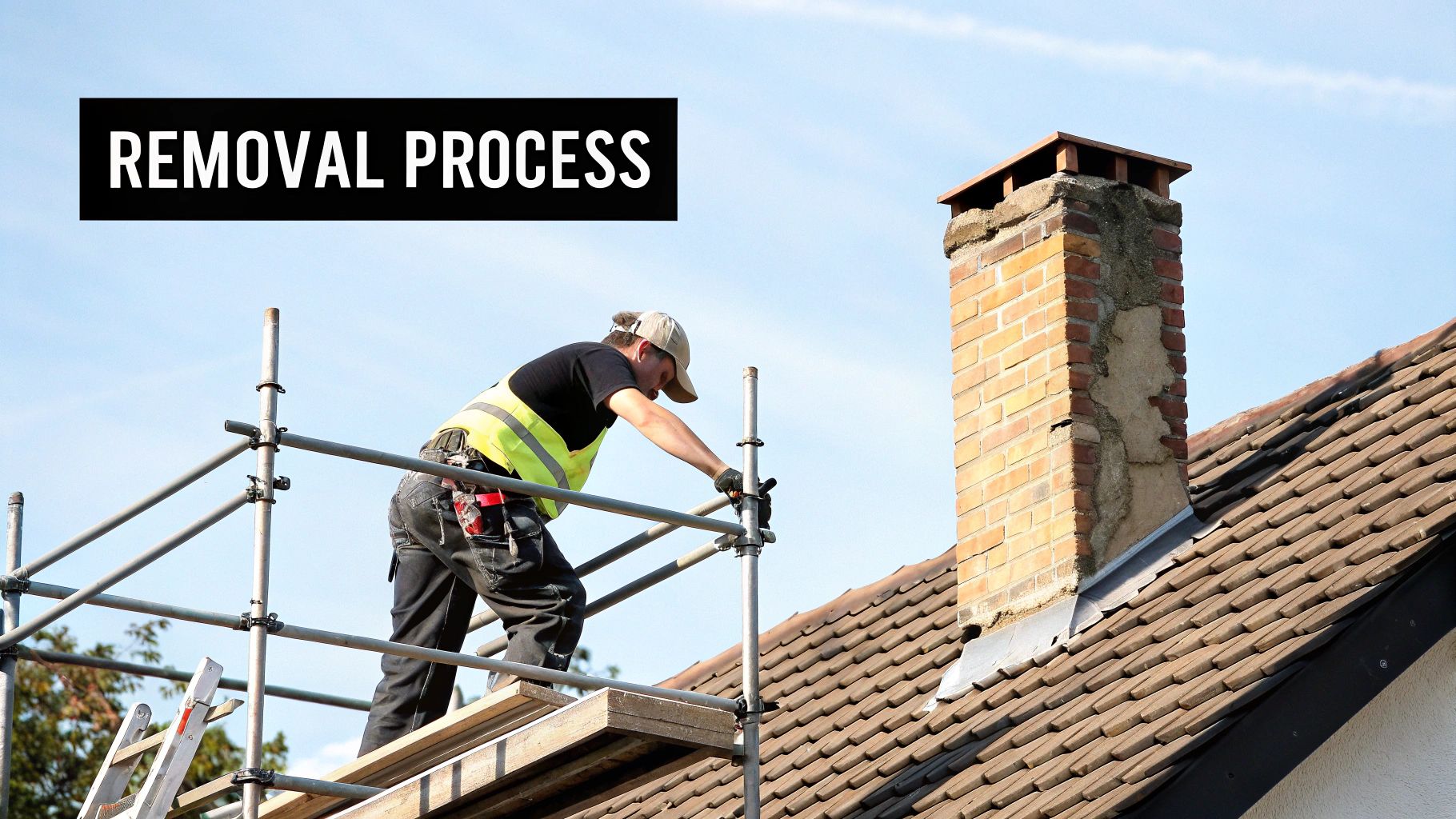
It's one thing to see the numbers on a quote for chimney removal cost, but it’s another to understand what’s actually going to happen in your home. Let's pull back the curtain on the process, so you know exactly what to expect and why this job is strictly for the professionals. A proper removal isn't about swinging a sledgehammer; it's a careful, planned operation.
You can think of it like a well-rehearsed play in four acts. Each stage sets up the next, all leading to a safe, clean, and structurally solid finale.
Stage 1: The Initial Survey and Structural Assessment
Before anyone picks up a tool, the project kicks off with a detailed survey. A specialist will visit your property to get a feel for the chimney's construction and condition. More importantly, they’ll figure out its role in your home's structure. Is it holding up the floor joists or the roof? This is the single most important question that needs an answer.
If it turns out the chimney is a load-bearing element, the next call is to a structural engineer. They'll do the maths to calculate the exact type and size of steel support—usually a Rolled Steel Joist (RSJ)—needed to take the weight once the brickwork is gone. This engineer's report isn't just a friendly suggestion; it's the blueprint for a safe job and a non-negotiable for getting Building Regulations approval.
Stage 2: Paperwork and Preparation
With the structural game plan sorted, it's time for the admin. While it might be the least glamorous part of the project, getting the paperwork right is essential to keep everything legal and above board.
Here are the key steps:
- Building Regulations Approval: Any major structural change, like taking out a chimney breast, needs a green light from your local council’s building control. Your contractor will submit the engineer's designs to prove the work will be done safely and to standard.
- Party Wall Agreement: If your chimney is on a shared wall with a neighbour (the 'party wall'), the law says you must inform them. This means serving a formal Party Wall Notice, which gives them a chance to consent or, if they have concerns, appoint their own surveyor.
Once the permissions are in place, the team gets your home ready. This means putting down heavy-duty protective sheets on floors and furniture and sealing off the work area to contain the dust cloud that’s about to be unleashed.
A professional crew knows that managing dust is everything. It’s far easier to trap it at the source than to spend days cleaning it out of every nook and cranny later. This attention to detail is a hallmark of a considerate, experienced team.
Stage 3: Controlled Demolition and Support Installation
Now for the main event. The team will start taking the chimney down, almost always from the top. It's a methodical, brick-by-brick process designed to prevent any uncontrolled collapses that could damage your home or, worse, cause an injury.
For a full removal, the work snakes down through the loft, into the bedrooms, and finally the living areas. As each section of the chimney breast comes out, the new steel beams and supports are carefully hoisted into place. This transfer of the building's weight is the most critical moment of the entire job.
Stage 4: Making Good and Finishing Touches
With the chimney gone and the new steel doing its job, the final act is all about making it look like the chimney was never there. This "making good" stage is what separates a rough job from a truly professional finish.
The finishing work involves several key jobs:
- Roof Repair: The hole in your roof is filled in with new timber, roofing felt, and tiles or slates that match the existing ones to create a perfect, weatherproof seal.
- Internal Patching: The gaps left behind in floors, ceilings, and walls are patched up. This means fitting new floor joists, laying floorboards, and putting up plasterboard before skimming it all for a smooth, ready-to-paint surface.
- Final Clearance: All the rubble and debris are completely removed from your property. You'll be left with a clean, tidy new space, ready for you to decorate and enjoy.
Smart Ways to Manage Your Removal Budget
Knowing what affects your chimney removal cost is one thing, but how can you actively keep those costs in check without cutting corners on safety? With a bit of smart planning, you can absolutely take control of the budget. It's not about being cheap; it's about being clever and getting the best value for your money.
Think of it like booking a holiday. You could just grab the first package deal you find, or you could shop around for flights, look for off-peak deals, and decide which extras are actually worth paying for. The same mindset works wonders here. A proactive approach can save you from nasty surprises and keep the project financially on track.

Get Multiple Detailed Quotes
This is, without a doubt, the single best way to know you’re getting a fair price. Don't ever just accept the first quote that comes through the door. Make it a rule to get at least three detailed estimates from reputable, properly insured builders or removal specialists.
A vague, one-line price is a massive red flag. A proper, professional quote should break everything down for you, including:
- Labour charges (spelling out their daily or hourly rates)
- Scaffolding and skip hire
- Fees for the structural engineer (if needed)
- The cost of materials like steel beams and matching roof tiles
- Waste disposal and removal fees
When you have a few itemised quotes side-by-side, you can clearly see where your money is going and easily spot if one company is charging way over the odds for a particular job.
Consider a DIY Finishing Touch
Look, the heavy-duty structural work is absolutely a job for the pros. No question. But if you're handy and confident with your DIY skills, you could save a decent amount on labour by tackling the finishing touches yourself.
The idea is to let the professionals do what they do best: the demolition, installing the structural supports, and making sure your roof is completely watertight. Once they're done, you can step in to handle the non-structural jobs like plastering, painting, and decorating the space you've just gained. This can easily shave a few hundred pounds off the total invoice.
Be Flexible with Your Timing
Good builders, like most businesses, have their peak seasons and quieter spells. If your project isn’t an emergency, it's always worth asking potential contractors if they can offer a better rate during their off-season. This often falls in the late autumn or winter.
Booking your chimney removal for a time when a contractor is less busy could lead to a 10-15% reduction in labour costs. They're often happy to fill gaps in their work schedule, which gives you a bit of leverage. It requires some flexibility on your part, but the savings can be well worth it.
This same logic of smart financial planning applies to all sorts of home projects. For instance, if you're planning a full house move, understanding the cost breakdown is just as important, which we cover in our guide to the average cost of moving companies. By thinking ahead and being strategic, you can make your budget go a lot further.
Why a Structural Survey Is Non-Negotiable
If you take just one thing away from this guide, let it be this: a professional structural survey is the most important investment you can make. It’s one thing to get a ballpark figure for your chimney removal cost, but an online estimate can never see what’s actually going on behind your walls.
Every single home is different. What looks like a straightforward job on the surface can quickly become a complicated and expensive headache due to hidden issues. Skipping this crucial step is a massive gamble, one that could lead to ballooning costs or, even worse, serious structural damage to your property.
Your Project’s Insurance Policy
The best way to think of a survey is as an insurance policy for your project. It's not just another expense; it's an essential safety measure that gives you a fixed, accurate quote based on the reality of your home. It’s all about spotting potential problems before a single brick is touched, making sure there are no nasty surprises waiting for you down the line.
A proper, in-person survey delivers:
- A Fixed, Accurate Quote: This puts an end to the guesswork. You’ll get a firm price for the work that’s actually needed.
- Problem Identification: A structural engineer can spot potential weak points with load-bearing walls or your roof's integrity well in advance.
- Regulatory Compliance: It confirms the entire project will meet building control standards. This is vital for safety and for the future saleability of your home.
Beyond the immediate structure, a survey also ensures the work aligns with wider building regulations. It’s always wise to stay aware of relevant legislation like the Building Safety Act 2022.
A survey brings complete peace of mind. You get a definitive plan and a concrete price, turning a big unknown into a clear, manageable project. That clarity is invaluable, especially if you’re hoping to use the new space for something like a loft storage conversion.
Booking a survey is the first real step towards getting the job done safely and successfully.
Common Questions About Chimney Removal
Even with a budget in hand, you've probably still got a few practical questions knocking around. It’s a big job, after all, and it's always smart to have all the answers before the work kicks off. Let's run through some of the most common things we get asked by homeowners.
Think of these as the final pieces of the puzzle, covering everything from paperwork to project timelines.
Do I Need Planning Permission to Remove My Chimney?
For most homes, the short answer is no. Taking out an internal chimney breast or even the external stack usually falls under what’s known as permitted development rights. This means you can get on with the job without needing to go through a formal planning application.
But—and this is a big but—there are a few crucial exceptions. You will almost certainly need to get permission if:
- Your home is a listed building.
- Your property sits within a conservation area.
- The chimney is built into a shared wall (a party wall).
It’s always best to give your local council's planning department a quick call first. Getting this wrong can turn into a legal and financial nightmare you really don't want.
What Is a Party Wall Agreement and Do I Need One?
If your chimney is on a wall you share with a neighbour, then yes, a Party Wall Agreement is non-negotiable. This is all covered by the Party Wall etc. Act 1996, a piece of legislation designed to stop neighbourly disputes before they even start.
Before any work begins, you are legally required to give your neighbour a formal written notice. This gives them a chance to agree to the work or, if they're worried, hire a surveyor to make sure their home is protected. It's not just about being polite; it’s a legal must-do.
A Party Wall Agreement isn't about asking your neighbour for permission. It's about ensuring the work is carried out properly and safely, protecting everyone's property. It’s an essential step for keeping the peace and avoiding expensive problems down the line.
Can I Remove a Chimney Myself?
I understand the temptation to save some cash on labour costs, but this is one of those jobs where DIY is a really bad idea. Chimney removal is serious business. It involves major structural work, dealing with heights, and disposing of tonnes of heavy rubble.
Without a proper understanding of your house's structure, you could easily remove a vital support. That could lead to anything from sagging floors to a partial collapse. Professionals have the right gear, the safety training, and the insurance to do the job properly. Trust me, the potential chimney removal cost of a DIY disaster is far, far higher than any initial savings.
How Long Does the Entire Process Take?
A simple chimney stack removal can often be done and dusted in one to two days. A full, top-to-bottom removal is a much bigger undertaking. You're typically looking at three to five days for the whole thing, which includes all the structural support work and making good afterwards.
Ready to get a clear, accurate, and no-obligation quote for your chimney removal? The team at SimplyPro Removal & Storage Ltd can provide a detailed assessment with an on-site visit or a convenient video survey. Get Your Free Quote Today