


Moving a piano isn't really about brute force. It's about smart, careful planning. The real work happens long before you lift anything, starting with a good, hard look at the piano itself and the path it needs to take.
Your Pre-Move Piano Assessment and Game Plan
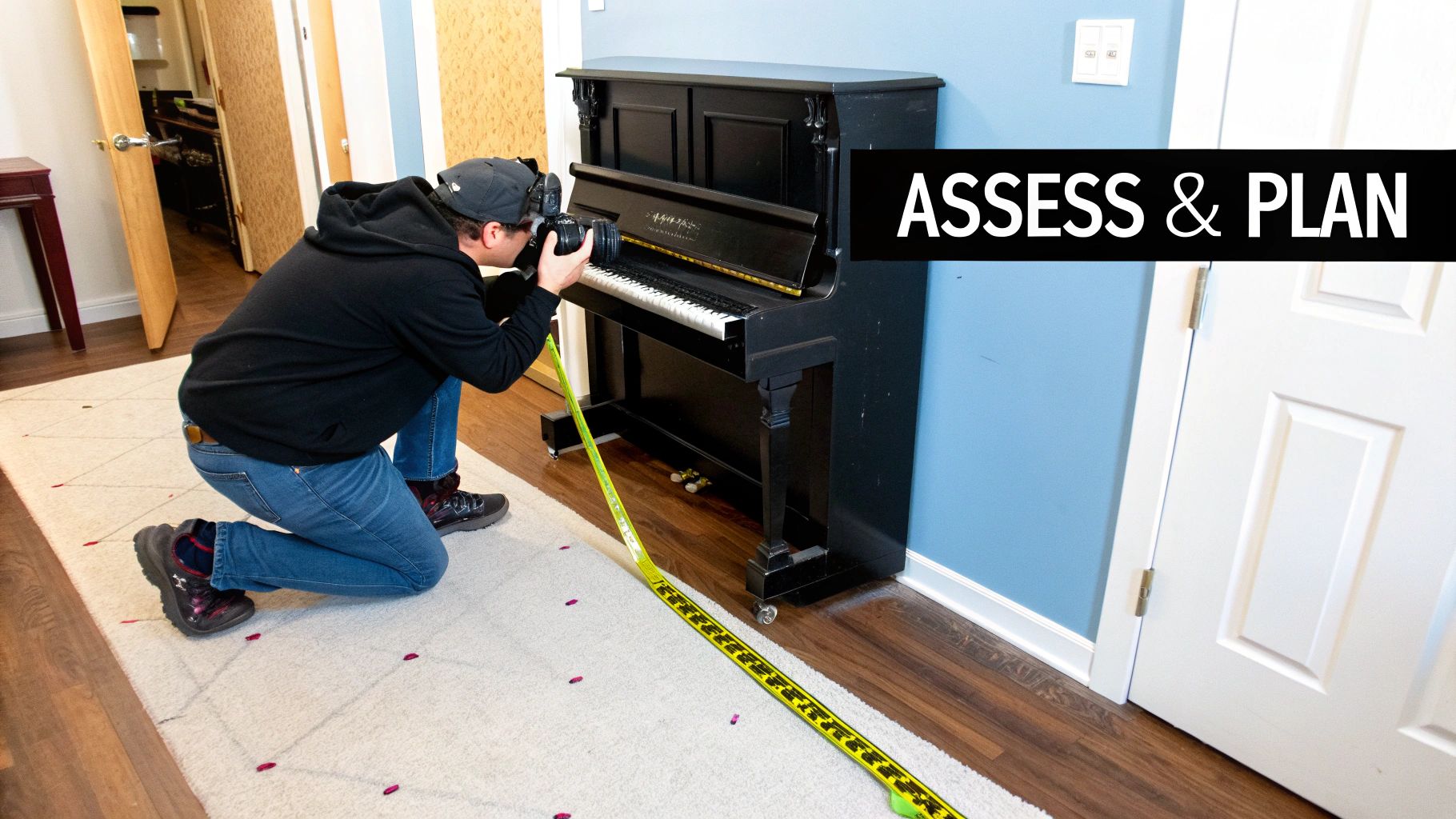
Before you even think about grabbing a blanket or a strap, you need a solid plan. This is where the success of your move is decided. Jumping in without a proper assessment is the number one mistake we see, and it’s a recipe for damaged instruments, scuffed walls, or worse, personal injury.
Think of this as drawing up a blueprint. It clarifies the job, helps you spot problems before they happen, and makes sure you have the right gear and people on hand.
First, Know Your Instrument
Pianos come in all shapes and sizes, and those differences are a big deal when it comes to moving them. Your first job is to figure out exactly what you're dealing with. Is it a little spinet, a classic upright, or a massive concert grand? The type of piano tells you the technique you'll need and, crucially, how heavy it is.
A small upright might weigh between 130 to 225 kg (roughly 300 to 500 lbs), which a small, experienced crew can handle. A grand piano, on the other hand, can easily top 450 kg (1,000 lbs) and will need to be partially taken apart by someone who knows what they're doing. You can usually find the make and model inside the fallboard (the lid that covers the keys).
Measure, Document, Repeat
Now, it’s time to get out the camera and measuring tape. You need to create a complete record of the piano's condition and its exact size.
- Take lots of photos: Snap pictures of the piano from every angle. Get close-ups of any existing scratches, dings, or scuffs. This is your 'before' evidence and is absolutely vital if you're hiring pros and need to file an insurance claim.
- Get the exact dimensions: Measure the width, depth, and height. These numbers aren't negotiable—they'll tell you if you can actually get it through doorways and around corners.
- Estimate the weight: If you can't find the exact weight from the maker, a quick Google search of the model should give you a good ballpark figure. Always err on the side of caution and assume it's heavier.
I’ve seen it countless times: people "eyeball" a doorway and think it’s fine. But a 200 kg piano has a funny way of making a wide-looking gap feel impossibly narrow. Always, always measure.
Map Out the Entire Route
With the piano's vital stats sorted, you need to walk the exact path it will take, from its current spot to its final destination. As you do, keep your eyes peeled for any potential trouble spots.
Before you start, here's a quick checklist to run through.
Quick Piano Moving Assessment
| Assessment Area | Key Considerations | Why It Matters for a Safe Move |
|---|---|---|
| Pathways | Measure the width of all doorways, hallways, and corridors. | You need to know if the piano will fit through. Don't forget to account for the dolly and the people carrying it! |
| Stairs & Steps | Count every step. Note any turns, landings, or spiral staircases. | Stairs are the highest-risk area. This information determines if you need ramps, skid boards, or specialist stair-climbing equipment. |
| Corners | Identify all 90-degree or tight turns. | Pivoting a long, heavy object is tricky. You need to ensure there’s enough clearance to avoid scraping walls and door frames. |
| Flooring | Check the type of floor surface (hardwood, carpet, tile, etc.) at both locations. | Different floors require different protection. Hardwood scratches easily, while deep-pile carpet can make wheels difficult to move. |
| Obstacles | Look for anything that could get in the way—low-hanging lights, radiators, furniture. | Clearing the path beforehand prevents accidents and last-minute panic. It's much easier to move a coffee table than a piano. |
This checklist is your starting point. Knowing the answers to these questions turns a vague plan into a precise operation.
Thinking about the bigger picture is key. This piano assessment is just one piece of the puzzle. For a more complete checklist covering your entire move, check out our guide on how to prepare for moving house. A bit of detailed prep now will save you a world of stress on the day.
Gathering the Right Equipment for the Job
Trying to muscle a piano out of your home with just a bit of optimism is a recipe for disaster. This isn't like shifting a sofa. To do this right, and to avoid a bill for thousands in repairs to the piano, your floors, or your back, you need very specific gear.
First things first: you need a heavy-duty piano dolly or a piano skid board. A standard furniture dolly won't cut it. Pianos are notoriously top-heavy and their weight—anywhere from 180 kg for a small upright to over 450 kg for a grand—is distributed unevenly. A proper piano dolly is built low and strong, designed to handle that immense, awkward load without tipping. It's the most critical piece of equipment you'll get.
Protecting Every Surface
With the piano ready to roll, the next job is to protect its delicate finish. This is where you can’t skimp on quality padding.
- Thick, Quilted Blankets: These are non-negotiable. You'll need enough to wrap the entire instrument, creating a thick cushion against scrapes and bumps as you navigate doorways and tight corners.
- Plastic Stretch Wrap: Once the blankets are on, wrap the whole thing tightly with industrial stretch wrap. This keeps the padding in place and adds a layer of protection against dust and moisture.
- Corner Protectors: These little pieces of foam or plastic are lifesavers, preventing the dings and chips that happen all too easily when pivoting the piano around a corner.
You'll also need strong packing tape to secure the blankets, but a word of warning: never let the tape touch the piano's wood finish. It can pull the varnish right off. If you're wondering where to get these supplies, our guide to the best packing materials for moving has some great pointers.
Securing the Load and Yourself
Getting the piano wrapped and onto a dolly is only half the battle. Now you have to keep it under control, especially if you're dealing with ramps or stairs.
This is where load-bearing straps (sometimes called hump straps or moving harnesses) are essential. They let movers use their body weight and leverage to manage the piano, taking the immense strain off their arms and back. For the journey in the lorry, you'll need several heavy-duty ratchet straps to bolt it down. You want zero movement during transit.
A piano that slides just a few inches inside a moving lorry can build up enough momentum to snap weak ropes and cause serious damage. Always use straps rated to handle far more than the piano’s actual weight.
Finally, don't forget about your own safety. A good pair of sturdy work gloves with a solid grip is a must. And we can't stress this enough: wear steel-toed boots. The consequences of a piano rolling over your foot don't bear thinking about. This gear isn't just about making the move easier; it's what makes it possible to do safely. If you're set on a DIY move, you can often rent professional moving equipment from tool hire shops.
So, You're Thinking of Moving a Piano Yourself?
Let’s be honest, the thought of saving a few hundred quid by moving a piano yourself is tempting. "How hard can it be?" you might wonder. "It's just a big box on wheels, right?" This is usually the moment a simple task starts its rapid descent into a costly, painful disaster. Before you start bribing your mates with pizza and beer, it’s worth having a frank look at what you’re up against.
A piano isn’t like shifting a wardrobe or a fridge. Its weight is incredibly unbalanced, often tipping the scales at 200-450 kg, and the delicate machinery inside is shockingly fragile. One bad jolt can knock hammers out of alignment, crack the soundboard, or even snap the cast-iron plate. Those are repairs that can easily run into the thousands.
This little decision tree can help you visualise whether a DIY move is even in the realm of possibility for you.
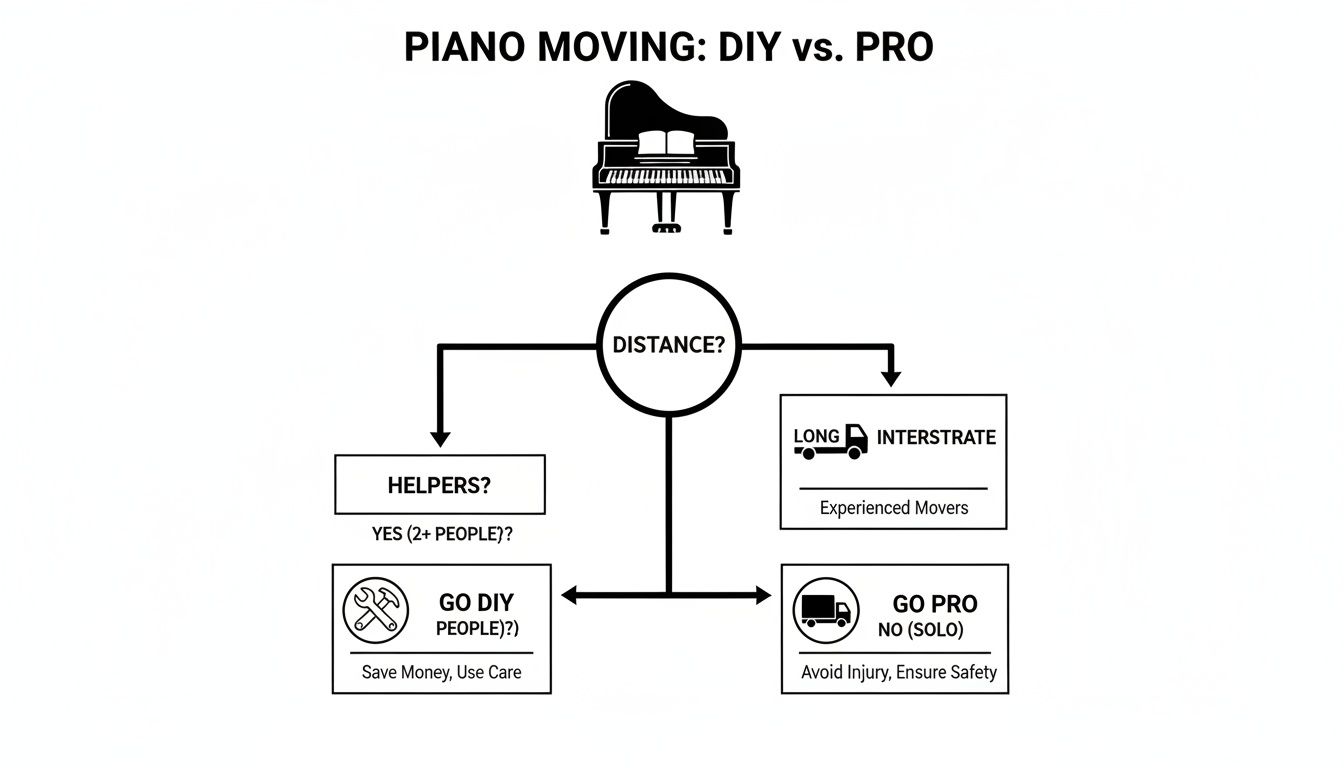
As you can see, the complexity of the move is what really separates a DIY job from a professional one. And the risks go far beyond just damaging the instrument.
The True Cost of a DIY Mishap
We’ve seen it all. The piano that slips on a ramp and carves a permanent trench into a beautiful hardwood floor. The misjudged turn in a hallway that rips a huge chunk out of a listed building’s original plasterwork. These aren't minor scuffs; they’re serious property damage that your standard home insurance is unlikely to cover when you’re the one doing the moving.
And then there's the very real danger of getting seriously hurt. Once a piano starts to tip, it's an unstoppable force. We're talking strained backs, crushed fingers, and broken toes—all common outcomes when people who don't do this day-in, day-out try to wrestle with hundreds of kilos of dead weight. Any money you thought you were saving vanishes the second you’re facing a huge repair bill or a trip to A&E.
The most common thing we hear after a DIY attempt goes wrong is, "It happened so fast." It only takes one second of lost control to cause thousands of pounds of damage to the piano, your home, or worse, a person.
The numbers back this up. Data from piano specialists shows a shocking 40% higher rate of damage claims on DIY moves, with repair bills frequently topping £5,000. With the surge in house moves since the pandemic, the demand for properly insured movers is high, which has actually made professional quotes more competitive than you might think. For a deeper dive, you can read the full analysis of piano moving costs.
When a DIY Move Might Actually Work
Despite all the warnings, there are a few very specific, very limited scenarios where you might get away with moving a piano yourself. If you can tick every single one of these boxes, then you might be in with a chance.
- The Piano Itself: It must be a small, lightweight spinet or console upright. Anything bigger, and especially a grand piano, is an absolute no-go for amateurs.
- The Route is Simple: The entire journey has to be on the ground floor. No stairs. Not even one or two steps. The path needs to be wide, straight, and completely clear.
- You Have the Right Gear: This isn't a negotiable point. You need a proper heavy-duty piano dolly, several thick moving blankets, and multiple load-bearing straps. An old duvet and a bit of rope won't cut it.
- Your Team is Capable: You'll need at least three or four strong, physically fit people who can communicate clearly under pressure and stick to a plan.
If your situation doesn't meet all of that criteria, the risk just isn't worth the reward. For most people, particularly here in Bristol and Bath with our beautiful old properties full of narrow halls and tricky staircases, the answer is simple: hire a professional. It's the safest, sanest, and often the most cost-effective choice in the long run.
Hiring Professionals: What to Look For
Deciding to bring in the professionals is easily the smartest move you can make. It protects your piano, your property, and your back. But here's the catch: not all removal companies are created equal. You need to find a team with genuine, hands-on expertise, and that means knowing the right questions to ask. This will help you quickly separate the true specialists from the generalists who might treat your treasured instrument like just another wardrobe.
You're not just looking for a company with a van and a couple of strong pairs of hands. A piano is a different beast entirely—it’s deceptively top-heavy, full of delicate mechanics, and demands specialist gear. Think of this as your guide to vetting a mover properly, so you can hire with total peace of mind.
Vetting Your Potential Movers
Before you even think about quotes, you need to draw up a shortlist of potential companies. Start by looking for businesses that actively promote piano moving as one of their core services, not just a footnote on their website. A real specialist will proudly show off photos of previous piano moves and have glowing reviews from happy customers.
Once you’ve got a few names, it’s time to get specific with your questions:
- Do they know your piano? Ask, "Have you moved a [Your Piano's Make and Model] before?" A crew that’s familiar with the balance points of a Steinway grand or the specific challenges of a Kemble upright is already a huge step ahead.
- What gear will they bring? Follow up with, "What specific equipment will you be using?" Listen for words like piano skids (or shoes), heavy-duty dollies, padded covers, and load-bearing straps. If their only answer is "a dolly," that’s a big red flag.
- Who is on the team? Ask, "How many people will be on the crew, and are they trained specifically for piano removals?" For a standard upright, you should expect at least two or three properly trained movers.
A true professional's confidence and knowledge are unmistakable. They'll answer your questions clearly and without hesitation, walking you through their process. If a company seems vague or brushes off your concerns, trust your gut and move on.
Understanding the nuts and bolts of a good removal service is key. For a broader look at what makes a great company, our guide on what to look for in a removal company is an excellent resource.
Understanding Insurance and Quotes
This is an area where it’s easy to get tripped up. Any company can claim they're "fully insured," but you need to know what that actually covers. There are two non-negotiables: Goods in Transit insurance, which protects your piano while it's in their vehicle, and Public Liability insurance, which covers any accidental damage to your property.
Don't be shy about asking to see a copy of their insurance certificate. Check that the coverage amount is enough to replace your piano if the worst were to happen. A reputable mover will have this information ready and won't mind you asking.
When it comes to quotes, always get at least three in writing. A proper quote should be detailed and transparent, breaking down every cost. Be very wary of any price that seems too good to be true—it often means they're cutting corners on insurance, equipment, or skilled staff. Keep an eye out for hidden fees for things like stairs, tight access, or fuel surcharges.
Breaking Down the Costs in the UK
So, what should you budget for a professional piano move? Several factors come into play, including the piano's size and type, the distance it's travelling, and any tricky access points like stairs or narrow corridors.
The table below gives you a rough idea of what you can expect to pay across the UK.
Estimated UK Professional Piano Moving Costs
| Piano Type | Local Move (Under 50 miles) | Long-Distance Move (Over 100 miles) | Common Additional Cost Factors |
|---|---|---|---|
| Upright Piano | £90 – £250 | £300 – £600 | Stairs, tight corners, gravel paths, parking restrictions. |
| Baby Grand Piano | £200 – £400 | £500 – £900 | Dismantling/reassembling legs & lyre, ground floor access. |
| Concert Grand | £400 – £700+ | £800 – £1,500+ | Specialist craning equipment, multiple floors, complex access. |
Remember, these figures are just a guide. Costs can vary significantly based on your specific circumstances and where you are in the country.
For example, movers in Southeast England often charge 20-30% more than the national average. A simple upright piano move in London might set you back £150-£250, while the same job in Bristol or Birmingham would more likely fall into the £90-£180 range. Stairs are always a major factor, with each flight potentially adding another £50-£150 to the bill.
If you’re in Bristol or Bath, choosing a local specialist like SimplyPro is a no-brainer. A local team not only provides more competitive pricing but also brings invaluable knowledge of the local architecture. Whether it's the elegant Georgian townhouses in Bath with their notoriously tight stairwells or the classic Victorian terraces in Bristol, they know what to expect and arrive fully prepared. That local expertise makes the whole day run that much smoother.
Getting Your Piano and Home Ready for the Big Day
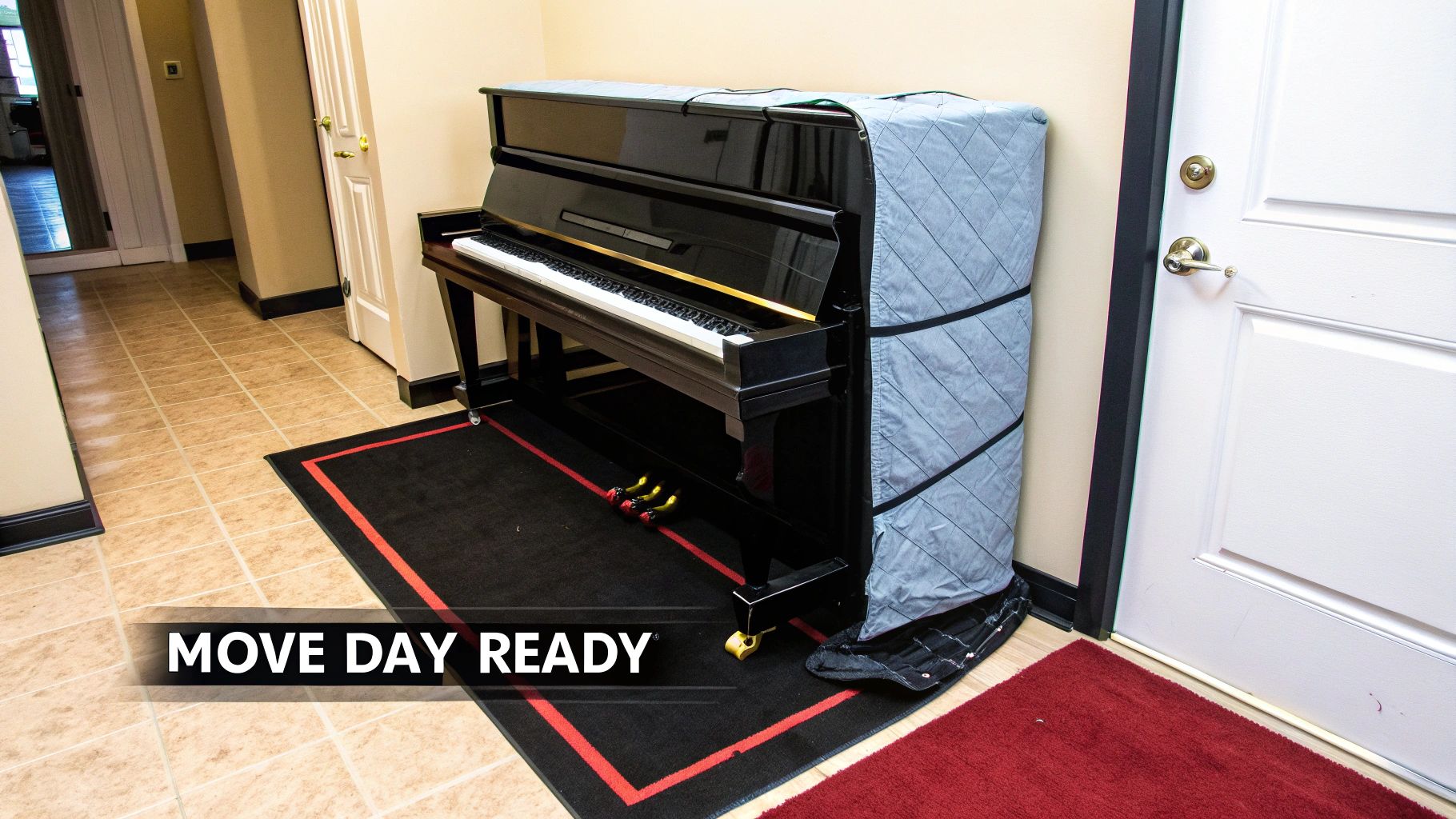
You’ve got a plan and your team is ready. Now comes the crucial part: the final prep work on moving day. This is where a smooth move is made, preventing those last-minute hiccups that can turn the day into a stressful ordeal.
Your focus should be twofold: getting the piano itself ready for travel and protecting your home from the move. Taking a bit of time on these steps can mean the difference between a seamless experience and an expensive repair bill for your instrument or property.
Securing the Instrument
Before that piano budges even an inch, a few quick checks are vital. The idea is to make the whole instrument as tight and solid as possible, so nothing rattles, shifts, or gets damaged in transit.
- Lock Down the Keyboard Lid: If the fallboard (the lid over the keys) has a lock, now’s the time to use it. If not, whatever you do, don't slap masking tape on it—it can pull the finish right off. Just close it. The moving blankets and shrink wrap will keep it snug and secure.
- Handle Loose Parts: For grand pianos, this is when professionals will carefully detach the legs, lyre (the pedal box), and music stand, wrapping each piece individually. For any piano, make sure the main top lid is closed and won't fly open.
- Protect the Pedals: The pedals are surprisingly vulnerable and can easily get bent or snagged. They need to be wrapped properly with padding to cushion them from bumps and knocks along the way.
Prepping Your Home and the Path
Your house needs just as much care as the piano. An instrument weighing 200kg or more on a dolly can wreak havoc on floors, door frames, and walls if you haven't prepared the path.
When getting your home ready, it’s crucial to think about how to protect your hardwood floors from scratches and dents. Laying down protective floor runners, cardboard sheets, or even old rugs along the entire route is a non-negotiable step.
Also, take a good look at any tight spots. Pad any vulnerable wall corners and door frames with blankets or foam to soften any accidental bumps. Spending five minutes on this can save you a whole weekend of filling, sanding, and painting.
A classic mistake is to only look at the floor. Don’t forget to look up! Low-hanging light fixtures or even smoke detectors can be easily clipped. If you can remove them, do it.
With an estimated 200,000 to 450,000 pianos moved in the UK each year, it's a common task. But the statistics tell a story. DIY moves suffer a damage rate of 25-40%, a stark contrast to the less than 2% rate for insured specialists. It’s a powerful argument for getting the prep work right.
The Final Step: Patience
Once your piano is finally in its new home, the most important thing to do is… nothing. Just let it be. It needs time to acclimatise to the new environment's temperature and humidity.
Fight the temptation to get it tuned immediately. Tuning it straight away is often a waste of money because the wood and strings are still settling.
Most professional tuners will tell you to wait at least two to four weeks. This gives the instrument's internal workings a chance to fully adjust, so when you do get it tuned, the tuning will hold properly.
Your Piano Moving Questions Answered
Even with a solid plan, there are always a few niggling questions that pop up when you're organising a piano move. They're often the small details, but getting them right can make all the difference on the day. Let's tackle some of the most common queries we hear from customers.
Can I Trust a Regular Moving Company with My Piano?
Honestly, it’s a huge risk. While a general removals firm might agree to the job, they almost never have the specialised gear needed—things like piano skids, hoisting straps, or even the right kind of lorry. More importantly, they lack the specific training.
Pianos are notoriously top-heavy and their internal workings are incredibly delicate. We’ve seen firsthand how an inexperienced crew can cause thousands of pounds in damage to the internal action, the soundboard, or the polished finish. A professional piano mover understands the unique physics of the instrument. It’s always worth paying that bit extra for a specialist who brings the right tools and, crucially, the right insurance.
How Long Should I Wait to Tune My Piano After Moving?
The golden rule is to give it time to settle. A piano needs to acclimatise to the temperature and humidity of its new home, which directly affects the wood and the tension of the strings. Most professional tuners will tell you to wait at least two to four weeks before booking a tuning.
If you tune it right away, you're essentially throwing money away. The piano will continue to adjust to the new conditions and will almost certainly slip out of tune again. Patience really is the key here to getting a stable, long-lasting tuning.
It's a common myth that the physical journey itself knocks a piano out of tune. While a massive jolt could cause an issue, it's nearly always the change in atmosphere that's the real culprit.
Of course, even with the best technique, moving something so heavy can lead to physical strain. If you do find yourself with a sore back after all the effort, it’s worth knowing how to relieve lower back pain at home safely. Looking after yourself is just as important as looking after your instrument.
Does My Home Insurance Cover Moving the Piano?
It's highly unlikely. Standard home and contents insurance policies nearly always have exclusions for items in transit, especially for high-value, specialised things like a piano. If you try to move it yourself and something goes wrong—whether it's damage to the piano or your property—you'll probably be footing the bill yourself.
This is one of the biggest arguments for hiring insured professionals. Before you book any company, you must ask to see proof of their current insurance policies. Specifically, you need to see:
- Goods in Transit Insurance: This covers your piano while it's on the move.
- Public Liability Insurance: This protects your property (both the home you're leaving and the one you're moving to) from any accidental damage.
Always check that the coverage amount is high enough to replace your piano if the worst should happen. Any reputable mover will be happy to provide their insurance certificates for your peace of mind.
When you need local expertise for a piano move in Bristol or Bath, you can't afford to take chances. At SimplyPro Removal & Storage Ltd, we combine specialist equipment with years of hands-on experience to get your instrument moved safely. Get your free, no-obligation quote today and let our professional team handle the heavy lifting.