


So, you’re planning a move and the big question is circling: how much is this all going to cost? It's the first thing everyone wants to know, and for good reason. Let's get straight to it.
For a local move in the UK (that’s typically anything under 50 miles), you’re probably looking at a bill between £500 and £1,800. If you're heading further afield, a long-distance move can set you back anywhere from £850 to over £2,500, all depending on how much stuff you have.
These figures give you a solid starting point for your budget before we get into the nitty-gritty of what can make that price tag wobble up or down.
Average UK Removal Costs at a Glance
Think of moving costs a bit like a taxi fare. The price starts with two basic components: how much stuff you're taking (the size of the taxi) and how far you're going (the length of the journey). Everything else, like packing or dismantling that tricky wardrobe, is an extra.
To give you a clearer picture, here’s a breakdown of what you might expect to pay based on the size of your home.
Average UK Removal Costs by Property Size
This table shows some ballpark figures for removals, splitting them between local moves and longer-distance relocations of over 100 miles.
| Property Size | Average Local Move Cost | Average Long-Distance Move Cost |
|---|---|---|
| 1-Bedroom Flat | £500 – £700 | £850 – £1,100 |
| 2-Bedroom Flat | £650 – £900 | £1,000 – £1,400 |
| 3-Bedroom House | £950 – £1,300 | £1,400 – £1,900 |
| 4-Bedroom House | £1,200 – £1,800 | £1,800 – £2,500+ |
As you can see, the jump from a flat to a family house significantly impacts the price, as does the added mileage of a long-distance move. These numbers cover the core job of getting your belongings from your old home to your new one.

While these averages are a fantastic guide, remember they are just that—averages. Your final quote will be tailored to your specific circumstances. This is where a good, local removal company really earns its stripes. Someone who knows the Bristol area, for example, will understand the traffic, the tight Victorian streets, and the parking challenges better than any national call centre, often leading to a much more accurate and fair price.
So, What Actually Goes Into Your Moving Quote?
Ever got a couple of moving quotes and wondered why one is wildly different from the other? It's a common question. The truth is, there’s no single, off-the-shelf price for a house move. Think of it more like a recipe, where a few key ingredients are combined to give you that final figure.
Every professional removal company uses a similar set of core factors to work out your price. Once you understand what they are, you're in a much better position to see where your money is going and, crucially, where you might be able to save a few quid. Let's pull back the curtain on the four main pillars that movers use to build your quote.
The Volume of Your Belongings
First and foremost, it all comes down to how much stuff you actually have. It's a simple matter of volume. Are we talking about the contents of a studio flat that’ll fit neatly into a small van, or a four-bedroom family home that needs a 7.5-tonne lorry?
The more you have, the more space it takes up. This directly affects the size of the vehicle they'll need and how many crew members it will take to load and unload it all. A professional mover will measure this in cubic feet. For instance, a typical one-bedroom flat might have 400-600 cubic feet of goods, while a large family home could easily top 1,500 cubic feet. This single measurement is a massive part of the cost calculation.
The Distance You're Moving
Next up is the distance. It’s a bit like a taxi fare – the further the journey, the higher the cost. This isn’t just about the diesel for the lorry; it covers the driver’s time and the longer hours the whole crew will be on the clock.
Generally, moves are split into two camps:
- Local Moves: Anything under 50 miles, which covers the vast majority of relocations.
- Long-Distance Moves: Any trip over 50 miles, which means more time on the motorway and higher fuel bills.
Interestingly, while the cost of living has been rising, it seems most of us are choosing to stay closer to home. The median distance for a UK house move recently dropped to just 10 miles. This means most people are keeping their moves local, which definitely helps stop removal costs from getting out of hand. You can dig deeper into these trends by reading the full analysis of UK home moves on Property Industry Eye.
How Easy Is It to Get In and Out? (Property Access)
This is a big one that people often forget. How easy is it, really, to get a big sofa from your living room to the back of the lorry? That's what movers call 'access', and it can have a huge impact on your final bill.
Put yourself in their shoes for a moment. A ground-floor house with a dedicated driveway is a dream job. On the other hand, a third-floor flat with no lift, a winding staircase, and the only parking being 50 metres down the road on a permit-only street? That’s a whole different ball game.
The bottom line: Poor access means the job takes longer and requires more physical effort. More time on the job for the crew translates directly into a higher cost.
Things that make a mover’s job harder (and more expensive) include:
- Stairs: Lots of flights of stairs, especially narrow ones, will slow everything down.
- Parking: If the van has to park far away, that’s a lot of extra walking for the crew.
- Lifts: The lack of a lift in a block of flats is a major time-sink. Even if there is one, its size matters.
- Tight Spaces: Narrow hallways and awkward corners can turn moving a wardrobe or sofa into a complex puzzle.
When You Choose to Move (Timing and Seasonality)
Finally, when you move matters. Just like the travel industry, the removals business has its peak seasons. When demand is high, prices naturally follow suit. It's simple supply and demand.
The busiest, and therefore most expensive, times to move are:
- The Summer Months: From June to August, everyone wants to move.
- The End of the Month: This is when most tenancy agreements end and property sales complete.
- Fridays: Without a doubt, the most popular day of the week, as it gives people the weekend to unpack.
If you have some wiggle room in your schedule, you can often get a much better deal. Moving mid-week (Tuesday to Thursday) or during the quieter months like October through to February can make a real difference to your quote. By keeping these four factors in mind—volume, distance, access, and timing—you can start to see how your moving costs are calculated and find smart ways to stay on budget.
Typical Removal Costs in Bristol and Bath
While national averages are a decent starting point, what you really need to know is how much it costs to move in your local area. Prices can be wildly different from one region to the next, and the South West – especially around Bristol and Bath – has its own pricing structure.
There’s a real advantage to choosing a local removals company. We’re not a national chain applying a one-size-fits-all price list. Local experts understand the nuances of the area on a whole different level. We know the tricky hills in Clifton, the permit-only parking zones in Bath, and when the M32 becomes a car park. This kind of on-the-ground knowledge means a more accurate quote from the get-go and a much smoother moving day.

Comparing Local Removal and Packing Costs
To give you a clearer idea of what to budget for, let's break down the estimated costs for moves within Bristol and Bath. The final figure really depends on whether you just want the transport, or if you'd prefer a full-service move that includes professional packing.
Adding a packing service typically increases the total cost by around £250-£600, depending on how much stuff you have. That extra investment covers all the materials, plus the time and skill of a professional team who know exactly how to get your belongings packed securely and efficiently. For many people, it's a lifesaver that cuts down on the stress and saves a huge amount of time. If you're trying to decide, our team can talk you through the different removals and storage options to see what fits best.
Here’s a table that outlines what you can generally expect to pay for a local move.
Typical Removal Costs in Bristol and Bath
This table gives you a solid idea of costs for moves within the Bristol and Bath area, showing the difference between a standard removal and a service that includes full packing.
| Property Size | Estimated Cost (Removals Only) | Estimated Cost (With Full Packing) |
|---|---|---|
| 1-Bedroom Flat | £450 – £650 | £700 – £900 |
| 2-Bedroom Flat | £600 – £850 | £900 – £1,200 |
| 3-Bedroom House | £900 – £1,250 | £1,250 – £1,650 |
| 4-Bedroom House | £1,150 – £1,600 | £1,550 – £2,100 |
Think of these figures as a practical guide. They’re based on the real operational costs and market rates in our corner of the country, so they’ll give you a much more realistic budget than a generic UK-wide average.
Why Bristol and Bath Offer Better Value
It’s no secret that your postcode has a big impact on moving costs. A move in London, for instance, comes with a hefty premium, with prices often 30-50% higher than elsewhere in the country. The good news for us is that residents in the South West get much more competitive pricing without having to sacrifice on service quality.
Data shows that UK removal costs have shot up by about 30% in the last five years, with a standard three-bedroom house move now averaging £1,300. While our local rates have followed this trend, they're still a world away from the prices you’d pay in the capital. This excellent value, combined with Bristol’s booming popularity as a place to relocate, makes choosing a local expert a genuinely smart move. You can dig into these trends and regional differences by checking out the latest UK moving data on Shiply.
By opting for a local Bristol or Bath-based mover, you're not just hiring a van; you're investing in regional expertise that translates into a more efficient, fairly priced, and stress-free relocation from start to finish.
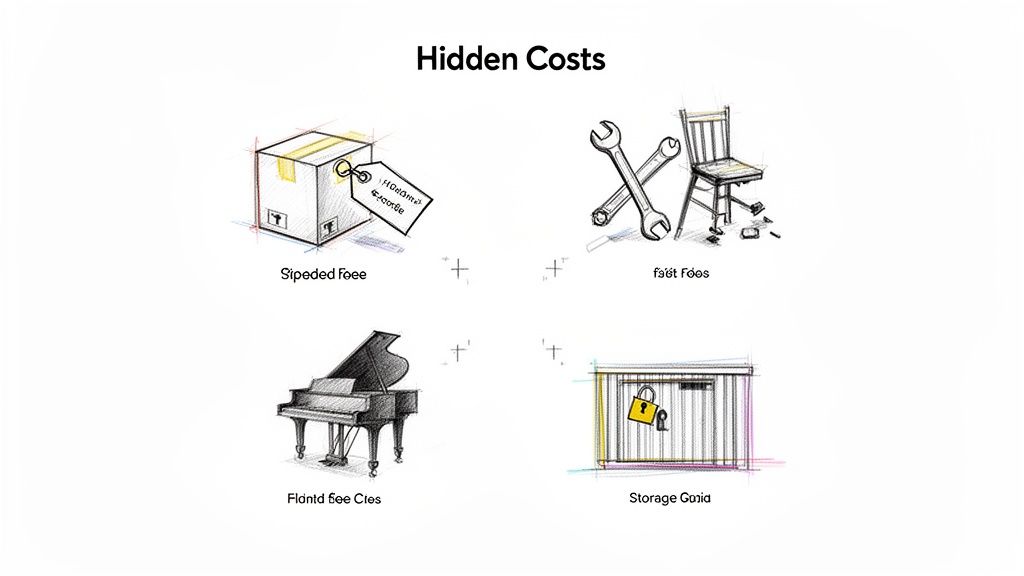
Unpacking the Hidden Costs of Moving
The price on your removal quote is just the starting point. When you’re trying to pin down exactly how much it costs to move, it’s often the extra services and surprise charges that can really stretch your budget. These aren’t necessarily ‘hidden’ fees from a dodgy mover; more often than not, they’re optional services or unavoidable extras that simply aren’t part of a standard A-to-B transport job.
Think of it like booking a flight. Your ticket gets you a seat, but checking in luggage, choosing your seat, or getting a meal all cost extra. Moving is much the same. The basic quote covers the crew loading your boxes, driving the lorry, and unloading at the other end. But what about packing, taking the beds apart, or storing things for a week? Those are the ‘checked bags’ of the moving world.
Getting a clear picture of these potential add-ons right from the start is the best way to avoid a budget blowout and any last-minute stress on moving day. It’s all about seeing the whole financial picture, not just the transport fee.

Professional Packing Services
Let's face it, packing is the one task everyone dreads. This is why a professional packing service is such a popular add-on—it saves a massive amount of time and hassle. The crew shows up with all the right materials (boxes, tape, bubble wrap, the lot) and gets your entire home packed up with practiced efficiency.
- Full Packing: The team packs absolutely everything for you. This will typically add £300 to £600 to your final bill, depending on how much stuff you have.
- Fragile Packing: A great middle-ground option. The pros handle just the delicate items like glassware, china, and artwork, leaving you to do the rest. Expect this to cost somewhere between £150 and £300.
Dismantling and Reassembling Furniture
That huge IKEA wardrobe isn't going through the door in one piece, and neither are the kids' bunk beds. Most removal crews are happy to dismantle bulky items at your old place and put them back together again in your new home. It’s a real lifesaver, especially if you've lost the instructions for that complicated flat-pack chest of drawers.
This is usually charged by the hour, typically around £30 to £50 per hour for each crew member. A big wardrobe might take an hour to take down and another to build back up, which can add a noticeable amount to the final invoice.
Handling Specialist and Bulky Items
Got a grand piano, a delicate antique grandfather clock, or a hefty snooker table? These things aren't just 'another box'. They need specialist equipment, extra muscle, and genuine expertise to be moved without damage, and they are almost never included in a standard quote.
For example, moving a piano is a highly skilled job. The cost can start from £150 for an upright piano with easy access and climb to over £500 for a grand piano that has to be navigated up a flight of stairs.
Always mention these items when you're getting a quote. The extra cost covers the specialised care needed to protect your most treasured possessions.
Temporary Storage Solutions
Sometimes the dates just don’t align perfectly. You might need to be out of your old place before you can get the keys to the new one. This is where temporary storage comes into play. Most professional removal firms offer secure, containerised storage facilities as part of their service.
The cost depends on how much you need to store, but in the UK, you can expect to pay between £80 and £150 per week for a 200 sq ft container—usually enough space for the contents of a three-bedroom house.
Insurance and Other Charges
Finally, don't forget insurance. While any reputable mover will have Goods in Transit insurance, it might have limits on its cover. It's vital to ask what’s included and decide if you need extra protection, especially for high-value items. You can find out more in our guide on the essentials of insurance for removals.
Beyond the removal service itself, you also need to account for other expenses, especially if you're selling a property. It's wise to understand what are closing costs when selling a house so you can build a truly realistic moving budget with no nasty surprises.
Smart Strategies to Lower Your Moving Expenses
Knowing what goes into a moving quote is one thing; using that knowledge to your advantage is where you can really save some money. Trimming your removal costs doesn’t have to mean compromising on a professional service. With a bit of smart planning, you can knock a surprising amount off the final bill without piling on the stress.
Think of it as fine-tuning your move. A few savvy decisions can easily trim hundreds of pounds from your budget. That’s cash better spent on making your new place feel like home. The trick is to focus on the things you can actually control, like how much you’re moving and when you decide to do it.
Declutter Before You Pack
This is, without a doubt, the single most effective way to cut down your moving bill. A huge chunk of your quote comes down to the sheer volume of your stuff. Less stuff means a smaller van, a smaller crew, and less time spent hauling boxes. It’s that simple.
Before you even look at a roll of packing tape, go through every room and be ruthless. Sort everything you don’t need into three piles:
- Sell: Get furniture, electronics, and other valuable items onto online marketplaces.
- Donate: Drop off clothes, books, and household goods at your local charity shop.
- Dispose: Responsibly get rid of anything that’s broken, worn out, or unusable.
The goal is to only move what you truly need and love. Not only does this cut your removal costs, but it also means starting fresh in your new home without all the old clutter.
Choose Your Moving Date Wisely
When it comes to removals, timing is everything. As we’ve mentioned, demand shoots up during certain periods, and prices climb right along with it. If your schedule has any wiggle room, you can save a packet just by avoiding these peak times.
The priciest times to move are almost always Fridays, weekends, the end of the month, and the summer school holidays. In contrast, booking your move for a Tuesday, Wednesday, or Thursday can often get you a much better rate. Removal firms are quieter, so you benefit from their off-peak pricing.
Handle Some of the Grunt Work Yourself
While a full-service move where you don't lift a finger is the dream, it’s not always the most budget-friendly option. Taking on a few tasks yourself is a great way to find a happy medium between a stressful DIY move and a full-on professional service.
For instance, you could opt for a partial packing service. Let the pros handle delicate items like glassware and artwork, while you box up sturdy things like books and clothes. You could also save money by dismantling and reassembling your own beds and flat-pack furniture, leaving the heavy, awkward pieces to the experts. This hybrid approach lets you save cash where you can, while still relying on the pros for the tough stuff.
And once you’re in, you can keep the savings going. Check out these affordable interior design ideas for your new home to get settled without splashing out. By thinking strategically, you can take control of your moving budget and get the best value for your money.
How to Get a Moving Quote You Can Trust
An inaccurate moving quote is a surefire recipe for stress and a busted budget. Getting a reliable, precise estimate isn’t about guesswork; it's about following a clear process and knowing what to look for. This final step is what makes all your careful planning pay off, leaving no room for nasty surprises on moving day.
The whole point is to get a price that reflects the reality of your move, not just a vague number plucked from thin air over the phone. A trustworthy quote is built on solid information, which means the removal company needs to see exactly what they're dealing with. This is where a proper survey comes in.
The Survey Showdown: In-Person vs. Video
Not so long ago, the only way to get a proper quote was for a surveyor to come to your house with a clipboard. It worked, but scheduling it could be a real pain. Thankfully, technology now gives us a much faster, equally accurate alternative.
-
In-Person Surveys: This is the traditional method. A representative from the moving company visits your home, walks through every room, and makes a detailed list of everything that needs to be moved. It’s incredibly thorough and still a great option for very large or complex moves with lots of specialist items.
-
Mobile Self-Video Surveys: This is the modern, super-convenient option. You simply use your smartphone to record a video, walking the surveyor through your home room by room and pointing out what's staying and what's going. You can do it whenever suits you, and it gives the team the exact same visual information they need to give you a precise quote.
Both methods get the job done brilliantly, but the video survey offers a level of flexibility that's hard to beat, all without sacrificing accuracy. It’s the key to getting a detailed quote on your own schedule.
Preparing for Your Quote
To make sure the quote you receive is rock-solid, it pays to be prepared. The more detail you can give the removal company upfront, the fewer question marks there will be later on. Before you even pick up the phone or fill out a form, have this information ready:
- A Full Inventory: Be clear on exactly what’s going. Have you finished decluttering? Don't forget the loft, the shed, and the garage!
- Access Details: Think about any potential challenges. Are there tricky stairs, narrow hallways, or awkward parking restrictions at either your old or new property? Let them know.
- Specialist Items: Always mention anything that needs special care or equipment. This includes things like pianos, valuable antiques, or that ridiculously heavy piece of gym equipment.
- Extra Services: Have you decided if you need help with packing, dismantling furniture, or perhaps some temporary storage between homes?
A professional moving company will actively ask for this information. Vague details lead to vague prices, so being prepared is your best defence against unexpected costs cropping up later.
Red Flags to Watch Out For
Getting the right quote is just as much about spotting the wrong one. Some prices seem too good to be true for a reason—they usually are. Knowing what to look for in a removal company is crucial for protecting yourself from dodgy operators and cowboy outfits.
Keep an eye out for these classic warning signs:
- Quotes Without a Survey: If a company gives you a fixed price over the phone without seeing your belongings (either in person or by video), run a mile. It's a huge red flag.
- Unusually Low Prices: An exceptionally cheap quote often signals hidden fees down the line, inadequate insurance, or simply an unreliable, unprofessional service.
- Vague Terms: Your quote should be a detailed, itemised document. If all you get is a single figure scribbled in an email with no breakdown, be very wary.
By following these simple steps, you’ll be in a fantastic position to get a moving quote you can genuinely count on. It’s the final piece of the puzzle for a smooth, predictable, and stress-free move.
A Few Final Questions About Moving Costs
Even with a detailed quote in hand, you probably still have a few questions buzzing around. Budgeting for a move is a big deal, and it's natural to want to tie up any loose ends.
This section is all about giving you quick, straight-to-the-point answers to the questions we hear most often. Let's get these last few details sorted so you can feel completely confident in your plan.
Is It Cheaper to Move on a Weekday?
Yes, it really is. Most people aim to move on a Friday or over the weekend, which naturally pushes up demand and prices. If you can be flexible, you'll almost always save money.
Booking your move for a Tuesday or Wednesday is your best bet for a lower rate. Removal companies often have more diary space mid-week and are keen to fill those slots. It never hurts to ask if they have a mid-week discount – you might be pleasantly surprised.
How Much Should I Budget for Packing Materials?
This all comes down to the size of your home and how much stuff you have. As a rough guide, for an average three-bedroom house, you should probably set aside between £150 and £250. That’ll cover good quality boxes, plenty of bubble wrap, packing paper, and strong tape.
Remember, many professional movers can supply these materials for you. Or, if you opt for a full packing service, the cost of all materials is usually bundled into the price, which saves you a lot of hassle and can be great value.
Do I Need to Pay a Deposit for My Move?
Pretty much every reputable removal company will ask for a deposit to confirm your moving day. It’s standard practice across the industry and it works both ways: it secures your slot in their schedule and shows you’re committed to the booking.
A word of warning: be wary of any company demanding the full payment upfront – that’s a definite red flag. On the flip side, a company that doesn't ask for any deposit might not be treating your booking with the seriousness it deserves, which could spell trouble later on.
What Does Moving Insurance Typically Cover?
The standard insurance included by movers is called Goods in Transit insurance. As the name suggests, it covers your possessions while they’re on the lorry, travelling from A to B. But it’s really important to know that the level of cover can differ hugely from one company to the next.
Always ask to see the policy details. Check for things like value limits on a single item and read the list of exclusions. If you have particularly valuable items – think antiques, artwork, or high-end electronics – you'll likely need to arrange a separate, specialist insurance policy to make sure you're fully covered.
Planning your move in Bristol or Bath? Let the experienced team at SimplyPro Removal & Storage Ltd provide you with a transparent, no-obligation quote. Our mobile self-video surveys make it quick and easy to get an accurate price you can trust. Get your free moving quote today!