


So, you're thinking about moving your boiler. It’s one of those jobs that seems simple on the surface but has a lot going on behind the scenes. In the UK, you can expect the cost to move a boiler to fall somewhere between £500 and £1,800.
Of course, that’s a pretty wide range. A straightforward shuffle to a different wall in the same room will keep you at the lower end of that estimate. But if you’re planning a more ambitious move – say, from the kitchen up into the loft or out to the garage – you'll be looking at the higher end of the scale.
Understanding Your Boiler Relocation Costs
Getting your head around the cost of moving a boiler is much easier once you break down what the job actually entails. It’s a world away from just unplugging a fridge and plugging it in somewhere else. Your boiler is the heart of your home's heating and hot water, tied into the very fabric of your property's plumbing and gas network.
Think of it less as a simple move and more like minor surgery on your home. It’s a job that absolutely requires a Gas Safe registered engineer. They have to carefully disconnect everything – gas lines, water pipes, electrical controls – and then meticulously re-establish all those connections in the new spot.
This process almost always involves:
- New Pipework: Extending the copper pipes for your heating and hot water, which often means lifting floorboards or chasing them into walls.
- A New Flue Exit: The flue is the boiler’s exhaust pipe. It needs a new path to the outside, which means drilling a sizeable hole through an external wall.
- Condensate Drainage: Modern condensing boilers create acidic wastewater. This needs to drain away, so a new waste pipe with a constant downward slope is essential.
- Reconnecting Controls: Your thermostat and any timers need re-wiring to talk to the boiler in its new home.
This infographic gives a great visual summary of what to expect in terms of cost.
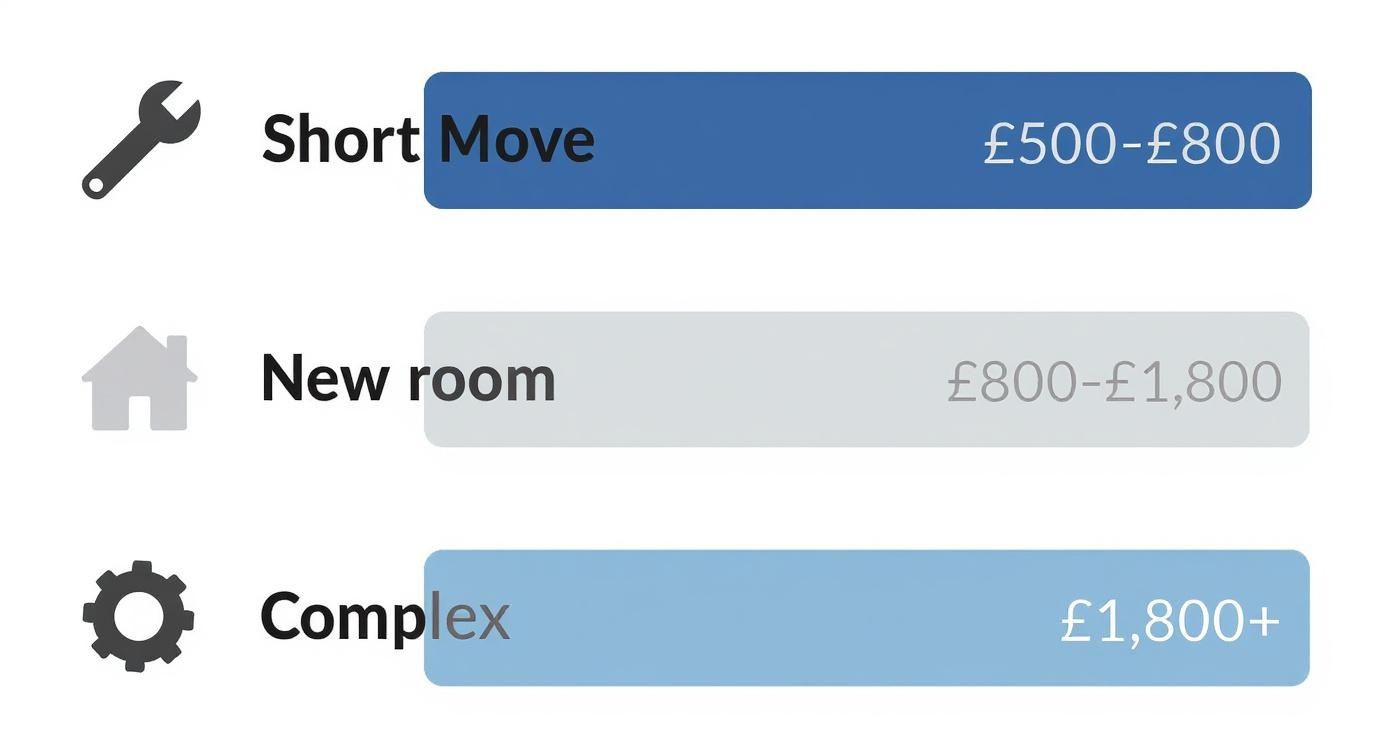
As you can see, the final bill is all about distance and difficulty. The more pipework you need and the more walls you have to go through, the more it's going to cost.
To give you a clearer idea, here’s a quick summary of what you might expect to pay.
| Estimated Boiler Relocation Costs at a Glance |
| :— | :— | :— |
| Relocation Scenario | Estimated Cost Range (UK) | Key Influencing Factors |
| Moving boiler to a new wall in the same room | £500 – £800 | Short pipework extensions, simple flue adjustment, minimal disruption. |
| Moving boiler to an adjacent room | £750 – £1,200 | Longer pipe runs through walls/floors, potential for new flue hole. |
| Moving boiler to a different floor (e.g., kitchen to loft) | £1,000 – £1,800+ | Extensive new pipework, new flue installation, complex drainage. |
These figures are a good starting point, but every home is different. The engineer will need to factor in your specific layout, the type of boiler, and the condition of your existing pipework.
Key Takeaway: The cost isn't just for lifting the boiler. It's for the skilled, specialist work of re-routing the gas, water, and waste systems that your home depends on. Every extra metre of pipe adds to the time and materials, and that's reflected in the final bill.
While this guide dives deep into boiler relocation, it’s often just one part of a bigger home improvement or moving project. For a complete overview of other potential expenses, this UK moving cost calculator for 2025 is a fantastic tool for budgeting. In the next sections, we’ll break down these costs even further.
Decoding Your Boiler Relocation Quote: What You're Really Paying For
When a quote for moving your boiler lands in your inbox, it can look like a long list of technical terms and figures. But it's far more than just a single price; it’s a detailed breakdown of the skilled work and essential parts needed to safely and legally move the heart of your home's heating system. Getting your head around what each line item means is the key to comparing quotes fairly and understanding the true scope of the job.
The first and most significant cost you'll see is labour. This isn't just for a bit of heavy lifting. This is for the specialist expertise of a Gas Safe registered engineer. Their time covers the whole process: safely decommissioning the boiler, draining your entire heating system, meticulously planning and fitting new pipework, drilling for the flue, and finally, recommissioning and testing everything to make sure it's perfectly safe.
Labour costs typically make up a hefty 60-70% of the total bill, which reflects the 1-2 days of complex, precision work involved. You're paying for peace of mind, safety, and the legal compliance that only a qualified professional can guarantee.
The Core Materials Bill
Beyond the engineer's time, the quote will list all the physical bits and pieces needed for the move. Think of these as the nuts and bolts of the operation. The final tally for materials is directly tied to how far you're moving the boiler and how complicated the new route for the pipework is.
Here are the main materials you should expect to see listed:
- Copper Pipework and Fittings: This is for extending the central heating, hot and cold water, and all-important gas supply pipes to the boiler's new spot. The more copper needed, the higher this cost will be.
- New Flue Kit: A boiler’s exhaust has to be vented safely outside. This almost always means a new flue pipe, a few elbow joints, and a terminal for the external wall are required.
- Condensate Pipe: Modern boilers produce a small amount of acidic water that needs its own plastic waste pipe. This has to be installed with a continuous downward slope to stop it from freezing and causing a blockage in winter.
- Brackets and Fixings: These are the heavy-duty supports needed to securely mount your (surprisingly heavy) boiler to the wall in its new home.
These core components are completely non-negotiable for a safe and working installation. This is one area where cutting corners simply isn't an option.
Uncovering the Hidden Extras
A proper, professional quote will also include items that protect your heating system's long-term health and ensure the job is finished correctly. These are often the "hidden" costs that a cheaper, less-detailed quote might leave out, only to surprise you with them later. A good engineer is upfront about these from the start.
Engineer's Insight: A quality quote isn't just about moving a box from A to B. It’s about making sure the entire system works better and lasts longer after the move. That means cleaning out the system's "arteries" and protecting it from future problems.
Keep an eye out for these crucial additions on your quote:
- Chemical System Flush: Before firing the boiler back up, the engineer should perform a system flush. This involves adding powerful cleaning chemicals to the radiator water to break down and shift any existing sludge, rust, and grime from your pipes and radiators. A clean system is an efficient system.
- Magnetic System Filter: This is a fantastic investment for the health of your boiler. A magnetic filter is fitted onto the pipework returning to the boiler and cleverly catches any metallic sludge (called magnetite) before it can get inside and damage the boiler's delicate and expensive parts. Most boiler manufacturers now insist on one to keep your warranty valid.
- Inhibitor Fluid: Once the system is clean, a chemical inhibitor is added. This liquid gold protects the inside of your pipes and radiators from future rust and sludge build-up, keeping everything running smoothly for years.
- Making Good: This covers the basic plastering needed to fill the hole where the old flue used to be and patch up any walls that had to be chased out for new pipes. It's worth noting this rarely includes re-decorating—that's usually a job for you to sort afterwards.
While these extras add to the initial cost, they are absolutely vital for efficiency and longevity. A boiler relocation without a flush and filter is a job half-done, risking damage to the very appliance you've just paid a lot of money to move.
It's also worth remembering that this project is often part of a bigger picture. To budget effectively for a whole house move, understanding the average cost of moving companies can give you a clearer view of your total expenses.
So, What Really Drives Up the Final Price?
When you start getting quotes to move your boiler, you'll probably notice they're all over the place. That's not engineers just plucking numbers from thin air. The final price is a direct reflection of your home’s unique quirks and the real-world demands of the job. Figuring out these variables is the key to understanding why one quote might be £700 and another hits £1,500.
A few core factors really push the price up, each adding extra complexity, time, and materials to the project. From the type of boiler you’ve got to its new home up in the loft, every single detail has a price tag. Let's get into what those key drivers are.
Your Boiler's Type and Age
Believe me, not all boilers are the same, especially when you're talking about uprooting them. The kind of system you have is one of the first things that will dictate the cost.
- Combi Boilers: These are generally the most straightforward and cheapest to move. It's a single, neat unit, so the engineer just needs to re-route the gas, hot and cold water pipes, and the flue. Job done.
- System Boilers: Things get a little more complicated here. These work with a separate hot water cylinder, which adds another piece to the plumbing puzzle and can bump up the labour time.
- Regular (Conventional) Boilers: Often, these are the most expensive to shift. You've got the boiler, a hot water cylinder, and a cold water feed tank (usually stashed in the loft). Moving this three-part system is a much bigger undertaking, involving a lot of new pipework and a lot more man-hours.
An older boiler can throw a spanner in the works, too. If your unit is over a decade old, an engineer might uncover corroded fittings or old pipework that simply isn’t safe anymore. That means extra parts and labour you hadn't budgeted for. It’s why so many people decide to just replace an old boiler rather than pay to move it.
The Distance of the Move
This one's pretty obvious. Think of it like a taxi fare—the further you go, the more you pay. Shifting a boiler from one wall to the adjacent one in the same room is a relatively small job. The engineer just needs to add some short extensions to the existing pipes.
But moving it from the kitchen to an airing cupboard upstairs? That's a completely different ball game. That kind of journey requires:
- A whole lot more copper pipe.
- More time spent lifting floorboards or chasing pipes into walls.
- A brand new route for the flue, which means drilling through an external wall.
Every metre of pipe, every hole drilled, and every hour of work adds directly to the final bill. The longer and more fiddly the new pipe runs are, the higher your quote will be.
Key Insight: The journey is just as important as the destination. A short, straight run for new pipework will always be cheaper than a complex route that has to navigate around obstacles or through multiple floors.
The New Boiler Location
Where you decide to put your boiler has a huge impact on the project's complexity and cost. Some spots present unique challenges that need extra work and materials just to meet the strict safety regulations.
Moving a boiler isn't just a one-off task; it's tied into the bigger picture of your home's running costs. For context, government data adjusted for 2025 shows a typical new combi boiler installation can cost around £2,820. While moving is cheaper, a tricky new location can push your costs up. It explains why homeowners see quotes that vary wildly, from £1,800 to over £5,000 for what seems like similar work—it all comes down to the specifics of the property. You can explore more about these official cost breakdowns to see how it all adds up.
Let's look at a few popular relocation spots:
- Loft or Attic: This is a great way to free up valuable living space, but it's often one of the most expensive moves. You’re looking at long pipe runs, a new flue through the roof (which is trickier than through a wall), and a properly insulated condensate drain pipe to stop it from freezing in winter.
- Garage: Another good choice for getting the boiler out of earshot, but it comes with similar challenges to a loft. The boiler will need frost protection, and the engineer has to make sure the long pipe runs don't cause a drop in water pressure or heat loss.
- Airing Cupboard: A classic spot, but space can be tight. The engineer must leave enough clearance around the boiler for future servicing, as required by law. If the cupboard is on the small side, it can make the installation more awkward and time-consuming.
At the end of the day, the cheapest location is always the one that needs the least amount of new pipework and the simplest flue installation.
Your Boiler Relocation Timeline From Quote to Completion

Knowing how much it costs to move a boiler is one thing, but understanding what the job actually involves from start to finish is just as important. It helps you brace for the disruption. Let’s be clear: this isn’t a one-and-done job. From that first phone call to the final safety certificate, moving a boiler is a methodical process, usually taking a few solid days of work.
It all starts with getting a proper quote. Any trustworthy Gas Safe engineer will tell you they can't price a job like this over the phone. They need to see it in person. They’ll arrange a visit to walk through your home, chat about where you want the boiler to go, and get a good look at your current heating setup.
During this survey, they'll be measuring up, figuring out the best route for the new pipework, and pinpointing the safest, most compliant spot for the new flue to exit. This initial chat is absolutely vital for getting a detailed, accurate quote that covers everything, so you don't get hit with unexpected costs later on.
Day One: The Strip-Out and Prep Work
Once you've given the go-ahead, the real work starts. Day one is all about prep. The engineer's first job is to safely shut down your old boiler, turning off the gas and electricity to make it safe.
Next up, they'll drain your entire central heating system. This can take a while, as every drop of water needs to come out of the radiators and pipes. Once the system is empty, the messy part begins: running the new pipework. This is often the most disruptive stage, potentially involving lifting floorboards, cutting channels into walls, and drilling through joists to create the new path.
Day Two: Reconnection and Installation
With the new pipe routes established, day two is all about mounting the boiler in its new spot and getting it all hooked up. Your engineer will securely fix the boiler to the wall, making sure it’s dead level and has all the correct clearances needed for future servicing.
This is the day all the critical connections are made:
- Gas Supply: The new gas pipe is run, connected, and rigorously tested for any leaks.
- Water Pipes: Your central heating flow and return pipes, along with the hot and cold water supplies, are soldered into place.
- Flue Installation: A large core drill is used to make a new hole through your external wall for the flue, which is then fitted and sealed tight against the weather.
- Condensate and Electrics: The small plastic condensate pipe is connected to a waste drain, and the boiler is rewired to its power source and controls.
Be Prepared: During this 2-3 day period, you're going to be without heating and hot water. It’s a good idea to plan the job for the warmer months if you can. If not, get some electric heaters ready, especially if you have vulnerable family members at home.
Day Three: Commissioning and Handover
The final day is all about safety, performance, and paperwork. The engineer will start by refilling the entire heating system, adding a special chemical inhibitor to protect your pipes and radiators from sludge and corrosion down the line.
Then comes the official part: "commissioning" the boiler. This is a series of manufacturer-mandated checks to ensure it’s running safely and at peak efficiency. It involves testing flue gas emissions, checking the gas pressure is spot-on, and making sure all the safety cut-outs work perfectly.
Once they're happy with everything, the engineer will register the installation with Gas Safe. You'll then receive a Building Regulations Compliance Certificate in the post. To finish, they'll walk you through how to use your new system, answer any questions, and leave you to enjoy your home—and your newly freed-up space.
Who Can Legally Move Your Boiler? Safety, Regulations, and Getting it Right
When you're working out the cost of moving a boiler, the most important factor isn't measured in pounds and pence—it’s safety. This is the one part of the project where there is absolutely no room for cutting corners. The law in the UK is black and white on this, and for good reason: it’s designed to protect you and your family from the very real dangers of bad gas work.
Let's be perfectly clear: only a Gas Safe registered engineer is legally allowed to touch your gas boiler. That means disconnecting it, moving it, and reconnecting it. This isn’t a guideline or a 'best practice' recommendation; it's a legal requirement. Hiring someone who isn't on the Gas Safe Register is not just a massive risk, it's also a criminal offence for both you and the person doing the work.
What is the Gas Safe Register?
Think of the Gas Safe Register as the official, government-approved list of every single engineer in the UK qualified to work safely and legally on gas appliances. To get on that list—and stay on it—engineers have to go through tough training and regular assessments to prove they know exactly what they're doing. It's the only official gas registration body for Great Britain.
When an engineer turns up at your door, they should have their Gas Safe ID card with them. This card is your proof they're legit. It even details the specific types of gas work they're qualified for. Don't be shy—always ask to see it before they start.
Crucial Takeaway: Letting an unregistered person work on your boiler is like asking a first-aid trainee to perform surgery. The potential consequences—gas leaks, fires, explosions, and silent but deadly carbon monoxide poisoning—are just not worth thinking about.
Understanding Key Building Regulations
It's not just about being Gas Safe registered. The new installation also has to meet current UK Building Regulations. Your engineer will take care of all the technical details, but knowing the basics helps you understand why they might say a certain location won't work. These rules are all about making sure your boiler runs safely and efficiently.
Two of the most common regulations you'll encounter are:
- Flue Placement: The boiler’s exhaust pipe (the flue) can't be positioned too close to windows, doors, air bricks, or your neighbour's boundary. This is vital to stop poisonous fumes from getting back into your home or your neighbour's.
- Condensate Pipe Installation: Modern condensing boilers produce a small amount of acidic water that needs to drain away. This pipe must have a constant downward slope and, if it runs outside, be properly insulated. This stops it from freezing solid in winter, which would cause your boiler to shut down right when you need it most.
The All-Important Compliance Certificate
Once the job is done and dusted, your Gas Safe engineer has a final task: they must register the work with your local authority. A few weeks later, you'll receive a Building Regulations Compliance Certificate in the post.
Hold onto this document! It’s your official proof that the work was done legally and safely. You’ll need it if you ever claim on your home insurance or when the time comes to sell your property.
Even if you decide against moving your boiler, keeping it in top condition with a professional boiler service is essential for safety and keeping your bills down. While the engineer handles the critical gas work, you might be left with some plastering or redecorating. For these non-gas jobs, calling in some professional handyman services in Bristol can be a smart move to get everything looking perfect again.
Practical Ways to Reduce Your Boiler Relocation Costs
While moving a boiler is never going to be cheap, the initial quote you get doesn't have to be the final word. With a bit of savvy planning, you can genuinely chip away at the total cost without cutting any corners on safety or quality. It’s all about making smart choices.
The best thing you can do to get a fair price is to get at least three detailed, itemised quotes from different Gas Safe registered engineers. This isn't just about hunting for the lowest number; it's about seeing exactly what's included. A cheap-looking quote might leave out essentials like a system flush or a magnetic filter, which you'll only have to pay for down the line anyway.
Be Strategic with Your Timing and Planning
When you schedule the work can make a real difference. Unsurprisingly, engineers are flat out during autumn and winter when everyone's heating is on full blast. If you can wait, try booking the job in for spring or summer. You'll often find they have more diary space and might offer a keener price to keep things ticking over.
The distance the boiler is moving is also a huge factor. The maths is simple: a shorter move means less copper pipe, less time spent running it, and a lot less disruption.
Pro Tip: When you’re walking through the options with your engineer, ask them straight up which spot would be the simplest and shortest pipe run. Shifting the boiler a few feet along the same wall will always be significantly cheaper than moving it to the other side of the house.
Just asking that one question could easily save you hundreds of pounds in labour and materials.
Consider a Smart Division of Labour
Now, let's be clear: any work involving the gas supply is strictly for a registered professional. But there are often other jobs you can tackle yourself to bring the labour costs down. The key is to discuss this and agree on it with your engineer before they start.
Here are a few things you might be able to handle:
- Chasing Walls: If you're handy, you could cut the shallow channels into the plaster or brickwork where the new pipes will be hidden.
- Lifting Floorboards: Carefully prying up floorboards to give the engineer clear access saves them a lot of time.
- Making Good and Redecorating: Once all the technical work is done, you can take over the plastering, filling, and painting to finish the job.
By doing this "pre-work" and "post-work" yourself, you free up the engineer to focus purely on the skilled gas and plumbing work. This can shave a good few hours off their final bill and gives you complete control over how the finished room looks.
Got a Question About Moving Your Boiler? We’ve Got Answers
Even the best-laid plans can leave you with a few nagging questions. Relocating a boiler is a big job, after all. Here are the answers to some of the most common queries we get from homeowners, helping you get everything straight before the work begins.
Can I Put My Boiler Anywhere I Want?
In theory, yes, but in practice, it’s not quite that simple. Every potential spot has to tick a lot of boxes when it comes to safety and building regulations.
A Gas Safe engineer is the only person who can give you the final green light. They’ll check for a safe and compliant route for the flue to an outside wall, make sure there’s enough ventilation, and see if a condensate drain pipe can be properly installed.
Utility rooms, kitchens, and garages are common choices. While putting a boiler in the loft or garage is definitely possible, be prepared for it to be a more complex and expensive job. You're dealing with much longer pipe runs, the need for frost protection for the unit and its condensate pipe, and potentially a more disruptive installation to get the flue through the roof.
Do I Need to Tell My Home Insurance Company?
Absolutely, yes. We strongly recommend you let your home insurance provider know you're moving your boiler. This is a major change to your home's heating system, and they will almost certainly see it as a "material change" to your policy.
Keeping them in the dark isn't worth the risk. If you ever needed to make a claim related to the new installation, you could find your policy is void. Once the work is done and you have the Gas Safe certificate, send them a copy – it’s your proof that everything was done professionally and by the book.
Is it worth moving an old boiler? This is a critical financial decision. If your boiler is over 10 years old, inefficient, or always seems to be on the blink, spending hundreds of pounds to move it is probably throwing good money after bad. It often makes far more sense to put that money toward a new, A-rated energy-efficient boiler instead.
Should I Just Replace It Instead of Moving It?
This is the big question. A brand-new boiler won't just save you money on your energy bills; it will also come with a solid manufacturer's warranty, usually for anywhere between five and ten years.
Think about that for a moment. You get long-term value and complete peace of mind, which is something you just don't have when moving an ageing, out-of-warranty appliance. A good engineer can take a look at your current boiler's age and condition and give you an honest opinion on the best way forward.
Planning a bigger home move at the same time as your boiler relocation? For a stress-free experience in Bristol and Bath, trust the experts at SimplyPro Removal & Storage Ltd. Get your free, no-obligation moving quote today!