


When it comes to moving house, the secret to staying sane is all about good timing and even better organisation. Trying to do everything at once is a recipe for disaster. But if you break the whole process down into a simple timeline, what feels like chaos can become a smooth, manageable plan that seriously cuts down the stress.
Your Moving Timeline from Two Months Out to Day One
Believe it or not, a successful move doesn't start the week before the van arrives. Giving yourself a good eight-week runway makes all the difference. It provides plenty of breathing room to sort everything from decluttering and booking movers to tackling all that dreaded admin. A clear timeline isn't just helpful; it's probably the most valuable tool you'll have for the entire move.
By spreading everything out, you avoid that last-minute panic. The first few weeks are for the big-ticket items, like researching and locking in your removals firm. As the day gets closer, your focus naturally shifts to the nitty-gritty details—packing boxes, calling utility companies, and getting your post forwarded.
Eight Weeks Before Your Move
It all starts with a plan and a good, old-fashioned clear-out. Now is the perfect time to take a proper look at everything you own and decide what's actually coming with you. Getting this done early means less to pack, less to move, and way less to unpack on the other side.
- Research and Book a Removal Company: Start getting quotes from trusted local firms. Good companies get booked up months in advance, especially during the summer rush.
- Declutter Like You Mean It: Work your way through the house, one room at a time. Make three piles: keep, donate/sell, and bin. Be honest with yourself—if you haven't touched it in a year, it's probably time for it to go.
- Get Your Paperwork in Order: Pull together all your vital documents—passports, birth certificates, insurance policies, you name it. Pop them all in a single, safe folder that you can grab easily.
This is also the time to flag any specialist items you might have. If there's a piano, a fragile antique, or complex IT equipment in the mix, have a chat with your chosen removal company right away to make sure they've got the skills and gear to handle it properly.
This handy infographic gives you a bird's-eye view of the key milestones, helping you stay on track from start to finish.
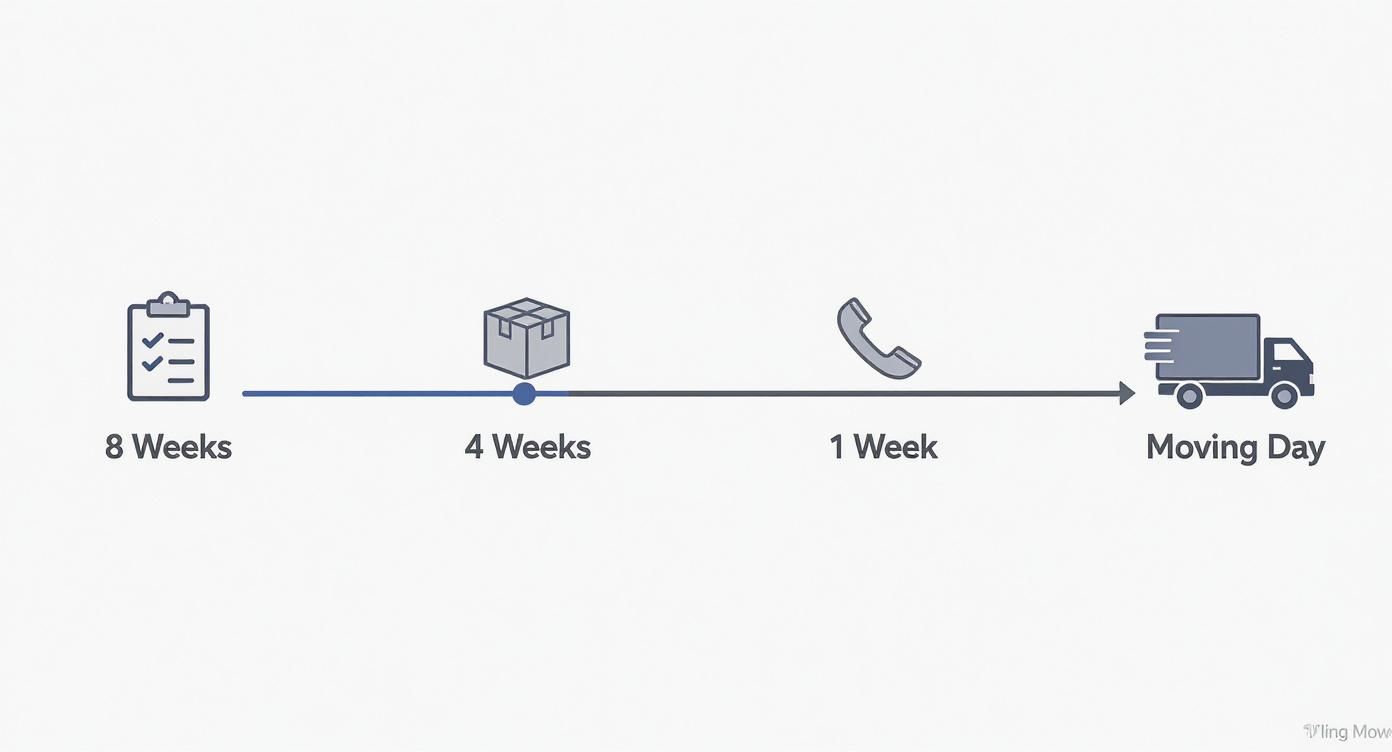
As you can see, the tasks ramp up as you get closer to the big day, moving from long-range planning to hands-on action.
To help you keep track, here's a quick summary of what your timeline should look like.
Your 8-Week Moving House Timeline
| Timeframe | Key Actions & Responsibilities |
|---|---|
| 8 Weeks Out | Confirm move date. Research & book removal company. Start decluttering. Gather important documents. |
| 4 Weeks Out | Order packing supplies. Begin packing non-essential items. Notify utility providers. |
| 2 Weeks Out | Arrange mail redirection. Confirm details with removals team. Pack majority of belongings. |
| 1 Week Out | Defrost freezer. Pack an "essentials box". Finish last-minute packing. Settle outstanding local bills. |
| Moving Day | Take final meter readings. Do a final walkthrough. Supervise the move. Collect keys to new home. |
This table acts as a great cheat sheet, but remember to tailor it to your own specific needs.
Four Weeks to Go
With a month until the move, things start getting real. Your removals firm should be confirmed, and it's time to get serious about packing and sorting the final admin. Now's the time to start boxing up all the things you don't use day-to-day.
It’s worth thinking about when you move, too. August is typically the busiest month for moving in the UK, and Friday is by far the most popular day—accounting for 34% of all moves. Everyone wants that weekend to settle in! The downside is that it means roads are busier and removal firms are stretched. For a full rundown of every little task, our comprehensive moving house checklist has you covered.
From experience, choosing a mid-week move or picking a date outside of the summer holidays can make a world of difference. You’ll often find it’s cheaper, and with fewer people on the move, everything feels a little less frantic.
One to Two Weeks Before Moving Day
The final fortnight is all about action. Your packing should be in full swing, and the priority now is to lock in all the final arrangements and get ready for the day itself.
- Notify Utility Providers: Give your gas, electricity, water, and internet providers a call. Let them know your move-out date and where to send the final bill. Don't forget the council tax, either.
- Redirect Your Mail: Head to the Royal Mail website and set up mail forwarding. It's a small task that saves a massive headache later.
- Pack Your "Survival Kit": This is a non-negotiable. Put together one box with everything you'll need the second you walk into your new home: the kettle, tea bags, mugs, phone chargers, loo roll, a few basic tools, and maybe a bottle of something celebratory.
You might also want to schedule a deep clean of your old place. Leaving it spotless is not only courteous but often a requirement for getting your full deposit back. For more on this, check out this helpful a guide to professional move out cleaning services.
The Final Week and Moving Day
You're on the home stretch! This last week is for tying up loose ends. Double-check the plan with your removal company, finish off the last of the packing, and get your old home ready to hand over.
On moving day itself, the main jobs are taking final meter readings, doing one last sweep of every room (check those cupboards!), and making sure you've got the keys for your new place. If you've followed the timeline, you'll be organised, prepared, and ready to start your next chapter without breaking a sweat.
Smart Packing Strategies for an Easier Unpack
Let’s be honest, packing can feel like the biggest chore of the entire move. But trust me, a bit of strategy here pays huge dividends later. It’s not just about chucking things in boxes; it's about making your life infinitely easier when you're unlocking your new front door.
Think of it as setting up your future self for success. A few smart choices now will save you from the classic moving day nightmare: tearing open twenty boxes just to find the kettle. Get this right, and you'll be enjoying a cuppa in your new kitchen in no time.
Choosing the Right Packing Materials
The foundation of a successful pack is solid materials. Trying to save a few quid on flimsy boxes is a classic false economy that often ends with a smashed vase or a box bottom giving way at the worst possible moment.
Here's what you absolutely need:
- Double-Walled Boxes: These are your workhorses. For anything with a bit of weight—books, pots and pans, tools—these are a must. They’re built to handle the load without buckling.
- Specialty Wraps: Bubble wrap and packing paper are your best friends for protecting anything delicate. Use paper to scrunch up and fill any empty space in boxes; it stops things from rattling around and breaking in transit.
- Wardrobe Boxes: A genuine game-changer. These tall boxes have a hanging rail inside, so you can move your clothes straight from your wardrobe to the box and back again. No folding, no ironing, no fuss.
And of course, don’t forget plenty of strong packing tape and a good, thick marker pen. Your future self will thank you.
Master the Room-by-Room System
The only sane way to approach packing is one room at a time. It keeps the chaos contained and gives you a clear sense of progress. Whatever you do, resist the temptation to mix items from the kitchen with things from the bedroom—it creates a logistical nightmare when you unpack.
As you go, create a simple inventory. Number each box and jot down a quick summary of what's inside on your phone or in a dedicated notebook. "Box #12 – Kitchen – Mugs & Kettle" might seem like overkill now, but it’s a lifesaver when you're desperate for a brew. For a deeper dive, our guide on how to pack for moving has even more detail.
Your most important box is the ‘Day One Essentials Box’. This is the last thing that goes on the van and the first thing that comes off. Pack it with everything you'll need straight away: the kettle, tea bags, mugs, phone chargers, a small tool kit, loo roll, hand soap, and maybe a bottle of something to celebrate with.
Labelling That Actually Works
An effective labelling system is what separates a smooth move from a stressful one. The goal is simple: know exactly where a box goes and what’s in it without having to open it.
Here’s a tried-and-tested method:
- Destination Room: Write the room it's going to in big, bold letters on the top and at least two sides. Think "KITCHEN" or "MAIN BEDROOM".
- Brief Contents: Underneath the room name, add a few key items. This helps you prioritise. "Pots & Pans" is a box you'll need sooner than "Cookbooks".
- Fragile Warning: For anything delicate, scrawl "FRAGILE" and draw arrows pointing up. This gives your items the best chance of arriving in one piece.
This simple system means the removals team can put every box in the right room, saving you the back-breaking job of shifting them later. If the thought of all this is still a bit much, you can always explore professional packing help for moving. A little bit of planning makes all the difference.
Moving Pianos, Antiques, and Other Awkward Items

Let's face it, not everything you own will happily slot into a standard cardboard box. Pianos, priceless antiques, and that huge wardrobe you somehow got into your bedroom present real challenges. Moving them requires more than just brute strength; it demands specialist knowledge, the right gear, and a whole lot of care.
Getting this bit wrong can lead to heartbreaking, irreparable damage to your treasured items, not to mention scrapes and gouges in the walls of both your old and new homes.
Trying to shift these items yourself is a massive risk. An upright piano, for instance, can easily weigh over 360 kilograms. That’s a serious hazard if handled incorrectly. This is where professional expertise isn't just a convenience—it's an absolute necessity.
Tackling Bulky and Fragile Furniture
Antique furniture, beautiful as it is, can be incredibly delicate. Its joints may have weakened over decades, and finishes can be easily marred. Each piece needs its own game plan before you even think about lifting it.
- Disassembly Is Your Friend: If you can, carefully take apart items like four-poster beds or large wardrobes. Keep every single screw and fitting in a clearly labelled bag and tape it securely to the main part.
- Protect Every Surface: Use thick, heavy-duty moving blankets and shrink wrap to guard surfaces against scratches and knocks. Pay extra attention to corners and delicate carvings, using foam padding for that added layer of security.
- Measure Everything. Twice: Before moving day arrives, measure your bulky items and all the doorways, hallways, and stairwells you'll need to navigate. It’s a gut-wrenching feeling to get a sofa to your new home only to realise it won't fit through the front door.
For extremely large pieces like American-style refrigerators, you might even need to have doors taken off their hinges. This is a job best left to the pros who can do it without damaging the door frames or the appliance.
When it comes to antiques, it’s not just about the physical move; it’s about preservation. The humidity and temperature changes inside a moving lorry can affect old wood. A professional mover will use climate-controlled transport if needed to protect your most valuable pieces.
The Unique Challenge of Moving a Piano
Moving a piano is a specialised skill, and one that should never be underestimated. You're dealing with immense weight combined with a delicate internal mechanism of strings, hammers, and keys that can be thrown out of alignment with the slightest jolt.
The process is far more complex than a simple lift. Professionals use specialist equipment like piano dollies (or 'skids'), heavy-duty straps, and ramps to guide the instrument safely. They know exactly how to distribute the weight to avoid putting stress on the piano's legs or casing. This is especially true when navigating the tight corners and staircases common in many older Bristol and Bath properties. For a detailed look at what's involved, you can learn more about professional piano movement in Bristol.
When to Call in the Experts
So, how do you decide? It all comes down to risk. While you and a few friends might be able to wrestle a standard sofa out the door, some items just aren't worth the gamble.
You should always bring in a professional team for things like:
- Pianos and Organs: Their weight and fragile inner workings make them a non-starter for DIY moves.
- Large Antiques: Especially items with delicate veneers, glass panels, or intricate carvings.
- Grandfather Clocks: The internal weights and pendulum must be secured by someone who knows exactly what they're doing.
- Oversized Appliances: Think range cookers, Aga stoves, or large fridge-freezers.
- Heavy Statues or Artworks: These often require custom crating and extremely careful handling.
Hiring a team with the right experience and equipment is the only way to ensure your most cherished—and often most awkward—belongings arrive at your new home in perfect condition. It's the ultimate peace of mind.
Finding a Removal Company You Can Trust
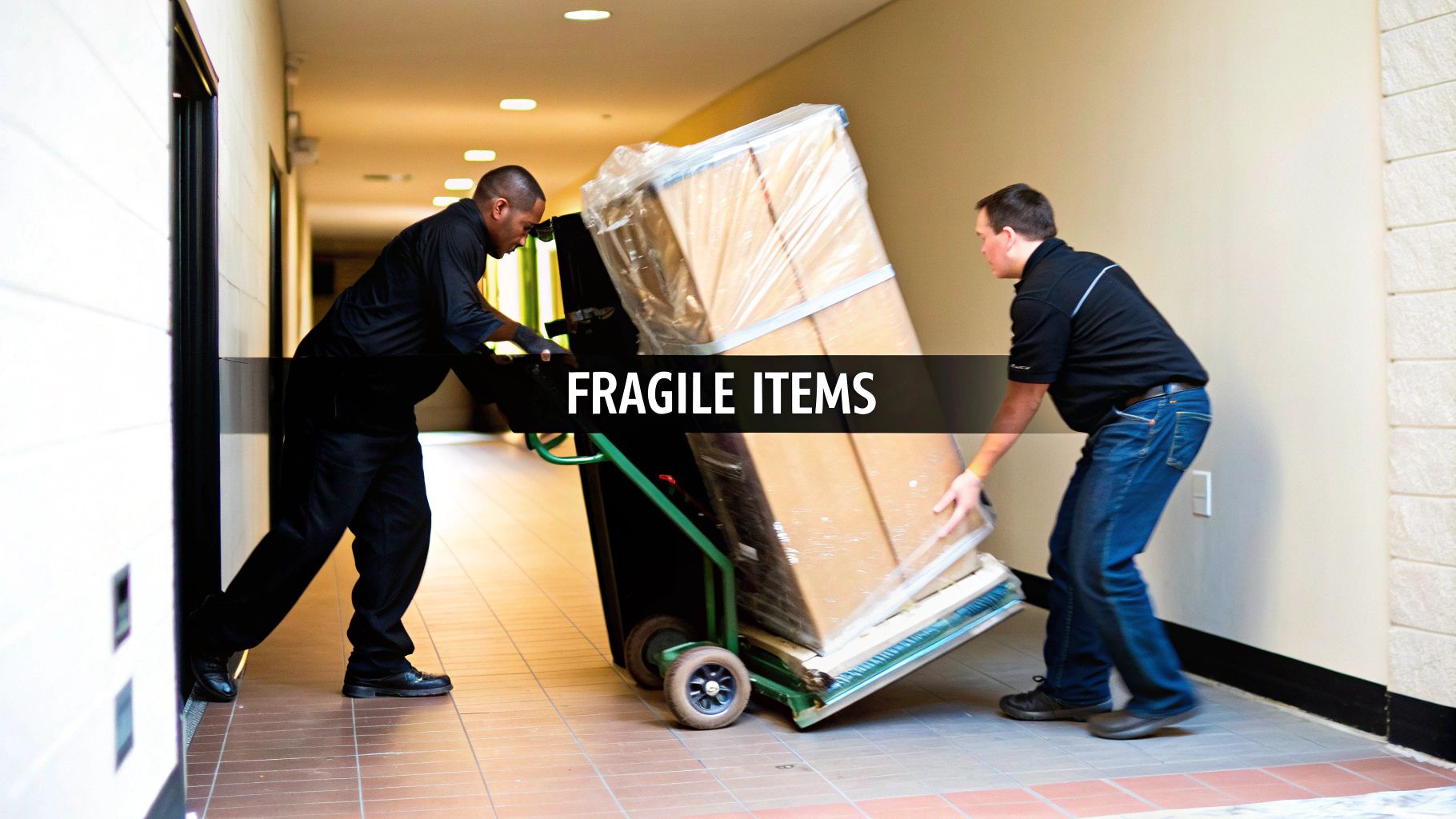
Let's be honest, choosing the right removal company is probably the biggest decision you'll make in this whole process. You’re literally handing over everything you own to a team of people. Get it right, and moving day can be a surprisingly smooth experience. Get it wrong, and it can quickly become a nightmare you'd rather forget.
It’s about so much more than just grabbing the cheapest quote. You need a crew that's professional, reliable, and properly insured. Knowing what to look for and what questions to ask will help you hire with confidence.
Checking Credentials and Reviews
Your first port of call should be to look for professional accreditations. Membership in an organisation like the British Association of Removers (BAR) is a massive green flag. BAR members are regularly audited and have to follow a strict code of practice, which gives you a safety net if anything doesn't go to plan.
Next, it's time to become a bit of a detective and dig into customer reviews. Don't just glance at the star rating; the real story is always in the comments. A few grumpy reviews aren't necessarily a deal-breaker, especially if the company has replied professionally and tried to sort things out. What you’re looking for are patterns. Do lots of people mention how punctual and careful the team was?
- Google Reviews: A great place to start for a wide range of unfiltered feedback.
- Trustpilot: Customers often leave very detailed stories of their experiences here, good and bad.
- Company Website: You'll find testimonials here, but remember they will be cherry-picked. It's always smart to check them against independent review sites.
Bear in mind that the demand for good movers can be fierce. In some cities, the market is incredibly active—Bournemouth, for example, sees a huge 38,132 moving-related searches per 100,000 residents each month. High demand means the best companies get booked up weeks, or even months, in advance. You can discover more insights about moving trends in UK cities to get a feel for your local area, but the lesson is clear: start looking early.
Understanding Surveys and Quotes
Any reputable removal company will insist on a proper survey before giving you a final quote. If someone tries to give you a fixed price over the phone based solely on the number of bedrooms, that’s a serious red flag. An accurate quote has to factor in the true volume of your belongings, access at both properties, and any tricky items you need moving.
There are two common ways to get this done:
- In-Person Survey: The traditional method. A surveyor visits your home to see everything for themselves. It’s ideal for more complex moves or if you have a lot of specific questions you want to ask face-to-face.
- Video Survey: The modern, incredibly convenient alternative. You simply walk a surveyor through your home using your smartphone's camera, pointing out everything that needs to go. It's quick, accurate, and so much easier to squeeze into a packed schedule.
We find that our self-video survey is a really popular option for our busy clients across Bristol and Bath. It gives you the pinpoint accuracy of an in-person visit but with the ease of a phone call, so you can be confident your quote is spot on.
Once you have a few quotes in hand, lay them out and compare them properly. Make sure you're comparing apples with apples. Does one price include packing materials while another adds them as an extra? Is VAT included? The cheapest quote often isn't the best value once you realise what's been left out.
Insurance: The Non-Negotiable Safety Net
This is the one area where you simply cannot afford to cut corners. At the absolute minimum, any professional moving company must have Goods in Transit insurance. This covers your possessions while they are physically in the lorry.
But that’s not all. You should also ask them about their Public Liability insurance. This is what covers any accidental damage to your property (think scuffed walls or scratched floors) or, in the worst-case scenario, injury to a person during the move.
Make sure you get clear answers to these questions:
- What's the total value your insurance covers? Does it match the value of your possessions?
- Is there an excess, and who pays it if a claim is made?
- Does the policy cover your items while they're being handled inside your home, not just when they're in the van?
A trustworthy company will be completely open about its insurance and will have no problem showing you the paperwork. That transparency is your peace of mind, ensuring you're fully protected no matter what happens on the day.
Managing Your Moving Budget and Finding Savings
https://www.youtube.com/embed/gki2r5dv79g
Let’s be honest: moving house is a big investment. Between the removal company, packing materials, and all the little costs that sneak up on you, it's easy to feel the budget stretch. The good news is that with a bit of forward-thinking and some savvy planning, you can keep a firm grip on your spending without compromising on a smooth, professional move.
The first step is always to map out a realistic budget. Get everything down on paper—big or small. This simple act gives you a clear financial picture from the start, showing you exactly where your money is going and, more importantly, where you might be able to save.
Breaking Down the Costs of Moving
To build a budget that works, you need to know what you're budgeting for. While every move is different, the major expenses tend to fall into a few predictable categories. Getting familiar with these will help you avoid any nasty surprises later on.
You’ll want to factor in:
- Removal Company Fees: This is usually the biggest single cost. It’s influenced by how much stuff you have, how far you’re going, and whether you need extra services like packing or dismantling furniture.
- Packing Supplies: Boxes, tape, and bubble wrap can add up surprisingly quickly.
- Storage Solutions: If there’s a gap between your moving-out and moving-in dates, you’ll need to account for the cost of short-term storage.
- Additional Services: Don't forget the extras. Things like a professional end-of-tenancy clean, a handyman to reassemble furniture, or specialist movers for items like a piano all come with their own price tags.
The financial side of moving in the UK has certainly become more challenging recently. Rising fuel, labour, and insurance costs have pushed prices up. As we head into 2025, you can expect to pay anywhere from £350 for a small flat removal to over £2,000 for larger homes needing a full packing service.
To put that into context, the average cost for a typical three-bedroom house move has jumped by around 30% in the last five years alone. If you're curious about the numbers, you can discover more about UK moving cost trends to see a full breakdown.
To help you visualise this, here’s a rough guide to the costs involved for a standard family home.
Typical Moving Costs Breakdown (3-Bedroom House)
An overview of potential expenses when moving a standard family home in the UK.
| Service / Expense | Average Cost Range | Notes & Cost-Saving Tips |
|---|---|---|
| Removal Service (Local) | £900 – £1,500 | Book a mid-week, mid-month date for better rates. The less you move, the less you pay. |
| Full Packing Service | £400 – £700 | Consider a "fragile-only" pack to save money. Pack clothes and books yourself. |
| Packing Materials (DIY) | £100 – £250 | Source free boxes from local shops, supermarkets, or community groups online. |
| Short-Term Storage | £100 – £200 / month | Decluttering first can significantly reduce the storage space you need to rent. |
| Specialist Item Moving | £150 – £400+ | Pianos, fine art, or antique furniture often require special handling and insurance. |
| End-of-Tenancy Clean | £200 – £450 | Compare quotes from local Bristol/Bath cleaners. Some landlords may allow a DIY clean if done to a high standard. |
This table is just a guide, of course, but it highlights how quickly the expenses can accumulate if you don't have a plan.
Smart Ways to Save Money on Your Move
With a clear budget in hand, you can start looking for clever ways to trim the costs. You’d be surprised how a few small adjustments can lead to big savings. It really just comes down to being resourceful and planning ahead.
One of the most effective cost-saving measures is also one of the simplest: declutter ruthlessly. The less you have to move, the less you'll pay. It reduces packing time, materials needed, and the size of the vehicle required.
Here are a few other proven tips to make your budget work harder:
- Be Flexible with Your Moving Date: Fridays and summer weekends are prime time for moving companies, and their prices reflect that. If you can move on a weekday in the middle of the month, you’ll almost always get a better rate.
- Source Free Packing Materials: Before you spend a penny on new boxes, ask around. Supermarkets in Bristol or Bath, local shops, and online community groups are fantastic sources for sturdy, free cardboard boxes.
- Do Some of Your Own Packing: While professional packing is a lifesaver, you can easily handle the non-fragile items yourself. Packing your own books, clothes, and bedding is a great way to cut down on labour costs. Just be sure to leave the delicate stuff to the pros.
Is Professional Packing Worth the Investment?
It might sound strange, but sometimes spending a little extra in one area can save you a lot of money and stress overall. Professional packing is the perfect example.
While it's an upfront cost, it's also your best insurance against something going wrong. Think about the true cost of a smashed TV, a badly scratched antique dining table, or a box of shattered heirlooms. Our expert packers use industry-grade materials and proven techniques to ensure everything is properly protected, massively reducing the risk of costly damage.
Curious about what it might cost for your move? The quickest way to get an accurate figure is with our self-video survey. It’s a free, no-obligation tool that lets you get a detailed quote right from your phone, helping you plan your budget with real numbers.
Got a Few Lingering Questions?
Even the most organised move can leave you with a few nagging questions. It’s perfectly normal—just when you think you’ve got everything covered, a new thought pops into your head. We get it. We’ve heard them all from our clients across Bristol and Bath.
Here are some straightforward answers to the questions we get asked the most. Getting these final details ironed out can be the difference between a frantic moving day and a smooth, stress-free one.
How Far Ahead Should I Book the Removal Company?
The golden rule is to book as early as you can, but a good benchmark is at least 4-6 weeks before your moving date. If you’re planning a move on a Friday or during the summer holidays, you’ll want to be on the front foot, as those slots get snapped up incredibly quickly.
Booking early not only guarantees you a spot with a reputable firm but can often save you a bit of money too. If you’re moving during a quieter time of year, say, mid-week in February, you might get away with 2-3 weeks' notice. But honestly, the moment you have your completion date, get on the phone. It’s one less thing to worry about.
What’s the Best Way to Handle Moving with Kids or Pets?
Moving house is unsettling enough for us, let alone for children and pets who don’t understand what’s happening. A bit of extra planning here goes a long way to keeping everyone calm.
For children:
- Give them a job. Let them pack a special box of their absolute favourite things—the toys, books, and blankets they can’t live without. Make sure this box travels with you in the car, not in the lorry.
- Plan a day out for them. If you can, arranging for a grandparent, friend, or babysitter to take them for the day is a game-changer. It keeps them safe and sound, away from all the heavy lifting and open doors.
For pets:
- Set up a safe room. On the day, pick one room (a spare bedroom or utility works well) and put your pet in there with their bed, food, water, and toys. Stick a big sign on the door so the crew knows not to open it.
- Travel together. Your pet should always travel with you in your car. It’s far less frightening for them than being in the back of a moving vehicle.
- Settle them in first. At the new place, before you let them roam, set up a room for them with all their familiar things. Let them get comfortable there before introducing them to the rest of the house.
Do I Really Need to Sort Out Parking for the Lorry?
Yes, one hundred percent. This is a small detail that can cause a massive headache if forgotten. In almost every situation, it's your responsibility to make sure the removal lorry has a legal and accessible place to park at both ends of the move.
In many parts of Bristol and Bath, this will mean applying to the council for a parking suspension or permit, especially if you’re in a residents' parking zone. Don’t leave it late—some councils need a couple of weeks' notice. Always give your removal company a heads-up about any tight streets, low bridges, or overhanging trees.
Don't just hope for the best with parking. A ticket is annoying, but finding the lorry can't get near your front door will throw your entire day off schedule and could even add extra costs. A quick call to the council is well worth the effort.
Should I Tip the Movers? And How Much?
Tipping is never expected in the UK, but it’s always hugely appreciated. If the crew has worked hard, been careful with your belongings, and made your day easier, a tip is a lovely way to say thank you.
There’s no set amount, but a general guide is around £10-£20 per person for a full day's work. Just as welcome, though, is keeping them going with plenty of tea, coffee, and cold drinks. Offering to buy them lunch is another fantastic gesture that the team will definitely appreciate.
Feeling more prepared? Now it’s time to put the plan into action. At SimplyPro Removal & Storage Ltd, we do the heavy lifting so you can focus on what matters—starting your new chapter. Our experienced Bristol and Bath teams are ready to make your move seamless, from professional packing to secure storage. Get a quick and accurate quote today with our simple self-video survey.