

Moving to another country is a monumental life event. Let's be honest, it can feel completely overwhelming. But here's the secret: finding the right international removal company is the single most important decision you'll make to transform that chaos into a calm, controlled process. This guide is designed to cut through the jargon and give you a clear, practical roadmap for moving your life across the globe.
Your Guide to a Smooth International Move

Shifting your life overseas is so much more than getting boxes from Point A to Point B. It’s a huge logistical puzzle that demands precision, specialised knowledge, and a team that has done it all before. Unlike moving down the road, an international relocation has layers of complexity that can trip you up if you don’t have an expert in your corner.
You're not just transporting furniture; you’re dealing with a maze of customs regulations, intricate shipping logistics, and country-specific rules. A genuine international removals specialist does far more than just pack and ship. Think of them as your personal project manager, there to guide you through every single stage.
What Sets a Specialist Apart
So, what’s the real difference? In a word: expertise. A dedicated international removal company lives and breathes the details that a standard domestic mover simply won’t know.
They bring a unique skillset to the table:
- Global Logistics: These companies have deep-rooted relationships with shipping lines and air freight carriers. This isn't just about getting a good price; it's about securing the most efficient and safest routes for your precious belongings.
- Customs Mastery: Their teams are fluent in the language of international paperwork. They know exactly what documentation your destination country requires, helping you avoid frustrating delays or, worse, unexpected fines.
- Destination Services: Their network doesn't end at the port. They have trusted partners on the ground in your new country to manage customs clearance, delivery to your new home, and even help with unpacking.
- Specialised Packing: The journey by sea or air is tough on your goods. They use packing materials and techniques specifically designed to withstand the rigours of a long-haul transit, which is a world away from a short trip in a van.
The demand for this level of skill is clear. The UK’s international removals sector is a significant industry, with an estimated market size hitting £1.4 billion in 2023, driven by more than 3,200 businesses. It’s a testament to how many people rely on professionals to manage these complex moves.
A successful international move hinges on proactive planning and expert guidance. The right partner doesn't just move your belongings; they move your life with care and precision, turning a stressful process into a seamless transition.
To keep everything on track, using an ultimate international moving checklist is a brilliant way to stay organised from start to finish.
We've designed this guide to give you that confidence. We'll walk you through the real-world, practical steps for choosing and working with the right removals team. Forget vague advice; we’re giving you actionable insights from years of hands-on experience. By the time you're done reading, you’ll know exactly how to find a partner who will get your belongings to your new home safely, on time, and without any nasty surprises.
How to Properly Vet Removal Companies

Choosing your moving partner is hands-down the most important decision you'll make in this entire process. A good choice means a smooth, well-managed transition. A bad one? It can lead to a world of stress, from lost possessions to unexpected fees that blow your budget.
When you're vetting an international removal company, you have to look past the glossy website and cherry-picked reviews. The real work is digging a little deeper to confirm their credibility, experience, and what they can actually deliver.
Look for Verified Credentials
First things first, check for professional accreditations. These aren't just logos to make a website look official; they're your assurance of quality and accountability. In the UK, the two heavyweights you want to see are the British Association of Removers (BAR) and FIDI, which is the global gold standard for international movers.
To become a member, companies have to jump through serious hoops, meeting strict operational, financial, and ethical standards. It’s a powerful layer of protection for you.
For instance, a company that's part of BAR's Overseas Group must follow a Code of Practice approved by the Trading Standards Institute (TSI). A key part of this is the Advance Payment Guarantee, which protects your pre-payments if the company runs into financial trouble. That’s a safety net you simply won’t get with unaccredited movers.
Once you see those logos on a company's website, don't just take their word for it. Head over to the official BAR and FIDI websites and use their member search tool to verify the company is currently listed. A legitimate firm will be proud of their credentials and make it easy for you to check.
Ask the Right Questions
Once you have a shortlist of accredited companies, it's time to find out if they're the right fit for your specific move. Moving abroad isn't a one-size-fits-all job. A company with decades of experience shipping to Australia might not be the best choice for a move to the UAE or Canada.
This is where you need to come prepared with some targeted questions. You’re trying to separate the true specialists from the generalists.
Here’s what you should be asking:
- Destination Expertise: "How many moves to [your destination country] have you handled in the past year?"
- Local Partners: "Who are your agents on the ground there? Are they also FIDI-accredited?"
- Customs Knowledge: "Can you walk me through the customs clearance process for my destination? What are the common pitfalls?"
- Shipping Options: "What are the pros and cons of a shared container versus a sole-use container for my timeline and volume?"
- Contingency Plans: "What happens if my shipment gets delayed or flagged for a random customs inspection?"
Listen carefully to their answers. A seasoned professional will respond with confidence and detail, maybe even sharing a quick story from a past move. Vague, uncertain answers are a major red flag.
Compare Quotes with a Vetting Checklist
When the quotes start rolling in, it can be easy to get overwhelmed. Prices and included services can vary wildly. To cut through the noise and make a smart decision, you need a system. A simple comparison table is your best friend here.
A word of caution: don't let price be your only guide. An unusually low quote is often a sign that corners are being cut, whether it's with cheap packing materials, inadequate insurance, or unreliable partners at the other end. The cheapest quote can quickly become the most expensive mistake.
By organising the details side-by-side, you can compare apples with apples and see who offers the best overall value, not just the lowest price tag. Our guide on how to choose the right removal company has more tips on what to look for in a quote.
To get started, we've created a simple framework to help you evaluate potential movers. Use this checklist to score each company you speak with.
International Removal Company Vetting Checklist
| Vetting Criteria | Company A | Company B | Company C |
|---|---|---|---|
| BAR/FIDI Accreditation | |||
| Experience in Destination | |||
| Clarity of Quote | |||
| Insurance Coverage Details | |||
| Reviews & Testimonials | |||
| Responsiveness of Coordinator | |||
| Total Score (out of 10) |
Tallying up the scores gives you an objective snapshot, making that final, crucial decision much clearer and less stressful.
Decoding Your Quote and Spotting Hidden Costs
https://www.youtube.com/embed/wvv7F8SSfzI
Getting that first quote for your international move feels like a huge step forward. But hold on before you celebrate the price – you need to look at this document as a contract, not just a number. Learning to read between the lines is the single best way to avoid nasty surprises and budget blowouts down the road.
Everything hinges on the accuracy of the pre-move survey. Any professional international removal company worth its salt will insist on one. These days, a video survey is standard and surprisingly effective, but for a big house packed with a lifetime of stuff, an old-school, in-person visit can still be the better bet.
Whatever the format, you have to be completely upfront. Show the surveyor everything. That means opening the cupboards, taking them out to the garage, and even trekking down to the shed. If you 'forget' about the boxes in the attic, the quote you get won't be worth the paper it's written on, and you'll be hit with extra charges on the day.
It's All About Volume, Not Just Weight
Your quote is built around the total volume of your belongings, usually measured in cubic feet or cubic metres. When you're shipping things across the world, space is the most precious commodity, far more so than weight. You're essentially paying rent for a slice of a shipping container or an aircraft's hold.
This is why you'll often hear the term volumetric weight, particularly for air freight. Think about shipping a massive box of duvets – it weighs next to nothing but takes up a huge amount of space. The carrier has to charge for that bulk, so they use a formula to calculate a 'weight' based on its size.
- Sea Freight: This is your go-to for a full house move. It's priced per cubic metre (m³) and is by far the most economical option for large shipments.
- Air Freight: Here, you're charged based on whichever is greater: the actual weight or the volumetric weight. It’s incredibly fast but comes with a hefty price tag, making it best for smaller, time-sensitive shipments.
Uncovering Those Sneaky Extra Charges
A good international mover provides a clear, itemised quote. But the reality of global logistics means some costs just can't be nailed down from the start. It’s up to you to be a bit of a detective and ask the right questions.
The biggest mistake people make? Jumping at a lowball quote. A price that seems too good to be true almost always is. It’s often a red flag that crucial services have been left out, leaving you to pick up a much larger tab later.
A suspiciously cheap quote is often missing key destination charges. What looks like a bargain upfront can easily double in price once your container lands, hitting you with unexpected fees you have no choice but to pay.
Get on the front foot and ask your move coordinator to confirm, in writing, if your door-to-door price covers these common extras:
- Terminal Handling Charges (THC): Basically, the port's fee for handling your container when it comes off the ship.
- Customs Duties & Taxes: These are set by the government of your destination country, not the mover. While they can't pay them for you, a good company should give you a decent idea of what to expect.
- Quarantine Inspection Fees: If you're heading to places like Australia or New Zealand with their strict biosecurity rules, your shipment might get flagged for a random inspection. That cost falls to you.
- Port Fees or Demurrage: If your paperwork isn't perfect and your container gets held up at customs, the port will charge you a daily storage fee. These add up fast.
- Difficult Access Charges: Is your new flat on a tiny street a massive lorry can't get down? You’ll likely have to pay extra for a smaller shuttle van to ferry your items.
- Storage Costs: If there’s a gap between your shipment arriving and you getting the keys to your new place, you’ll need to pay for storage. Find out the weekly or monthly rates beforehand.
Getting a handle on all the potential variables is essential for building a realistic moving budget. For a deeper dive, our guide on the average cost of moving companies is a great resource. Before you sign anything, go through every single line and get confirmation on what’s in and what’s out. A little diligence now will save you a world of financial headaches later.
Getting Your Paperwork and Insurance Sorted
Let’s be honest, tackling customs paperwork and insurance is probably the least exciting part of moving abroad. But getting it right is the absolute foundation of a stress-free move. This is one of those areas where a seasoned international removal company really earns its keep, turning a potential bureaucratic headache into a straightforward process.
If you get this bit wrong, you’re looking at frustrating delays, unexpected fines, or even the nightmare scenario of your shipment being sent back. It all comes down to one simple rule: be completely transparent. Customs officials need a clear, accurate picture of everything you’re bringing into their country.
Your Document Checklist: The Essentials
Think of your paperwork as a passport for your belongings. You'll need a detailed inventory list, and I mean detailed. "Box of kitchen stuff" won't cut it. It needs to read more like, "Box #7: Kitchen – 12 dinner plates, 12 side plates, 8 coffee mugs, 1 cutlery set." Your movers will guide you, but the final accuracy is on you.
Beyond the inventory, you'll need a few other crucial documents:
- Proof of ID: A clear copy of your passport photo page is non-negotiable.
- Right to Reside: You’ll need to show your visa or residence permit to prove you're allowed to live there.
- Official Customs Forms: Each country has its own forms, like the TOR1 for the UK or the 3299 for the USA. Your moving company will supply the right ones and help you fill them out.
A word of advice from years of experience: never try to hide an item or undervalue your goods to save a few quid. If a random customs inspection uncovers something you haven't declared, your entire shipment can be seized for weeks, and you'll be hit with heavy fines. Just be honest.
Making Sense of Transit Insurance
This is a big one, and it’s where a lot of people get tripped up. The standard liability offered by a mover is not the same as proper insurance. It's usually based on weight and might only pay out a tiny fraction of what your things are actually worth.
What you need is a dedicated Marine Insurance Policy. This is specifically designed to cover the risks of a long-distance move, from a storm at sea to accidental damage during handling. Any reputable international mover will offer this as a critical part of their service.
When you fill out the insurance forms, you have to be meticulous. You’ll create a ‘valued inventory’, which means putting a replacement value next to every single item. Crucially, this is the cost to buy the item new in your destination country, not what you paid for it years ago. It’s a bit of a chore, but it's the only way to make sure you’re fully covered if you need to make a claim.
It’s tempting to undervalue things to lower the insurance premium, but please don't. It’s a false economy. If you need to claim, you’ll only get back the value you declared, leaving you to cover the rest.
And while you're sorting insurance for your belongings, don't forget about yourselves. It's a good time to look into your health coverage, too. There's a great breakdown of what's involved with international health insurance for expats that can help you get started.
At SimplyPro, we walk you through this whole process step-by-step. Our coordinators check your paperwork for common mistakes before anything is submitted, drastically reducing the chances of a holdup at customs and giving you one less thing to worry about.
From Packing Day to Final Delivery
The day the removal crew pulls up to your door is when everything gets real. All the planning, the lists, the late-night worrying—it all shifts from paper to action. Knowing what to expect from the moment the first box is taped shut to the last one being placed in your new home can make a world of difference to your stress levels. This whole operation is a finely tuned process, orchestrated by your international removal company.
To Pack or Not to Pack?
One of the first big questions you'll face is whether to pack yourself or let the professionals handle it. It's tempting to think you can save a bit of cash by doing it all yourself, but for an international move, this is often a false economy.
Professional packers aren't just there to put things in boxes. They're trained to do it in a way that protects your belongings for a long, often bumpy, journey. They use export-grade materials and techniques that the average person simply doesn't have access to. We’re talking about things like specialised wrapping, double-walled cartons, and even custom-built crates for fragile or valuable items like art or family heirlooms.
Think of it this way: you spend a weekend packing your grandmother's antique china using old newspapers and supermarket boxes. After a long sea voyage, the box arrives looking a bit worse for wear, and the contents are shattered. The real sting comes when you file an insurance claim, only to have it rejected due to "insufficient packing." A professionally packed shipment, on the other hand, gives you that vital insurance coverage and a whole lot more peace of mind. For some extra guidance, our article on how to pack for moving is packed with useful tips.
The scale of international moving in the UK is massive. In 2023 alone, the country saw a net migration increase of 672,000 people. This constant movement means that experienced companies have seen it all and are equipped to handle everything from a few cherished boxes to the contents of an entire family home.
Sea Freight or Air Freight: The Big Decision
Once everything is packed up and loaded onto the truck, the next stage of the journey begins. Your belongings are heading to the port or airport, and you'll generally have two choices for getting them across the globe: sea freight or air freight. The best option really boils down to your budget, your timeline, and how much stuff you’re actually moving.
-
Sea Freight: This is the go-to for most people, especially for larger moves. It’s by far the most cost-effective method. Your items are loaded into a shipping container, which you might have all to yourself (FCL – Full Container Load) or share with other people's belongings (LCL – Less than Container Load). The trade-off for the lower cost is time; you’re looking at transit times of anywhere from 4 to 12 weeks.
-
Air Freight: This is your express delivery option. It's much, much faster—think 7-14 days from your old door to your new one. Naturally, that speed comes with a significantly higher price tag. Air freight is perfect for smaller shipments, or if you need essential items (like kids' toys, kitchen basics, or work equipment) to arrive ahead of the main shipment.
A good move coordinator should walk you through a clear comparison of both, breaking down the costs and timelines. It's always a smart idea to ask for a quote for a small air shipment alongside your main sea freight quote—it can be a great way to get the best of both worlds.
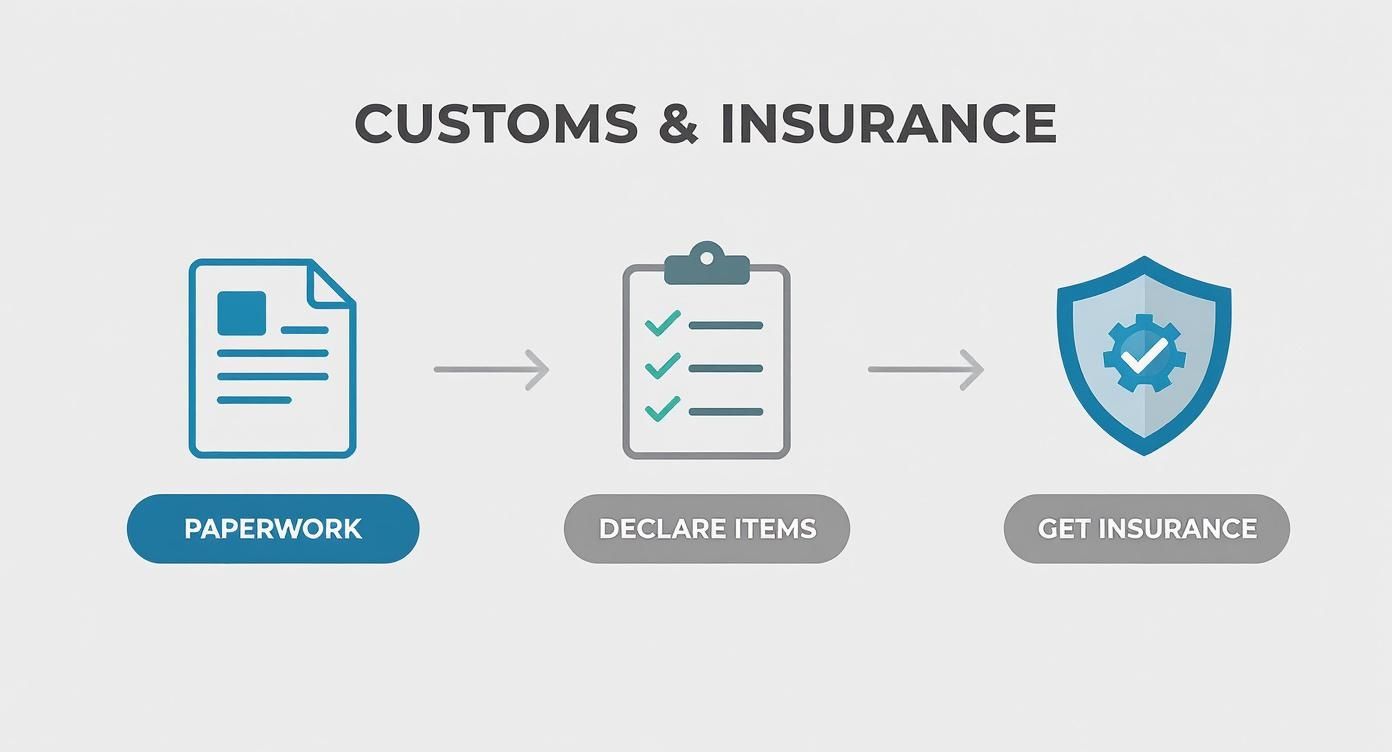
The image above really gets to the heart of it: getting through customs smoothly relies on having your paperwork in order, being honest in your declarations, and making sure you have the right insurance.
The final piece of this complex puzzle is the destination agent. This isn't just some random delivery company. Your mover's destination agent is their trusted partner on the ground in your new country. They're the ones who will handle the local customs clearance, sort out any port fees, and coordinate the final delivery and unpacking at your new address. Any reputable international removal company will have strong, long-standing relationships with its agents, ensuring you get the same high standard of service from start to finish.
Common Questions About International Removals
Even with the most detailed plan in the world, moving abroad is a huge undertaking. It’s only natural to have a few questions buzzing around your head as moving day gets closer. To help put your mind at ease, we’ve pulled together some of the most frequent queries we get as an international removal company and answered them based on our years of experience.
How Far in Advance Should I Book My Move?
The golden rule for moving overseas? Start early. Way earlier than you think.
Ideally, you should begin the process of researching and getting quotes from removal specialists a good three to four months before your target departure date. This gives you plenty of breathing room to compare services properly and make a decision you're comfortable with, without the pressure of a looming deadline.
We always advise our clients to lock in their booking at least 8-10 weeks before they need to move. This is especially true if you’re planning a move during a peak season, like the summer holidays, when the best companies get booked up months in advance. Securing your slot early means there’s ample time for a proper pre-move survey and for all the necessary customs paperwork to be sorted out without any last-minute panic.
What Items Can I Not Ship Internationally?
This is a critical one, because getting it wrong can cause major headaches, delays, and even fines. While every country has its own unique list of prohibited and restricted items, there are some things that are almost universally banned from household shipments for obvious safety and legal reasons.
As a general guide, you can't ship the following:
- Flammable or Hazardous Materials: Think things like paint, aerosols, certain cleaning supplies, and batteries.
- Explosives and Firearms: These are strictly controlled and fall well outside the scope of a standard household move.
- Perishable Foods and Live Plants: Most countries have very strict biosecurity laws to prevent the spread of pests and diseases, so these are a definite no-go.
- Alcohol and Tobacco: You might be able to take a small amount, but there are usually tight limits and the import taxes can be eye-wateringly high.
A good removal company will give you a detailed list specific to your destination country. The most important thing you can do is be completely honest on your inventory. Declaring everything properly is your best defence against frustrating delays or, worse, having part of your shipment confiscated by customs.
Understanding what is and isn't allowed is a key part of the planning process. A professional mover will guide you, but the final responsibility lies with you to ensure your shipment is compliant. This prevents any unwelcome surprises when your goods arrive at the border.
What Is Door-to-Door vs Door-to-Port Service?
Getting your head around this terminology is key to managing your budget and your expectations. The difference is pretty significant and will have a massive impact on what you need to do once your shipment arrives.
-
Door-to-Door Service: This is the full, all-inclusive package. It's the "let us handle everything" option. Your movers will manage every single step: packing at your old home, shipping, customs clearance, and final delivery to your new address. They'll often even unpack for you. It's completely hassle-free.
-
Door-to-Port Service: This is a more budget-friendly choice, but it means you have to roll up your sleeves and do a lot more of the work yourself. The company transports your goods to the destination port or airport, and that's where their job ends. From there, you're responsible for everything: hiring a customs agent, paying local port fees and taxes, and arranging for your things to be collected and delivered to your new home. It's cheaper upfront, but it can be a real logistical challenge, especially in a country where you're still finding your feet.
Can I Track My Shipment During Transit?
Yes, you absolutely can. Let’s be honest, the waiting period while your life's possessions are on a ship or plane can be the most stressful part of the entire move. Being able to track your shipment offers incredible peace of mind.
Most reputable international movers provide tracking, but the level of detail can vary.
For sea freight, you’ll usually get a container number and a link to the shipping line’s website. This lets you see the vessel’s progress as it makes its way across the ocean. Air freight tracking tends to be more granular and is updated more frequently, giving you almost real-time information.
Some movers, like SimplyPro, offer their own online portals that pull all this information together for you. You get seamless updates in one place, from the moment your things are collected right through to the final delivery. When you’re getting quotes, definitely ask what kind of tracking system they have—it’s a feature that makes a huge difference.
Planning an international move? The details matter, and having an experienced team on your side is crucial. At SimplyPro Removal & Storage Ltd, we handle every aspect of your relocation with precision and care, ensuring a smooth transition to your new home. Get your free, no-obligation quote today and let us take the stress out of your move.