


Key Takeaways
- Talk to the building first: most city centre blocks have a managing agent or concierge with rules about move times, lift bookings, protective covers and where vans can stop. Ask for them in writing before you book a date.
- Measure the lift, not just the flat: the lift car, its door opening and the turn in the corridor decide what goes up in one piece. Sofas, wardrobes and bed frames often need dismantling.
- Know the road rules: double yellow lines mean no waiting at any time, and you can’t load or unload where there are yellow kerb marks with signs showing a loading ban. Bristol’s bus gates are camera-enforced 24 hours a day.
- Check the Clean Air Zone: Bristol’s small Class D zone charges non-compliant vans £9 a day and heavy goods vehicles over 3.5 tonnes £100 a day, so check any hired or borrowed vehicle before moving day.
- Plan the carry: the distance from the van to the front door, any steps or cobbles, and the wait for the lift add up. A good plan for the “last 50 metres” saves more time than anything else.
Moving into a flat on Bristol’s Harbourside or in the city centre is a different job from moving into a house on a suburban street. The van can rarely park outside the door, the building usually has its own rules, and everything you own has to fit in a lift or be carried up a stairwell that’s shared with your new neighbours. Get the access sorted before moving day and the move itself is often quicker than a house move. Leave it to chance and you can spend half the day circling for somewhere to stop.
This guide covers what we’ve learned about moving into and out of flats around the harbour, Redcliffe, Temple Quarter, Broadmead and the Old City: how to deal with managing agents and concierge desks, what to measure, where vans can and can’t stop, the bus gates and Clean Air Zone, and how to get large furniture into a modern apartment. We’ve been moving people around Bristol for over 22 years, and city centre flats are some of the jobs where planning makes the biggest difference.
Why City Centre Flat Moves Need Their Own Plan
On a typical terraced street in Bishopston or Southville, the main problem is parking. In the city centre you have that, plus shared entrances, fob-controlled doors, lifts that other residents are waiting for, and roads that are designed to keep general traffic out. None of this is difficult once you know about it, but it does mean the planning starts with the building and the street rather than with the boxes.
The “last 50 metres” problem
In most house moves the van stops a few steps from the front door. In a city centre block it might stop at a loading bay round the corner, on a side street, or in a basement car park with a low entrance. Every item then has to be wheeled through a lobby, along a corridor and into a lift. If that route is long, the move takes longer, however quickly the packing went. That’s why we always ask about the route from kerb to front door when we quote for a flat.
Shared spaces and neighbours
Entrance halls, lifts and corridors belong to everyone in the building. Most managing agents want them protected and kept clear, and they don’t want a lift tied up for hours in the morning rush. A bit of courtesy goes a long way: tell the concierge when you’re starting, keep fire doors closed, and don’t leave boxes stacked in the corridor. You’ll be living next to these people, after all.
Old buildings and new buildings
Bristol’s centre has both. On one side you have converted warehouses, Georgian and Victorian buildings split into flats, and old office blocks turned into apartments; on the other, new-build blocks around Wapping Wharf, Finzels Reach and Temple Quarter. Conversions often have tighter stairwells, odd turns and smaller lifts (or no lift at all). New builds usually have better lifts and dedicated bin and bike stores, but stricter rules about when you can move and where vans can stop.
Speak to the Building Before You Book Anything
The single most useful thing you can do is get the building’s moving rules in writing before you fix your date. Ask the managing agent, the concierge, or your landlord or letting agent if you’re renting. If you’re buying, your solicitor may be able to get the information from the seller’s side.
What to ask the managing agent or concierge
- Are there set times or days for moves? Some buildings don’t allow moves on Sundays, late in the evening or during busy morning hours.
- Do you need to book the lift, and can it be put on a key or “service” setting so it isn’t called to other floors while you’re loading?
- Will they fit protective covers in the lift and padding on door frames, or do you need to bring your own?
- Where can a removal van stop? Is there a loading bay, a service road or a car park entrance, and what height restriction does the car park have?
- Is there a goods entrance or a second door that’s better than the main lobby?
- Do they need the removal company’s details, a certificate of insurance or a risk assessment in advance?
- Is there a deposit for damage to communal areas, and how is it returned?
Leases, tenancy agreements and house rules
Most flats are leasehold, and your lease sets out what you’ve agreed to, including rules about alterations, repairs and how you use the building. The GOV.UK guide to leaseholder rights and responsibilities explains that you can be taken to court and ordered to pay for damage if you don’t follow the conditions of the lease. In practice, moving rules are usually in a separate set of building regulations or house rules issued by the managing agent. If you’re renting, your tenancy agreement and the letting agent should tell you what applies.
Good to know: if the building asks for proof of insurance before your move, ask early. A removal firm can usually send it straight to the managing agent, but it can’t be done on the morning of the move if the concierge hasn’t seen it.
Moving out of a flat counts too
The same applies when you leave. Your old building will have its own rules, and the managing agent will want the lift and corridors left as they found them. If both ends are flats, you’ll need two lift bookings that line up with the van’s travel time between them. Morning at one end, afternoon at the other usually works best.
Lifts, Stairs and Measuring Up
Most of the problems on a flat move come down to measurements. A sofa that went into a house through a wide front door won’t necessarily fit into a lift, and a wardrobe that came up the stairs flat-packed won’t come down again in one piece.
What to measure
Take a tape measure to the new building if you can, or ask the agent for the details. Write down:
- The width and height of the lift door opening.
- The internal width, depth and height of the lift car. Height matters for anything stood on end, such as a tall fridge freezer or a mattress.
- The width of the corridors and of the flat’s front door, and any tight turns between the lift and your door.
- Any steps between the street and the lobby, and whether there’s a ramp.
- The stairwell, in case the lift is out of action on the day.
Then measure your largest pieces: the sofa (including the diagonal depth), wardrobes, bed frames, dining tables, the fridge freezer and any large mirrors or artwork. If something won’t fit, you’d much rather know a fortnight before than on the morning.
When the lift is small
Smaller lifts are common in converted buildings. Sofas can sometimes go in stood on end, but only if the lift is tall enough and the sofa can safely take its weight that way. Beds, wardrobes and tables normally need taking apart. Our furniture fitting team dismantles and reassembles furniture as part of a move, so a bed or wardrobe can go up in pieces and be put back together in the room.
No lift, or a broken one
Some older conversions don’t have a lift, and lifts in any building can break down. If you’re on the third or fourth floor of a walk-up, tell your removal firm when you ask for a quote, because it changes how many people and how much time the job needs. If the lift fails on the day, the crew will need to use the stairs, which takes longer, so it’s worth asking the managing agent how quickly lift faults are usually fixed.
Tip: take a short video of the route from the street to your new front door, including the lift and any tight corners. It’s the most useful thing you can send a removal firm, and it’s exactly what we use for a video quote.
Where a Removal Van Can Stop in the City Centre
Parking is the part people worry about most, and with good reason. Much of central Bristol is covered by yellow lines, bus lanes and pedestrian areas, and some roads only allow buses through. Knowing the basic rules makes it much easier to plan.
Yellow lines and loading
Under the Highway Code’s rules on waiting and parking, double yellow lines mean no waiting at any time, even if there are no upright signs. Rule 247 says you shouldn’t load or unload where there are yellow markings on the kerb and upright signs show restrictions are in place. It also says loading may be allowed where parking is otherwise restricted. In other words, a stretch of double yellow lines without kerb marks may allow loading, while one with kerb marks and a loading ban sign won’t. Always read the signs on the actual street, because restrictions vary from one block to the next.
Junctions, crossings and obstruction
The Highway Code also tells drivers not to stop within 10 metres of a junction, except in an authorised parking space, and not to leave a vehicle where it causes an unnecessary obstruction. In tight streets around the Old City and Redcliffe, that rules out a lot of spots that look tempting. A removal van parked on a corner might save ten minutes of carrying, but it can also block a bus route or a fire engine.
Loading bays, car parks and bay suspensions
Many newer blocks have a loading bay or a service road, and some let removal vans use the building’s car park. If you use a car park, check the height restriction first: a long-wheelbase van might fit, but a Luton or a 7.5 tonne lorry almost certainly won’t. Where there’s no loading bay and the street outside has pay-and-display or resident bays, you may be able to suspend a bay through the council. We’ve written a separate guide to removal van parking in Bristol and suspending a parking bay, which goes through that process step by step.
| Where you’re moving | Typical access challenges | What to sort out in advance |
|---|---|---|
| New-build block with concierge (e.g. around Wapping Wharf, Finzels Reach or Temple Quarter) | Fixed move times, lift bookings, car park height limits, loading bay shared with deliveries | Written moving rules, lift booking, insurance details for the managing agent, which entrance to use |
| Converted warehouse or office building | Smaller lifts, long corridors, goods entrance at the back, cobbled or uneven approach | Lift and door measurements, route from van to door, whether furniture needs dismantling |
| Georgian or Victorian house split into flats | No lift, narrow stairs, tight turns, steps up to the front door | Stair measurements, which items need dismantling, extra crew or time on the quote |
| Flat on a pedestrianised or restricted street | Van can’t stop outside; long carry; time-limited vehicle access | Nearest legal place to load, permitted access times, trolleys and sack trucks for the carry |
| Flat above shops in a busy street | Shared entrances, deliveries competing for kerb space, stairs from street level | Early start before trade picks up, check the loading signs on the day before |
Cobbles, quaysides and pedestrian areas
Parts of the city centre, including stretches around the harbour and Welsh Back, are cobbled, and some quaysides and squares are pedestrian areas. Cobbles slow everything down and make sack trucks and trolleys bounce, so delicate items need extra wrapping. Where the van can’t get close, plan for the carry rather than hoping for a gap: it’s better to stop legally a little further away than to risk a fine or a confrontation with a traffic warden halfway through the job.
Bus Gates and the Clean Air Zone
Two things catch out a lot of people driving their own or a hired van into central Bristol: bus gates and the Clean Air Zone. Neither stops you moving, but both can cost you money if you don’t plan the route.
Bristol’s bus gates
Bristol City Council’s bus gates page explains that a bus gate is a short section of road that only buses and authorised vehicles can use, that all of Bristol’s bus gates are in use 24 hours a day, seven days a week, and that CCTV cameras enforce them. Several are in the middle of the area where people move into flats, including:
- Baldwin Street at its junctions with Marsh Street, Broad Quay and High Street
- High Street and Bristol Bridge, and Victoria Street and Bristol Bridge
- Union Street at The Haymarket, and the Broadmead and Union Street junction
- Broad Quay, Colston Avenue and Colston Street
- Cumberland Road
Some bus gates allow taxis and motorcycles through, and the council’s table shows HGVs allowed at only two of them (Baldwin Street at High Street, and Victoria Street at Bristol Bridge). Ordinary vans aren’t on the exemption list, so if you’re driving yourself, plan a route that avoids them. A sat nav set up for cars won’t always know about them, so check the route on the council’s page before you set off.
The Clean Air Zone
Bristol has a small Class D Clean Air Zone covering the centre of the city, which started on 28 November 2022. The council’s Clean Air Zone charges and vehicle checker page lists the daily charges for vehicles that don’t meet the zone’s emission standards. As a guide, the council says Euro 4, 5 and 6 petrol vehicles (about 2006 or newer) and Euro 6 diesel vehicles (about end of 2015 or newer) won’t be charged, along with fully electric vehicles.
| Vehicle (if not compliant) | Daily charge |
|---|---|
| Private petrol or diesel car | £9 |
| Light goods vehicle (under 3.5 tonnes), e.g. most vans | £9 |
| Heavy goods vehicle (over 3.5 tonnes) | £100 |
The council also says the charge runs midnight to midnight, 24 hours a day, every day of the year. You can pay up to six days before, on the day, or up to six days after you enter the zone. If you don’t pay, you’ll get a Penalty Charge Notice of £120 plus the charge, reduced to £60 plus the charge if paid within 14 days. If you drive in the zone either side of midnight, that’s two daily charges.
What this means for moving day
If you’re using a removal company, ask them whether their vehicles are compliant with the zone. If you’re hiring a van yourself or borrowing an older one, put the registration into the government checker before the day. Larger hired vehicles over 3.5 tonnes count as heavy goods vehicles, so a non-compliant one would cost £100 for the day rather than £9. Moves that start late in the evening and finish after midnight can trigger two charges, which is another reason to start early.
Tip: the zone charge applies to driving in the zone, not to being parked there. The council says charges don’t apply if a vehicle is parked in the zone but doesn’t move. That’s worth knowing if a van is loaded the night before and left in a secure car park.
Getting Furniture Into a City Centre Flat
Modern apartments tend to have open-plan living areas, built-in storage and less space for large freestanding furniture. It’s worth deciding what’s coming with you before you start, because space in a flat goes quickly.
Decide what fits before you move it
Get a floor plan from the agent and mark where your larger pieces will go. Measure the walls where the sofa, bed and wardrobes need to sit, and check where the sockets, radiators and windows are. If a piece won’t fit, it’s cheaper to sell, donate or store it before the move than to carry it up five floors and down again. If you’re downsizing from a house, our storage in Bristol is a good halfway house while you work out what fits. Our storage is secure and monitored by 24/7 CCTV.

Dismantling and reassembly
Beds, wardrobes, large tables and corner sofas are the usual pieces that need taking apart for a flat. Keep screws, bolts and fittings for each item in a labelled bag taped to the main part, and take a photo before you take anything apart. If your removal firm is doing it, tell them in advance which items need dismantling so they bring the right tools and allow the time.
Protecting your things on the way up
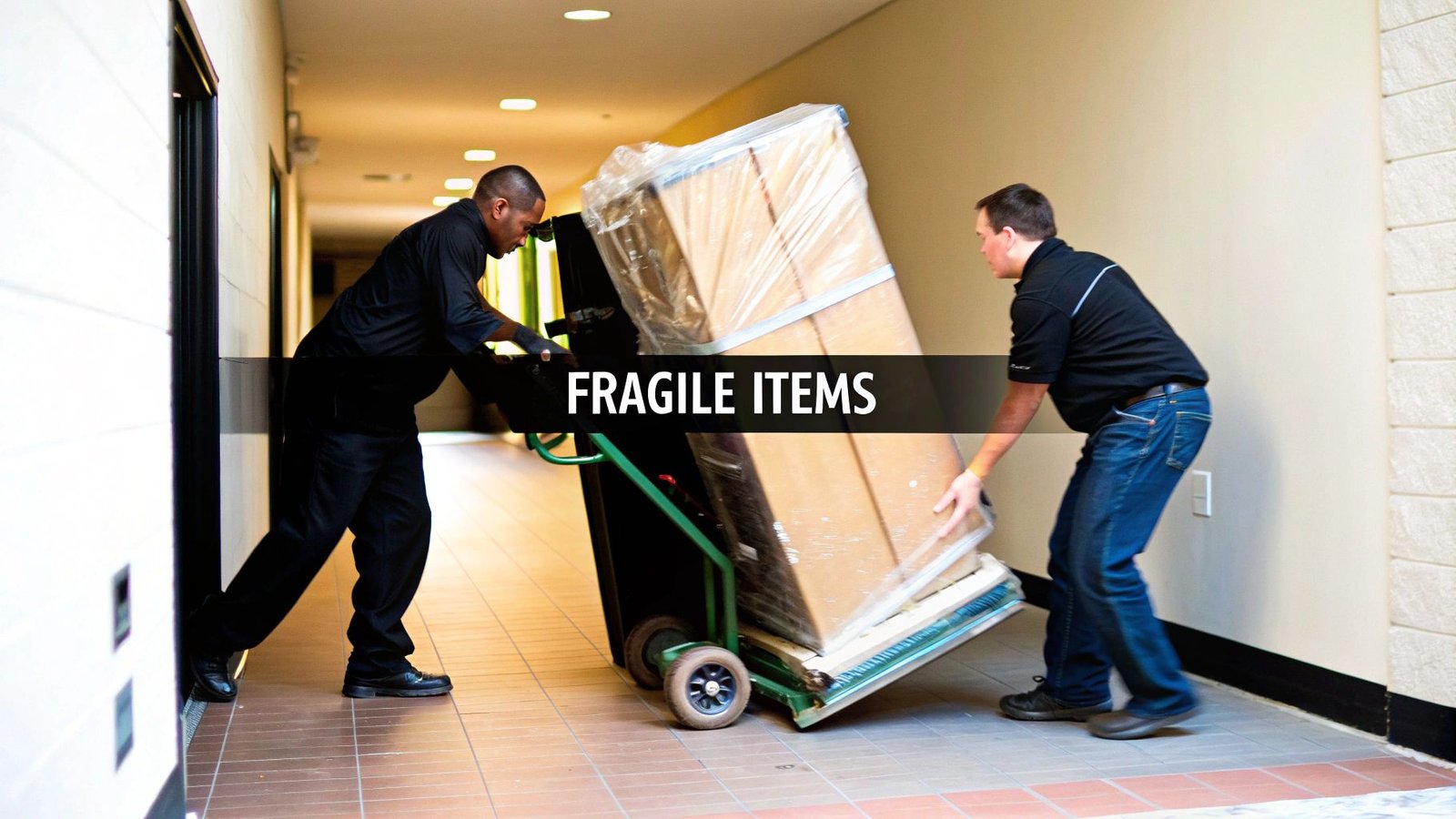
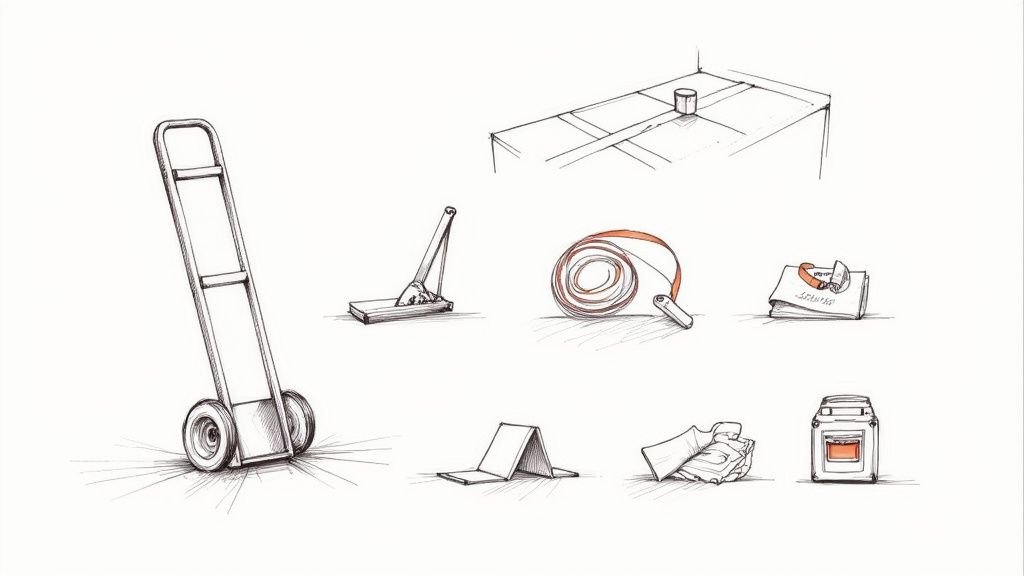
The route from the van to your flat has more corners and doorways than a house move, and every one is a chance to knock something. Furniture should be wrapped in blankets and strapped when it’s on a sack truck or trolley. Mirrors, pictures and glass tabletops need proper protection, and soft furniture is best covered so it stays clean through lobbies and car parks. Our removal packaging page lists the boxes and protective materials we supply.
Appliances
Many new-build apartments come with integrated appliances, so you may not need to bring your washing machine or fridge freezer at all. Check the inventory or the sales particulars. If you are bringing a tall freestanding fridge freezer, measure the lift height first, and remember fridges shouldn’t be laid flat for long periods. Washing machines need their transit bolts fitted before they’re moved.
Timing Your Move in Central Bristol
The right day and time can make a flat move much easier. Central Bristol is busy on weekday rush hours, on Saturdays around Broadmead and Cabot Circus, and whenever there are events around the harbour.
Picking the day
Midweek moves often suit flats best: the building is quieter during the working day, the lift is easier to book, and loading bays aren’t full of weekend shoppers. That said, some buildings don’t allow moves at weekends at all, so check the rules before you decide. If you’re buying, your completion date may decide it for you. Weekend and last-minute moves are possible, subject to availability.
Picking the time
An early start helps on most flat moves. You get to the loading area before deliveries and traffic build up, you’re well inside any permitted move hours, and you avoid running into the evening. If both ends are flats, plan the lift bookings around the drive between them, and leave some slack in case one end runs late.
Events and closures
Large events around the Harbourside, Millennium Square and Queen Square can close roads or make them very busy. Check the council’s road closure and event information the week before your move, and ask the building whether anything is planned locally. A street that’s clear on your viewing day could be fenced off on moving day.
The Admin: Council Tax, Keys and Utilities
There’s a bit of paperwork that comes with any move, and a few things that are specific to flats.
Council tax
Bristol City Council’s page on telling the council you’re moving home says you should only contact them in the month before you move. If you’re moving from one Bristol address to another, you must be named on your current council tax account before you tell them. You’ll need your old and new addresses, your move-in and move-out dates and the names of anyone moving with you.
Keys, fobs and parking permits
City centre blocks often have separate fobs for the main door, the car park, the bin store and the bike store. Check how many you’re getting and whether they work on the day you move in, because a dead fob on moving day means propping doors open, which most managing agents don’t allow. If the building has allocated parking, find out which space is yours and whether visitors or vans can use it.
Service charges and meters
If you’re buying a leasehold flat, you’ll pay a service charge for the upkeep of the building. Find out how it’s paid and who to contact. Take meter readings when you arrive, and find the meter cupboard; in some blocks it’s in the corridor or a locked room rather than inside the flat.
Frequently Asked Questions
Can a removal van park on double yellow lines in Bristol city centre?
The Highway Code says double yellow lines mean no waiting at any time, but loading may be allowed where parking is otherwise restricted. You can’t load or unload where there are yellow kerb markings and upright signs showing a loading ban. Check the signs on your street, and if loading isn’t allowed, use a loading bay, a car park or a suspended parking bay instead.
Do I need to book the lift in my building?
Many managed blocks ask residents to book the lift for moves, and some will put protective covers up or set the lift to a service mode for you. Ask the managing agent or concierge, and get their rules in writing before you fix your moving date.
What if my sofa won’t fit in the lift?
Measure the lift opening and the inside of the lift car before the move. Some sofas can go in stood on end if the lift is tall enough, and some can have their feet or arms removed. If it still won’t fit, it may need to go up the stairs, so tell your removal firm in advance.
Will I pay the Clean Air Zone charge on moving day?
Only if the vehicle you drive in the zone doesn’t meet the emission standards. Non-compliant vans under 3.5 tonnes pay £9 a day and heavy goods vehicles over 3.5 tonnes pay £100 a day. Check any hired or borrowed van on the government checker before the day.
Can I drive a van through Bristol’s bus gates if I’m only unloading?
No. The bus gates are only for buses and authorised vehicles, they’re in use 24 hours a day and they’re enforced by CCTV. Bristol City Council’s bus gates page lists every location and which vehicles are exempt.
When should I tell Bristol City Council I’m moving for council tax?
The council says you should only contact them in the month before you move. Use their online form to tell them you’re moving, with both addresses and your move-in and move-out dates.
How do I get a quote for a city centre flat move?
The quickest way is a video quote. Film your rooms and, if you can, the route from the street to your front door, then send it to us on WhatsApp through our video quote page. Include both addresses, the floor levels and anything you already know about lifts and parking.
Get a Clear Quote for Your City Centre Flat Move
A flat move in central Bristol goes well when the building, the street and the furniture are all planned for in advance. Get the building’s rules in writing, measure the lift and your largest pieces, work out where the van can legally stop, and check the bus gates and Clean Air Zone if you’re driving yourself. If you’re new to the city, our guide to moving to Bristol areas like Clifton, Redland and Bedminster is a good place to start.
Simply Removals Bristol has more than 22 years’ experience of house and flat removals in Bristol. We’re fully insured, we run long-wheelbase vans, Luton vans and 7.5 tonne lorries so we can match the vehicle to the access, and we use blankets, straps and sack trucks to protect your things. For smaller flat moves our man and van service may be all you need. Send us a video quote request with your dates and both addresses, and we’ll come back to you with a quote.