


Moving house in the UK can feel like a monumental task, whether you are relocating a cosy flat in Bristol, a family home in Bath, or a small business office. The secret to a smooth, efficient, and stress-free move isn't just about packing boxes; it's about smart, forward-thinking preparation that starts weeks, or even months, in advance. This comprehensive guide delivers a definitive list of practical moving house tips UK residents and businesses need for a successful relocation. We will break down the entire process, from the initial decision to move right through to settling into your new property, focusing on actionable steps that make a real difference.
Forget the generic advice you may have heard before. Here, you will find targeted, UK-specific insights covering everything from navigating local council parking regulations and budgeting for often-overlooked costs like stamp duty, to clever packing strategies and day-of logistics. We address the unique needs of homeowners, renters, and even businesses planning commercial moves, with a special focus on the Bristol and Bath areas. The advice covers essential tasks like arranging end-of-tenancy cleaning, coordinating with letting agents, and handling specialist items such as pianos or sensitive IT equipment.
This article is designed to be your go-to checklist. It provides the structured approach necessary to manage the complexities of moving within the UK. By following these proven steps, you can avoid common pitfalls, save valuable time and money, and transform what is often a source of anxiety into an organised and exciting new beginning. Let's get started on planning your perfect move.
1. Book a Removal Company Early and Compare Quotes
Securing a reliable removal company is arguably the cornerstone of a stress-free move. This is one of the most vital moving house tips UK residents often overlook, but booking well in advance, ideally 6-8 weeks before your moving date, prevents last-minute panic and ensures you get a reputable firm at a fair price. This is especially crucial during the peak moving season from May to September, when demand soars.

Why Early Booking and Comparison is Key
Starting your search early allows you to conduct thorough research without pressure. Most reputable UK removal companies, from national players like Pickfords to excellent local independent movers, offer free, no-obligation home surveys. These surveys provide an accurate quote based on the volume of your belongings, access to your property, and any specialist items like pianos or antique furniture. Getting multiple quotes is essential for comparing not just the price, but also the level of service and insurance cover included.
Actionable Steps for Choosing a Removal Company
To ensure you find the right fit, follow a structured approach. A little diligence now pays dividends on moving day.
- Gather at Least Three Quotes: Contact a mix of national and local firms to get a broad view of the market. This gives you a strong negotiating position and helps you spot any quotes that are unusually high or suspiciously low.
- Check for Accreditation: Prioritise companies that are members of the British Association of Removers (BAR). This accreditation guarantees they adhere to a strict code of practice, offering you greater protection and peace of mind.
- Scrutinise Online Reviews: Use platforms like Trustpilot and Google Reviews to read recent customer feedback. Look for patterns in comments regarding punctuality, care for belongings, and communication.
- Clarify Insurance and Policies: Always ask what level of insurance is included as standard and what the excess is. Crucially, get their cancellation and postponement policy in writing, which is vital in the unpredictable UK property market. If you want more information, you can find helpful advice on how to choose the right removal company here.
- Consider Mid-Week Moves: If your dates are flexible, booking your move for a Tuesday or Wednesday can often be cheaper than a Friday or weekend.
2. Understand and Budget for Additional UK Moving Costs
Focusing solely on the removal company fee is a common oversight that can lead to significant financial stress. This is one of the most crucial moving house tips UK homeowners, especially first-time buyers, must embrace. The reality is that ancillary costs, from legal fees to taxes, can quickly accumulate, often totalling between 2-5% of the property's purchase price. Acknowledging and budgeting for these expenses from the outset is vital for a smooth financial transition.
Why a Comprehensive Budget is Key
Beyond the physical move, numerous professional and administrative services are required, each with its own price tag. Failing to account for these can derail your finances at a critical time. For instance, on a £500,000 property purchase in England, Stamp Duty Land Tax (SDLT) alone could be a five-figure sum, while essential services like property surveys typically range from £400 to £800. Creating a detailed budget prevents nasty surprises and ensures you have sufficient funds to cover every eventuality.
Actionable Steps for Budgeting Your Move
To gain full control over your moving finances, a methodical approach is necessary. Diligent planning will protect you from unexpected shortfalls.
- Create a Detailed Moving Spreadsheet: List every potential expense, including solicitor fees, surveyor costs, mortgage arrangement fees, searches, and potential early repayment charges on your current mortgage. Update it as you receive quotes.
- Estimate Stamp Duty Accurately: Use the official government SDLT calculator for an exact figure based on your purchase price and status (e.g., first-time buyer). This is often the largest single cost after the deposit.
- Gather Multiple Conveyancing Quotes: Contact at least three solicitors or licensed conveyancers. Ask for a detailed breakdown of their fees and disbursements, and clarify if they offer a fixed-price service for peace of mind.
- Factor in a Contingency Fund: Even the best-laid plans can go awry. Set aside an extra 10-15% of your total moving budget to cover unforeseen costs, such as temporary storage or unexpected repairs.
- Don't Forget Post-Move Costs: Budget for immediate expenses in your new home, such as re-keying locks, initial council tax payments, and potential connection fees for utilities. To get a more detailed breakdown, you can learn more about the complete cost to move house here.
3. Declutter and Downsize Before Packing
One of the most effective yet frequently postponed moving house tips UK homeowners can adopt is a thorough declutter. Moving house is a rare opportunity to reassess every single item you own. By systematically decluttering at least 4-6 weeks before you start packing, you significantly reduce the volume of goods to be moved, which in turn lowers removal costs, saves packing time, and makes unpacking in your new home far more manageable.
Why a Pre-Move Sort-Out is a Game Changer
Decluttering is not just about tidying; it’s a strategic step that makes the entire moving process more efficient and economical. The less you have to pack and transport, the quicker and cheaper your move will be. Given that many UK properties have space at a premium, arriving with only the things you truly need and love sets you up for a more organised start in your new home. This process helps you avoid paying to move items you no longer want, from old furniture to unworn clothes.
Actionable Steps for Effective Decluttering
To tackle this task without feeling overwhelmed, break it down into manageable chunks using a clear system.
- Create Four Categories: As you go through each room, sort items into four distinct piles: Keep, Sell, Donate, and Dispose. This simple method forces a decision on every item.
- Sell Unwanted Valuables: Use platforms like Facebook Marketplace or Gumtree for larger items like furniture, and Vinted for clothing. Take clear, well-lit photos and write honest descriptions to attract buyers. Schedule collections well in advance of your moving date.
- Donate to Local Charities: High-street charity shops like the British Heart Foundation or Oxfam are excellent options for good-quality clothing, books, and homeware. Many also offer a collection service for larger furniture donations.
- Plan for Temporary Storage: If you have sentimental items or furniture you can't part with but won't fit in your new home immediately, consider your options. Exploring various self-storage container solutions can provide a secure, temporary home for these belongings until you are ready for them.
- Book a Council Collection: For items that cannot be sold or donated, check your local council's website for their bulky waste collection service. Be aware that these often need to be booked weeks in advance.
4. Notify Relevant Authorities and Service Providers in Advance
Failing to inform the right organisations about your move is a common pitfall that can lead to billing errors, service interruptions, and even identity fraud risks. This is a critical moving house tip UK residents must prioritise, as timely notifications ensure a seamless transition of services and legal responsibilities. Ideally, you should start this process at least 4 weeks before your moving date to avoid final-bill chaos and ensure services are active at your new home from day one.
Why Timely Notification is Key
Giving advance notice allows companies and authorities to schedule final meter readings, process your change of address, and calculate your final bill accurately. It prevents you from paying for services at your old address after you have left and ensures continuity of essential utilities like electricity, gas, water, and broadband at your new property. Forgetting this step can result in chasing refunds, dealing with debt collectors for bills that aren't yours, or missing important documents sent to your old address.
Actionable Steps for Notifying Organisations
A systematic approach is the best way to ensure no one is missed. Create a master list and work through it methodically.
- Create a Notification Checklist: List every single provider you need to contact. This includes utilities (gas, electricity, water), council tax for both your old and new local authorities, and communication providers (broadband, phone, TV).
- Set Up Mail Redirection: Use the Royal Mail's Redirection service to catch any post you may have forgotten. This is an inexpensive safety net that can be set up online and costs from as little as £33.99 for a year.
- Take Meter Readings: On moving day, take final meter readings for gas, electricity, and water at your old property. Take a photo for your records. Do the same as soon as you get the keys to your new home to ensure you are only billed for your own usage.
- Update Financial and Official Records: Inform your bank, credit card companies, pension providers, and insurance companies (home, car, life). Crucially, update your address with your employer for tax purposes, HMRC, your GP, dentist, and the DVLA for your driving licence and vehicle registration.
- Cancel or Transfer Subscriptions: Don't forget magazine subscriptions, gym memberships, and any local services like milk or newspaper deliveries.
5. Plan Parking and Access for Removal Lorries
Overlooking logistics like parking is a common pitfall that can derail your entire moving day. In the UK, with its many narrow streets, terraced houses, and strict parking regulations, you cannot simply assume a large removal lorry will be able to park outside your old or new home. Planning this well in advance is one of the most practical moving house tips UK residents should prioritise to avoid costly delays and stressful last-minute problems.
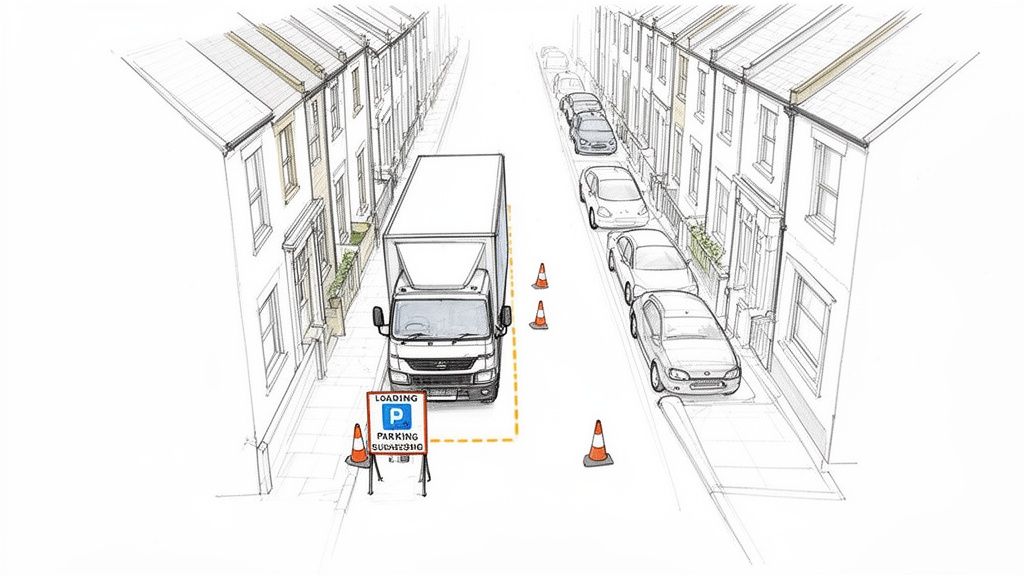
Why Pre-Arranged Parking is Non-Negotiable
Failing to secure adequate parking can lead to the removal crew having to park far away, significantly increasing the loading and unloading time and potentially incurring extra charges. Worse, it could result in a parking fine or even prevent the move from proceeding altogether. Councils in cities like London, Manchester, and Birmingham have specific procedures for parking bay suspensions or dispensations that require significant notice, often several weeks.
Actionable Steps for Securing Removal Lorry Access
Being proactive is the key to ensuring your removal vehicle has a designated, safe, and legal place to park on the day.
- Contact Your Local Council Early: Get in touch with the highways or parking department for both your current and new local council at least 4-6 weeks before your move. Inquire about applying for a parking suspension or dispensation. For example, many London boroughs require more than 10 working days' notice.
- Inform Your Removal Company: As soon as you book, provide your removal company with detailed information about the parking situation and access at both properties. Mention any narrow roads, low bridges, or overhanging trees that could obstruct a large vehicle.
- Communicate with Neighbours: A polite conversation with your neighbours can work wonders. Ask if they would be willing to keep a space clear for the removal lorry. This is particularly helpful in suburban areas or streets without formal permit schemes.
- Prepare a Backup Plan: Even with a permit, things can go wrong. Identify a viable alternative parking location nearby just in case the designated spot is blocked upon arrival.
- Check for Physical Obstacles: Walk the route to your front door and measure the width of any tight alleyways or gates. This ensures that large furniture items can be moved without causing damage to your belongings or the property.
6. Use Proper Packing Materials and Labeling Systems
Effective packing is the foundation of a successful move, protecting your belongings during transit and simplifying the unpacking process at your new home. Investing in quality materials and adopting a systematic labelling strategy is one of the most practical moving house tips UK professionals advocate. It prevents damage to fragile items and saves hours of confusion when you arrive, turning potential chaos into organised efficiency.
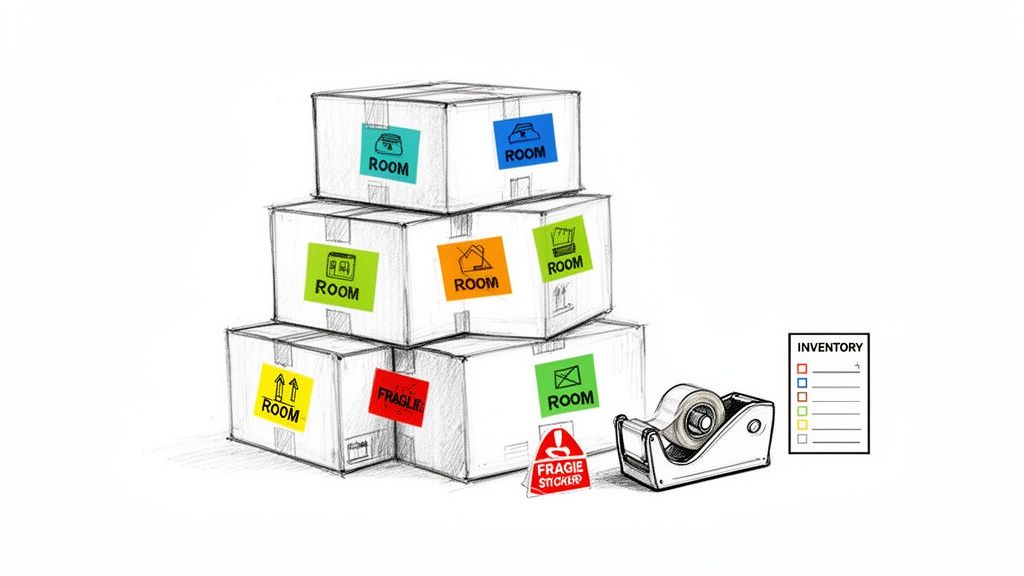
Why Quality Packing and Clear Labelling Matter
Using flimsy boxes or failing to label correctly can lead to broken valuables and a frustrating unpacking experience. Professional UK removal companies stress that strong, double-walled boxes prevent crushing, while a clear labelling system ensures movers place boxes in the correct rooms, dramatically speeding up the settling-in period. This systematic approach transforms unpacking from a daunting task into a manageable one.
Actionable Steps for Smart Packing and Labelling
A methodical approach to packing ensures everything arrives safely and can be found easily. A little organisation now will save a lot of stress later.
- Implement a Colour-Coding System: Assign a different coloured marker or sticker to each room (e.g., blue for kitchen, red for main bedroom). This provides a quick visual cue for movers and yourself.
- Adopt a Numbering and Inventory Method: Label each box with the room name and a unique number (e.g., Kitchen – 1, Kitchen – 2). Keep a corresponding inventory list on your phone or in a notebook detailing the key contents of each numbered box.
- Use the Right Box for the Job: Pack heavy items like books and crockery in small boxes to keep them manageable. Use larger boxes for lighter, bulkier items such as bedding and cushions. This prevents boxes from becoming too heavy and reduces the risk of them breaking. You can learn more about how to choose the right packing materials for moving house here.
- Label on Multiple Sides: Mark each box on the top and at least two sides. This ensures the label is visible even when boxes are stacked in the removal van or in your new home.
- Create an "Essentials" Box: Pack a clearly marked box with items you'll need immediately upon arrival: kettle, tea, coffee, mugs, snacks, phone chargers, basic toiletries, a first-aid kit, and essential tools. Keep this box with you or ask the movers to load it last so it's the first one off the van.
7. Arrange Childcare and Pet Care During the Move
Moving day is a whirlwind of activity, with open doors, heavy lifting, and potential hazards. This organised chaos is not a safe or calming environment for young children or pets. Arranging dedicated care for them is one of the most important moving house tips UK families can follow, ensuring their safety and reducing stress for everyone involved. Planning this 4-6 weeks in advance allows you to focus entirely on the logistics of the move, confident that your most vulnerable family members are happy and secure.
Why Off-Site Care is Essential
The primary benefit is safety. An open front door is an escape risk for pets, while movers carrying heavy furniture create trip hazards for small children. Beyond safety, removing them from the immediate environment minimises their anxiety. The noise, unfamiliar people, and disappearance of familiar furniture can be deeply unsettling for both children and animals. A calm, stable environment with a trusted carer is a far better alternative.
Actionable Steps for Arranging Care
A proactive approach ensures a smooth experience for your children and pets, allowing you to concentrate on the tasks at hand.
- Explore Your Options Early: Your first port of call might be trusted family or friends who can provide a familiar and free care solution. If this isn't possible, look into local nurseries, registered childminders, or professional nanny services for your children.
- Book Professional Pet Services: For pets, options include local kennels, catteries, or doggy daycare facilities. If friends or family aren't available, consider looking into professional pet carers to ensure your furry friends are safe and comfortable during the move.
- Prepare a 'Go-Bag': Pack a bag for your child or pet with everything they'll need for the day: food, favourite toys, comfort items (like a blanket), medication, and any necessary documents. This ensures a seamless handover to the carer.
- Provide Clear Instructions: Leave detailed written instructions covering feeding schedules, nap times, allergies, and emergency contact numbers. Include the contact details for your removal team and the address of your new home.
- Prepare Them for the Change: Talk to your children about the move using positive language and storybooks. For pets, keep their routine as normal as possible in the days leading up to the move and consider using calming pheromone diffusers like Feliway for cats or Adaptil for dogs.
- Update Microchip Details: Before you move, ensure your pet's microchip information is updated with your new address and contact number.
8. Obtain and Review Property Surveys Before Commitment
When buying a property in the UK, commissioning a professional survey is a non-negotiable step to protect your investment. While it may seem like an extra expense during a costly process, skipping a survey can lead to discovering financially crippling defects after you've moved in. This is a critical one of our moving house tips UK purchasers should never ignore, as it provides a comprehensive health check on what is likely your largest asset.
Why a Property Survey is Essential
A property survey, conducted by a qualified surveyor (often RICS-accredited), provides an expert assessment of a building's condition. It uncovers potential structural problems, highlights necessary repairs, and can identify issues like damp, subsidence, or asbestos, which are common in the UK's varied and often older housing stock. This report gives you the power to make an informed decision, renegotiate the asking price, or even withdraw from a purchase that could become a money pit.
Actionable Steps for Managing Property Surveys
Navigating surveys effectively requires understanding your options and knowing what to do with the information you receive. A methodical approach ensures you're fully protected.
- Choose the Right Survey Level: In the UK, there are typically three main types. A Condition Report (Level 1) is basic, a HomeBuyer Report (Level 2) is suitable for conventional properties in reasonable condition, and a Building Survey (Level 3) is a full structural survey for older, larger, or more unusual properties.
- Don't Just Rely on the Mortgage Valuation: The valuation survey carried out for your lender is for their benefit, not yours. It is a brief assessment to confirm the property is worth the loan amount and is not a substitute for a proper condition survey.
- Read the Report Thoroughly: Once you receive the survey, read every section carefully. Pay close attention to the 'traffic light' ratings often used to signify the urgency of defects. Don't be afraid to call the surveyor to clarify any points you don't understand.
- Use the Findings to Negotiate: If the survey reveals significant issues requiring costly repairs, use this evidence to renegotiate the purchase price with the seller. A detailed quote from a builder can strengthen your position.
- Commission Specialist Reports if Needed: If the main survey flags specific concerns like potential subsidence, damp, or issues with the electrics, you may need to arrange for a specialist to conduct a more in-depth investigation.
9. Establish Home Insurance and Utility Connections Before Moving Day
One of the most crucial yet easily forgotten moving house tips UK homeowners must follow is arranging insurance and utilities before the big day. Walking into your new property without electricity, water, or broadband is an avoidable hassle. More importantly, having the correct home insurance in place from the moment of exchange is often a legal requirement from your mortgage lender, protecting your significant investment from day one.
Why Pre-Arranging is Non-Negotiable
Failing to sort out these services can lead to a chaotic and uncomfortable first few days in your new home. Utility companies, especially for broadband installation, often have long lead times. Furthermore, your mortgage offer will almost certainly stipulate that buildings insurance must be active on the date you exchange contracts, not the completion date. This covers the property's structure, while contents insurance, which you should arrange to start on your moving day, protects your possessions during and after transit.
Actionable Steps for a Seamless Transition
A methodical approach ensures everything is active when you need it. Taking these steps a few weeks in advance will prevent last-minute stress.
- Arrange Insurance Early: Start comparing quotes for buildings and contents insurance at least 2-3 weeks before your exchange date. Use comparison websites but also check direct providers like Aviva or Direct Line. Ensure your buildings cover begins on your exchange day and your contents cover starts on your moving day.
- Notify Utility Providers: Contact your current and new energy (gas and electricity) suppliers at least two weeks before you move. Provide them with your moving date and new address to set up your account and ensure a smooth switchover.
- Book Your Broadband Installation: Internet providers can have waiting lists of 4 weeks or more, especially in busy areas. Book your installation as soon as you have a confirmed moving date to avoid being left without a connection.
- Take Final and Initial Meter Readings: On moving day, take a photo of the gas, electricity, and water meters at your old property after you’ve finished using them. Do the same as soon as you arrive at your new home. Submit these readings to the relevant suppliers to ensure you are only billed for what you use.
- Inform Your Local Council: Remember to contact the council tax departments for both your old and new local authorities to close one account and open another. This prevents you from being overcharged.
10. Create a Moving Day Action Plan and Emergency Kit
A well-orchestrated moving day is the result of careful planning, not luck. This is where a detailed action plan and a dedicated emergency kit become indispensable moving house tips UK families rely on. Creating these in advance transforms a potentially chaotic day into a structured, manageable process, ensuring you have immediate access to essentials without frantically searching through dozens of boxes.
Why Planning and a Survival Kit are Essential
The first few hours in a new, empty house can be disorienting. An action plan provides a clear schedule and allocates responsibilities, keeping everyone on track. The emergency kit, often labelled 'Open First', contains everything you need to feel comfortable and functional straight away, from a much-needed cup of tea to essential toiletries for your first night. This proactive approach minimises stress and prevents common moving day frustrations.
Actionable Steps for a Seamless Moving Day
To ensure your move runs like clockwork, prepare these two key components a few days before the move.
- Draft a Detailed Timeline: Create a printed schedule for the day. Include key timings such as the removal company's arrival (e.g., 8am), final checks of the old property, the journey to the new home, and when to take meter readings. Share this with everyone involved.
- Assemble an 'Open First' Emergency Box: This is your moving day survival kit. Pack it with a kettle, tea bags, coffee, mugs, and milk. Also include phone chargers, basic toiletries, a roll of toilet paper, essential medications, and a first-aid kit.
- Keep Important Documents on Your Person: Do not pack passports, driving licences, property deeds, or removal contracts. Keep these in a secure bag that stays with you at all times.
- Prepare a 'First Night' Bag: Just like packing for a weekend away, each family member should have a small bag with a change of clothes, pyjamas, and their personal toiletries. This saves you from having to unpack bedrooms immediately.
- Gather Essential Contacts: Compile a list of important phone numbers on a single sheet. This should include your removal company, solicitor, estate agent, and emergency contacts for your new utility providers.
Comparing 10 Essential UK Moving Tips
| Item | Implementation Complexity 🔄 | Resource Requirements ⚡ | Expected Outcomes ⭐ / 📊 | Ideal Use Cases 💡 | Key Advantages ⭐ |
|---|---|---|---|---|---|
| Book a Removal Company Early and Compare Quotes | Medium 🔄🔄 — coordination of quotes & surveys | High cost, moderate time ⚡ | Professional handling, predictable costs ⭐📊 | Full-house moves, peak-season bookings | Professional handling, insurance, time-savings |
| Understand and Budget for Additional UK Moving Costs | Medium 🔄 — gather multiple fees and estimates | Moderate (financial planning + time) ⚡ | Fewer financial surprises, realistic budget 📊 | All buyers, especially first-time buyers | Prevents unexpected costs, better planning |
| Declutter and Downsize Before Packing | Medium 🔄🔄 — time-consuming sorting decisions | Low cost, high time investment ⚡ | Lower move volume and costs, easier unpacking ⭐📊 | Small properties, cost-sensitive moves | Reduces removal fees, potential resale income |
| Notify Relevant Authorities and Service Providers in Advance | Low-Medium 🔄🔄 — administrative tasks | Low time, minimal cost ⚡ | Uninterrupted services and accurate billing 📊 | All moves; vital for utilities & council tax | Prevents service disruption and billing errors |
| Plan Parking and Access for Removal Lorries | Medium 🔄🔄 — permits and council liaison | Moderate (time, possible permit fees) ⚡ | Efficient loading/unloading, fewer delays 📊 | Urban/terraced homes, narrow streets | Avoids fines/delays, smoother move-day operations |
| Use Proper Packing Materials and Labeling Systems | Medium 🔄🔄 — systematic packing & inventory | Moderate cost (materials) + prep time ⚡ | Reduced damage, faster unpacking ⭐📊 | Fragile items, long-distance moves | Protects belongings, speeds unpacking |
| Arrange Childcare and Pet Care During the Move | Low-Medium 🔄🔄 — booking carers/boarders | Moderate cost, advance booking needed ⚡ | Safer environment, less distraction on moving day 📊 | Families with children or pets | Ensures safety and reduces stress |
| Obtain and Review Property Surveys Before Commitment | Medium 🔄🔄 — choose survey level, interpret report | Moderate–High cost, time to report ⚡ | Identifies defects, bargaining power ⭐📊 | Buyers of older/complex properties | Protects investment, reveals hidden issues |
| Establish Home Insurance and Utility Connections Before Moving Day | Medium 🔄🔄 — compare policies, schedule installs | Moderate cost, appointment scheduling ⚡ | Immediate utilities and legal/financial protection ⭐📊 | Mortgaged purchases, first-night readiness | Ensures cover and service continuity |
| Create a Moving Day Action Plan and Emergency Kit | Low 🔄 — write timeline and pack essentials | Low cost, small planning time ⚡ | Reduced stress, quicker problem resolution 📊 | All moves; critical for first night | Clear roles, essential items ready for arrival |
Putting It All Together for a Successful Move
The journey from one front door to the next is rarely a straight line; it's a complex project with numerous moving parts. However, by embracing a structured and proactive approach, you can transform what often feels like a chaotic upheaval into a well-managed transition. The ten crucial moving house tips UK residents need to master, which we've explored in this guide, are not just suggestions, they are the foundational pillars of a successful relocation.
From the initial strategic decision to book a reputable removal company well in advance, to the final, satisfying moment you unpack your 'essentials' box in your new home, every step is interconnected. Mastering these elements isn't about achieving a "perfect" move, which is an unrealistic goal. Instead, it's about building resilience into your plan, minimising friction, and maintaining control over the process.
Your Blueprint for a Stress-Free Relocation
Think of this collection of tips as your personal project management blueprint. Each piece of advice addresses a critical stage of the moving timeline:
- Financial Foresight: Budgeting accurately for often-overlooked UK moving costs, from stamp duty to potential storage fees, prevents nasty financial surprises and empowers you to make informed decisions.
- Logistical Mastery: The practical, on-the-ground tasks, such as decluttering ruthlessly before you pack a single box and arranging lorry parking with your local council, are what separate a smooth moving day from a logistical nightmare.
- Administrative Diligence: Systematically notifying everyone from your bank and the DVLA to your broadband provider ensures a seamless continuation of your life and services at your new address. It’s the behind-the-scenes work that keeps your world turning without interruption.
- Packing with Purpose: Adopting a methodical packing and labelling system is more than just an organisational exercise. It saves invaluable time and energy during the unpacking phase, allowing you to settle in and feel at home much faster.
The ultimate value in applying these strategies lies in reclaiming your peace of mind. A move represents a significant life change, an opportunity for a fresh start, and it should be an exciting prospect, not one overshadowed by dread and anxiety. By methodically working through a detailed checklist, creating a robust moving day action plan, and preparing for the unexpected with an emergency kit, you are not just moving boxes; you are skilfully orchestrating a major life event.
Ultimately, the most important takeaway is this: preparation is your most powerful asset. The time and effort you invest in planning weeks and even months before the removal lorry arrives will pay dividends in the form of reduced stress, lower costs, and a more positive overall experience. You are now equipped with the knowledge and actionable steps to navigate the complexities of moving house in the UK. Embrace the change, trust your plan, and look forward to the exciting new chapter that awaits.
Ready to put these tips into action with a professional, reliable partner by your side? For those moving in Bristol, Bath, and the surrounding areas, SimplyPro Removal & Storage Ltd offers a comprehensive suite of services designed to handle every aspect of your move. From expert packing and secure storage to seamless home and office relocations, let our experienced team make your next move your best one.