

Managing an office move is about so much more than just shifting desks and computers from A to B. It’s a complex, strategic operation that, if handled properly, can set your business up for its next chapter of growth. If handled poorly? It can descend into chaos, costing you time, money, and a whole lot of team morale.
Office relocation project management provides the structure to get it right. Think of it as the central command for your entire move, a system for managing timelines, budgets, suppliers, and risks to ensure everything happens smoothly, with as little disruption to your daily operations as possible.
Why You Can’t Afford to Wing an Office Move Anymore
Gone are the days when moving office meant simply hiring a removal company and hoping for the best. Today, the stakes are much higher. Many businesses are rethinking their entire workplace strategy, often driven by the rise of hybrid working and the need for high-quality spaces that genuinely attract and keep the best people.
Without a solid project management framework, what should be an exciting new start can quickly turn into a logistical nightmare. It’s this framework that coordinates every single element, from the critical IT migration (which can bring a business to its knees if it goes wrong) to getting the new furniture set up and ready for day one. It keeps everyone on the same page.
Thriving in a Fierce Commercial Property Market
The pressure cooker environment of the UK's commercial property market, especially in hotspots like Bristol and Bath, only adds to the challenge. When demand for top-tier office space is high, you need to be organised and ready to act fast.
The numbers don't lie. Recent data from CBRE on UK office market trends shows that office take-up hit a staggering 20.3 million square feet over the last year, the highest it’s been since late 2022. This demand means availability is shrinking, and brand new, high-spec spaces account for just 23% of what’s out there. For businesses in booming sectors like Tech and Media, this means hesitation isn't an option—delay, and you’ll likely lose that perfect new office to a competitor.
In a fast-moving market, a well-managed relocation is your competitive edge. It gives you the confidence to move quickly and decisively when the right property appears, securing your company’s future home without fumbling the opportunity.
Ultimately, treating your office move like a proper project isn’t just an added cost; it’s an insurance policy. It protects you from crippling downtime, spiralling budgets, and the kind of logistical headaches that can derail a business. It’s the difference between a move that’s a source of stress and one that’s a genuine springboard for success.
Building Your Relocation Blueprint and Core Team
An office move that goes off without a hitch is never a fluke. It's the result of a solid, well-thought-out plan and a team that knows exactly what they’re doing. Think of this initial plan as your blueprint—it’s the document that grounds the entire project, clearly defining why you're moving and what a successful outcome actually looks like.
This isn't the time for vague aspirations. You need to set clear, measurable goals right from the start.
For instance, are you downsizing to better support a hybrid work model? A key performance indicator (KPI) might be to slash your physical footprint by 30% while simultaneously upgrading your collaborative spaces. On the other hand, if you're moving to a flashier office in central Bristol to attract the best talent, you'd measure success by a noticeable jump in application quality or a faster time-to-hire.
Getting these objectives down on paper will steer every decision you make from here on out.
Assembling Your Internal Relocation Team
Let's be realistic: no one person can manage an entire office move on their own. Pulling together a dedicated internal team is one of the first, and most important, things you need to do. This isn’t about just adding another weekly meeting to everyone’s diary; it's about giving key people clear ownership and the authority to get things done.
A well-chosen team makes sure nothing slips through the cracks. Your key players will almost always include:
- The Project Manager: This person is your maestro, conducting the entire orchestra. They own the master plan, keep a tight grip on the budget, coordinate all the different suppliers, and act as the single point of contact. It's a role that demands serious organisational skills and the ability to stay calm when things get hectic.
- The IT Lead: The IT migration is, without a doubt, the riskiest and most complex piece of the puzzle. This person has a huge job, from auditing all your current tech and planning server shutdowns to making absolutely sure the new network is up and running from day one.
- Department Champions: It’s smart to pick an influential person from each main department (like HR, Finance, and Operations). They're your eyes and ears on the ground, providing vital insights, keeping their teams in the loop, and helping manage the all-important human side of the move.
To make sure your blueprint covers all the tech angles, it’s worth bringing in expert business IT consulting services early on. An outside expert can often spot potential IT headaches you might have missed.
Creating a Realistic Project Timeline
One of the most common pitfalls is simply not allowing enough time. A realistic timeline, broken down into distinct phases, is your best defence against last-minute chaos and expensive mistakes. For a medium-sized company, you should really start planning 12-18 months before you intend to move.
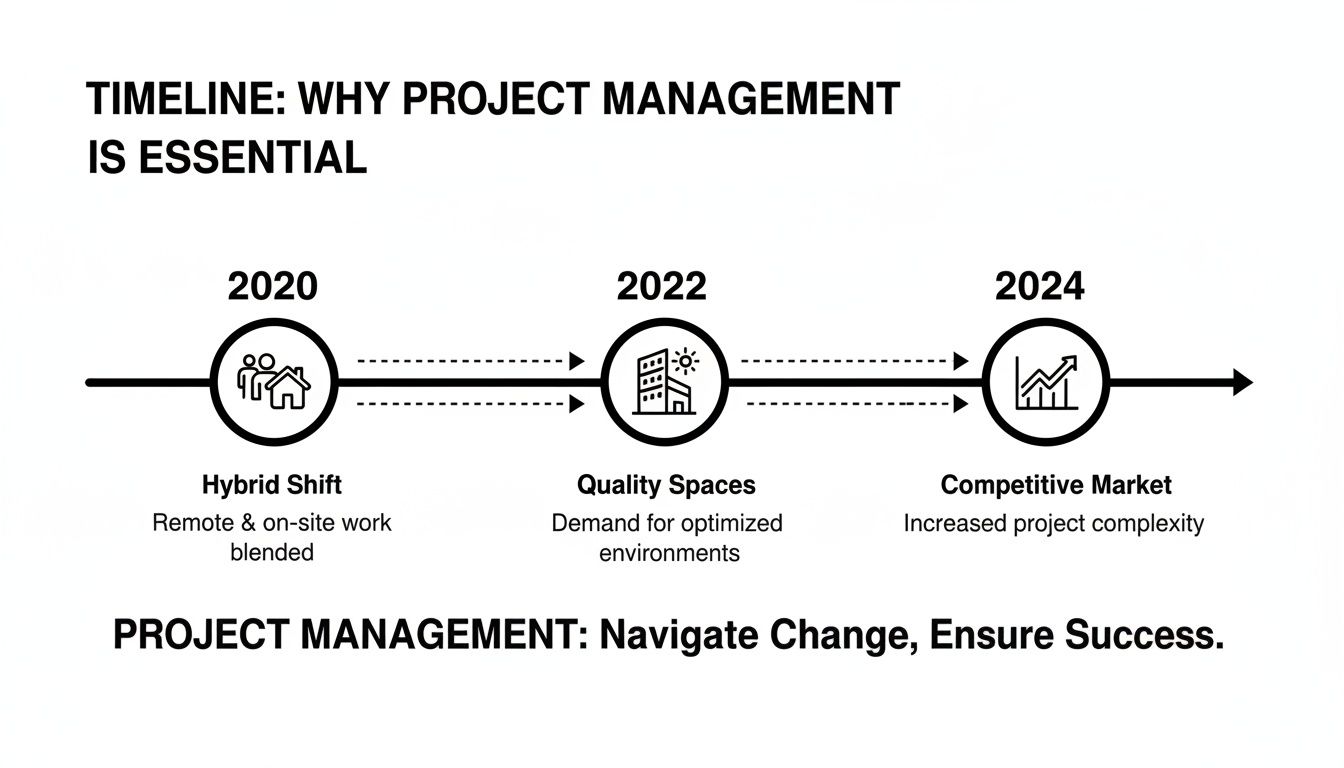
This just goes to show that a successful move is a long-term project, not just a quick logistical task.
Your timeline should be a flexible document, but setting firm milestones is crucial for keeping everything on track. Here’s a rough guide to what that looks like:
- 12+ Months Out: Nail down your objectives, get the core team together, and draw up an initial budget. This is also when you should start looking for a new property.
- 6-9 Months Out: Sign the lease on your new space. Now you can appoint your main suppliers, like the removals company and fit-out contractors, and start detailed space planning.
- 3-6 Months Out: Finalise the new office layout and design. It's time to order any new furniture and IT kit. You also need to develop a clear plan for communicating everything to your staff.
- 1-3 Months Out: Confirm the final move dates with all your suppliers. Start the big clear-out and get archiving. For a more detailed guide, our office move planning checklist breaks down every task to keep you organised.
A good timeline does more than just list deadlines. It builds a rhythm for the project, keeping everyone accountable and informed. It ensures every stakeholder, from the directors to the department champions, is on the same page from start to finish.
By putting in the effort to create this solid foundation—a clear blueprint and a capable team—you turn a potentially stressful process into a well-managed, successful project.
Mastering Your Budget and Vendor Logistics
Right, let's get down to the brass tacks: the money and the people you'll hire to make your move happen. A solid budget isn't just a spreadsheet of costs; it's your financial roadmap. It’s what keeps surprises at bay and prevents the entire project from spiralling out of control.
The biggest mistake I see companies make is only budgeting for the obvious things, like the movers and the first month's rent. A realistic budget digs much deeper, anticipating the hidden costs that can completely derail your plans.
Ever heard of dilapidation fees? It’s your legal duty to return your old office to its original state, and it can cost thousands. You also need to account for new IT infrastructure, updated signage, and professional cleaning at both your old and new sites. These costs add up fast.
Expert Tip: Always, always build in a contingency fund. I tell every client to set aside 10-15% of the total estimated budget for the unexpected. Trust me, something will always pop up. This buffer is what turns a potential crisis into a manageable hiccup.
Building Your Budget Line by Line
To get a real grip on your finances, you need to break down every single potential cost. Don't just have a single line item for "Fit-Out." Get granular. The more specific you are, the more control you'll have.
Think about segmenting your budget into clear categories:
- Professional Fees: This covers your solicitors handling the lease, building surveyors, and any space planners you bring in.
- Fit-Out and Refurbishment: All the construction work—new partition walls, electrical wiring, decorating, carpets, and so on.
- IT and Telecoms: This is a big one. It includes new data cabling, server migration, any new hardware, and getting your phones and internet up and running.
- Removals and Logistics: The core moving costs, such as the removal firm, crate hire, specialist IT moving services, and insurance.
- New Furniture and Equipment: Any new desks, chairs, storage, or kitchen appliances you'll need.
- Miscellaneous Costs: The small things that add up. Think new stationery with the updated address, marketing materials to announce the move, and maybe even a small welcome party for the team.
To give you a clearer picture, here’s a sample budget for a medium-sized business.
Sample Office Relocation Budget Breakdown
| Expense Category | Estimated Cost (£) | Percentage of Total Budget (%) | Notes |
|---|---|---|---|
| Fit-Out & Refurbishment | £35,000 | 35% | Includes partitioning, flooring, and decorating. |
| IT & Telecoms | £20,000 | 20% | New cabling, server migration, and comms setup. |
| Professional Fees | £10,000 | 10% | Solicitors, surveyors, and project management. |
| New Furniture | £10,000 | 10% | Desks, chairs, and breakout area furniture. |
| Removals & Logistics | £8,000 | 8% | Includes crate hire and specialist IT moving. |
| Dilapidations (Old Office) | £7,000 | 7% | Cost to return the previous space to its original state. |
| Contingency Fund | £10,000 | 10% | Essential buffer for unforeseen expenses. |
| Total | £100,000 | 100% |
This table illustrates how costs are distributed across a typical project, highlighting that the physical move is often a smaller part of the overall financial picture.
Selecting and Coordinating Your Key Vendors
With your budget mapped out, it's time to find the right partners. The quality of your vendors—from your removal company to your IT specialists—will make or break your move. This is one area where going for the cheapest quote can backfire spectacularly. You're paying for reliability and experience.
A good rule of thumb is to get at least three detailed quotes for every major service. When you compare them, make sure you're comparing apples with apples. A suspiciously cheap removal quote might not include proper insurance or the labour for dismantling and reassembling furniture.
Knowing what to look for in a removal company is half the battle, as they'll be your most visible partner on the day. Check their commercial moving experience, read recent reviews, and make sure they have the right gear for the job. Once you’ve hired your team, keep the lines of communication wide open. A quick weekly check-in call with your key vendors in the final month can iron out any potential issues before they become problems.
The Art of Packing and Labelling
You can have the best budget and the best team in the world, but if your packing and labelling is a mess, move day will be chaos. The goal is simple: make sure every item, from a server to a stapler, arrives at its exact new home. This is the secret to minimising downtime and getting your staff back to work fast.
A colour-coded system is the most effective method I've seen. It’s visual, simple, and hard to get wrong. Just assign a different colour to each department or zone.
Here’s how to put it into practice:
- Map It Out: Get a detailed floor plan of the new office and colour-code each area. For example, Marketing is blue, Sales is green, and the kitchen is yellow. Post these plans everywhere.
- Label Everything: Every single box, monitor, and piece of furniture needs a label showing its colour, destination room, and a unique crate number.
- Create an Inventory: Use a shared spreadsheet. Each department logs what's in their numbered boxes. If someone is desperately looking for their "special notebook" on day one, you can find it in seconds.
This systematic approach transforms unpacking from a treasure hunt into a smooth, organised process. It’s a seemingly small detail in the grand scheme of an office move, but its impact on a successful day-one launch is huge.
Executing a Seamless IT and Tech Migration

Let’s be honest. Of all the moving parts in an office relocation, the IT migration is the one that keeps people up at night. It’s where the most significant risks lie, and there's absolutely no room for error. A single misconfigured server or a delayed internet connection can bring your entire business to a grinding halt on day one.
A successful tech move is the unsung hero of the whole operation. When it’s done right, your team walks in, logs on, and barely notices it even happened. That’s the goal.
This part of your office relocation needs its own detailed plan, running in parallel with the physical move itself. It’s so much more than just unplugging computers and plugging them back in somewhere else. Think of it as a precision-timed operation involving servers, network gear, phone systems, and all the cloud services that keep your business ticking over.
The name of the game is absolute continuity. When your team arrives at their new desks, you want them getting straight to work, not calling an emergency helpline.
The Initial Technology Audit and Planning
Your IT migration strategy should kick off long before the first packing box appears. It all starts with a comprehensive audit of your entire technology stack. You need a complete inventory of every single piece of hardware and software, from the server racks and network switches right down to individual workstations and printers.
This audit does two crucial things. First, it clarifies what's coming with you, what needs a much-needed upgrade, and what can finally be retired. Second, it gives you the blueprint for mapping out the network layout of your new office. Will your existing Wi-Fi setup be enough, or do you need to install new access points for better coverage? Are there enough data ports for every desk? These are questions you need answers to now.
This is also the moment to get on the phone with telecom providers. Getting your broadband and phone lines installed and thoroughly tested well before move-in day is non-negotiable. Place those orders months in advance—you'd be surprised how long the lead times for new business connections can be.
Don’t just plan for the business you have now; plan for the business you want to be. An office move is the perfect chance to build an IT infrastructure that will support your growth for the next three to five years.
Decommissioning and Recommissioning with Precision
Moving your actual IT equipment is a delicate dance that has to be timed to perfection. This is not a job for general movers. You absolutely need specialists who understand how to handle sensitive, expensive hardware.
A detailed timeline for this phase is critical. Here’s what it typically involves:
- Systematic Shutdown: Plan a phased decommissioning of servers and network hardware at the old office. This is almost always best scheduled for a Friday evening to keep disruption to a minimum.
- Specialist Transport: Using anti-static bubble wrap and custom crates for servers is a must. For more advice, check out our guide on finding the right packing materials for moving.
- Priority Installation: Your core network infrastructure—the servers, routers, and switches—must be the very first thing installed and tested at the new location. Everything else depends on this.
- Workstation Setup: Once the core network is live and stable, the team can fan out and begin setting up individual PCs, monitors, and phones at each desk, following the new floor plan precisely.
During an office move, many businesses discover the advantages of outsourcing IT to a specialist firm. An external team can focus solely on managing this entire process, which frees up your own IT staff to handle the inevitable user support requests on move-in day.
Ensuring Business Continuity Through the Transition
So, how do you keep the business running while your core infrastructure is literally on the back of a lorry? This is where your business continuity planning really proves its worth. Zero downtime is the dream, and with careful planning, it’s entirely achievable.
The good news is that modern working trends make this easier than it used to be. With 26% of workers in Great Britain expected to be on a hybrid basis by February 2025, many companies already have solid remote work capabilities in place. This is often a key driver for relocating in the first place, as businesses reconfigure for hot-desking and more agile layouts.
Here are a few proven strategies to keep things moving during the transition:
- Lean on the Cloud: If your key systems are already cloud-based, the physical location of your office servers becomes far less of a bottleneck.
- Move in Phases: If your business can support it, consider moving departments in stages over a couple of weekends instead of a single 'big bang' move.
- Schedule a Remote Work Day: This is a fantastic tactic. Plan for all staff to work from home on the Monday immediately following the move. It gives your IT team a precious, pressure-free buffer day to test every connection and iron out any snags.
By meticulously planning every technical detail, from that first audit to the final workstation test, you can transform the IT migration from the riskiest part of your move into a seamless, successful transition.
Managing the Human Side of Your Office Move
It’s easy to get lost in the spreadsheets, timelines, and technical specs of an office move. But while you’re worrying about IT infrastructure and removal quotes, don't forget your most important asset: your people.
An office move is a huge disruption. Handled badly, it creates uncertainty and resistance. But get it right, and it’s a golden opportunity to boost morale and get everyone genuinely excited for what’s next.
The secret? A solid communication strategy. In my experience, silence is your worst enemy. It’s a vacuum that will quickly be filled with rumours and anxiety. Proactive, honest communication is the only way to manage this.
Don't Just Announce It, Launch It
Your communication plan isn't something you tack on at the end; it needs to be part of the project from the very first day. The moment the move is a definite "go," you need a plan for how you’ll tell the team.
Kick things off with a positive, open announcement where people can actually ask questions. Don't just send a memo. Frame the move around the benefits—maybe it's a more collaborative space, better facilities, or a location that’s a dream commute for most of the team. This first impression sets the tone for everything that follows.
After the initial buzz, keep the conversation going with regular, predictable updates. A monthly email newsletter or a dedicated Slack/Teams channel works wonders. Even small progress reports show that you haven't forgotten about them.
An office move is a story you're telling your team. By controlling the narrative with positive, clear, and consistent communication, you turn potential anxiety into shared anticipation.
Practical Ways to Get Your Team on Board
Engagement is more than just broadcasting information. It’s about making your team feel like they’re part of the journey, not just being herded from one place to another. Involving them in small but meaningful ways makes all the difference.
Here are a few things that have worked brilliantly on past projects:
- Share the Vision: As soon as you have the floor plans, share them! Let people see where their team will be sitting and get a feel for the new breakout areas. Visuals make it real.
- Create a Local Guide: If you’re moving to a new part of Bristol or Bath, pull together a simple guide. Map out the best transport links, highlight great lunch spots, and point out the nearest gyms. It shows you're thinking about their whole day, not just the hours they're at their desk.
- Organise "Hard Hat" Tours: If logistics allow, arranging small group visits during the fit-out phase is a game-changer. It builds a real sense of excitement and ownership.
- Plan a Small Welcome: On the first day, have a little welcome pack waiting on each desk. It doesn't have to be lavish—a branded mug, a decent pen, and a map of the new office layout makes everyone feel seen and valued.
Looking After Their Well-being and Safety
A new building means new health and safety procedures. Don't leave this until moving day.
Well before the move, make sure you clearly communicate the location of fire exits, first aid stations, and any new building-specific rules. It’s a simple step, but it shows a genuine commitment to their welfare.
Ultimately, navigating the human side of a move comes down to empathy and good planning. Keep your team in the loop, get them involved, and show them you care. Do that, and they'll arrive at their new desks feeling positive, motivated, and ready to get started.
Bringing the Plan to Life: The Move Itself
After months of careful planning, it’s time to see all that hard work pay off. The final weeks before an office move are always a whirlwind, but this is where your detailed project plan becomes your best friend, turning potential chaos into a controlled, structured process.
Your focus now splits into two key areas: saying a proper goodbye to your old office and getting the new one ready for day one. This isn't just about shifting boxes. It’s about scheduling the final deep clean of the old premises and making sure all utilities are set to be transferred. At the same time, you need absolute certainty that the new office is ready to go – especially crucial services like internet and phone lines. Test them. Then test them again before a single employee walks through the door.
The Final Countdown
In the last few days, your role shifts to that of an orchestra conductor. You’re coordinating all your vendors to ensure everyone knows their part and the timing is perfect.
- The All-Hands Vendor Call: Get your removal company, IT team, and cleaners on a final conference call. Run through the schedule one last time, confirm who has keys, what the access arrangements are, and who the point of contact is over the move weekend.
- The Final Employee Push: By the last afternoon, every desk should be cleared and all personal belongings packed. Make sure you’ve sent out clear, simple instructions telling everyone where to go and what to do on their first morning in the new space.
- Protect the Property: A quick but vital check: confirm your removal team will be putting down proper floor and wall protection at both sites. Scuffs and scrapes are the last thing you want to deal with.
Settling In and Ironing Out the Wrinkles
The last box might be in, but you’re not done yet. The first week is all about tackling the "snagging list" – those small, niggly issues that always pop up. It could be a door that doesn't quite close properly, a dodgy network port, or a missing lightbulb.
Expert Tip: Set up a shared "snagging list" using something simple like Google Sheets or a Trello board. This gives staff an easy way to flag problems as they find them and provides your project team with a live, organised list to work through with contractors.
This isn’t just about fixing teething problems; it’s about getting the space to 100% and showing your team that their comfort matters. Once the dust has settled, get your core project team together for a post-move review. What was a stroke of genius? What would you never, ever do again? Honesty here is gold dust for any future projects.
And don’t forget to celebrate! A welcome breakfast or some Friday drinks can do wonders to thank everyone for their patience and build some positive energy in the new space.
Making Your New Address Official
There's one final, crucial piece of the puzzle: telling the world where you are. This is a simple admin task, but overlooking it can cause real headaches.
Get your new address updated everywhere, and do it immediately. Start with your Google Business Profile, then your website's contact page and all your social media bios. Next, work through your list of banks, suppliers, and key clients to ensure invoices and deliveries don't go astray. This final push makes your new location official and paves the way for the next chapter of your business.
Your Office Move Questions, Answered
Even with the best-laid plans, a few questions always crop up during an office move. I've been managing commercial relocations for years, and these are some of the most common queries I hear from business owners and facilities managers in the thick of it.
When Should We Really Start Planning Our Office Move?
The honest answer? Much, much earlier than you think. For a medium-sized company, kicking things off 12 to 18 months in advance isn't over the top—it's just smart planning.
That sort of lead time gives you the breathing room you need to properly define your strategy, hunt down the right property (which is no small feat in a competitive market like Bristol or Bath), handle the lease negotiations, and design the fit-out without making panicked, last-minute decisions. Starting late is the number one reason moves get stressful and budgets spiral out of control.
How Can We Keep Staff Positive About the Move?
Change makes people nervous, and the office rumour mill can be brutal. Your best defence is open and honest communication from the very start. Announce the move yourself, clearly explaining why it's happening and what the benefits are. Maybe it’s better transport links, fantastic new facilities, or a workspace designed for better collaboration.
Get your team on board by involving them in small, meaningful ways. It makes a huge difference.
- Share the floor plans and some visuals of the new space as soon as you can.
- Get their input on things like the furniture for the new breakout area or the name of a meeting room.
- If you can swing it, organise a little "hard-hat tour" during the fit-out phase.
When you keep your team in the loop, the move stops being something that’s happening to them and becomes a journey they're part of. That change in perspective is absolutely vital for keeping morale high.
What Is the Single Biggest Mistake to Avoid?
Underestimating the sheer complexity of the IT migration. I've seen it time and time again, and it's easily the most common—and most costly—mistake a business can make.
Your IT isn't just another box to be moved; it's the central nervous system of your entire operation. Getting it wrong means instant, painful business disruption. You can't just lump moving your servers in with moving desks. It needs its own dedicated team, a ring-fenced budget, and specialist IT movers who know exactly what they're doing.
The goal is simple: on day one, your team should be able to walk in, switch on their computers, and get straight back to work. Anything less than that is a planning failure.
Ready to make your Bristol or Bath office move seamless and stress-free? The team at SimplyPro Removal & Storage Ltd has over two decades of experience in commercial relocations, from detailed planning to flawless execution. We handle everything, ensuring your business is back up and running with minimal downtime. Get your free, no-obligation quote today.