

Choosing the right size storage unit is simpler than you might think. As a rule of thumb, a one-bedroom flat usually needs a 25-35 sq ft unit, whereas the contents of a typical three-bedroom house often fit comfortably into a 75-100 sq ft space. Getting this right from the start means you won’t waste money on a unit that’s half-empty or, even worse, find yourself with a pile of belongings that just won’t fit on moving day.
How to Quickly Estimate Your Ideal Storage Size
Trying to figure out what size storage unit you need can feel like a bit of a guessing game. It's easy to get bogged down in abstract numbers like square feet. A much better approach is to actually visualise your stuff inside the space. This simple mental exercise can be the difference between getting it right and getting it wrong.
Think of this as a cheat sheet to avoid the most common mistakes we see. People either go too big and end up paying to store fresh air, or they underestimate just how much stuff they have and are left scrambling for a larger unit at the last minute. This quick overview will give you a solid starting point before you even think about making a detailed list.
Matching Your Home to a Unit
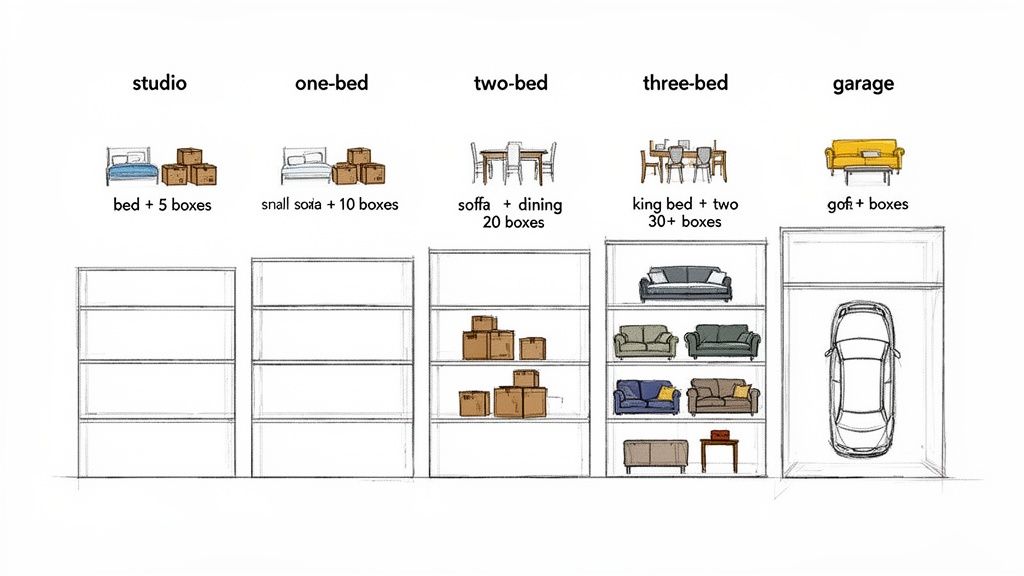
The easiest way to get started is to match your home's size to a standard UK storage unit. This is based on real-world experience we've gained helping countless Bristol customers over the years. For a more in-depth look with visuals and detailed item lists, check out our comprehensive storage unit size guide.
Here are a few common scenarios to get you thinking:
- Studio or One-Bedroom Flat: The contents of a smaller flat, including a bed, a small sofa, and around 20-30 boxes, will almost always fit neatly into a 25-35 sq ft unit.
- Two-Bedroom House: You'll likely need a 50-75 sq ft unit to comfortably hold furniture from two bedrooms, plus your living room and kitchen appliances.
- Four-Bedroom House or More: For larger family homes, especially those with garden furniture and garage clutter, a 100-150 sq ft unit is usually the best fit.
The goal is to match your real-life inventory—from that bulky wardrobe in the master bedroom to the boxes of seasonal decorations from the loft—with a space that fits just right. An accurate estimate saves you money, time, and stress.
Quick Reference Storage Unit Size Guide
To make things even clearer, here’s a table that breaks down the most common unit sizes and what you can realistically expect to fit inside them.
| Unit Size (sq ft) | Typical Household Equivalent | Commonly Stored Items | Roughly Equivalent To |
|---|---|---|---|
| 25-35 | Studio / One-Bedroom Flat | Double bed, sofa, small dining set, 20-30 boxes | A large garden shed |
| 50-75 | Two-Bedroom House | Two double beds, wardrobes, living room furniture, white goods | A single car garage |
| 100-125 | Three-Bedroom House | Contents of a family home, including garden tools and large appliances | One and a half Luton vans |
| 150+ | Four+ Bedroom House | Entire household contents, bulky furniture, business stock, equipment | A large double garage |
This table gives you a reliable reference point, but remember that awkwardly shaped items or poor packing can quickly eat up space.
Get It Right from the Start: Create a Smart Inventory
Guessing your storage needs based on your house size is a decent starting point, but if you want to get it spot-on, the secret is a smart, honest inventory. This isn't just about jotting down a quick list; it’s a strategic move that saves you from last-minute stress and stops you from paying for space you simply don't need. It’s often the one thing that separates a smooth move from a chaotic one.
Taking the time to walk through your home, room by room, gives you a truly realistic picture of what you're dealing with. This methodical approach is exactly what we use to give our most accurate quotes, whether you use our handy self-video surveys or we pop round for a traditional in-person visit.
Start with a Room-by-Room Walkthrough
Pick a room—the living room, for instance—and begin listing every single item you plan to store. Be specific. Don't just write "sofa"; note its dimensions and whether it can be taken apart. Is it a standard two-seater or a massive L-shaped sectional? The details really do matter.
A detailed inventory is your best friend here. If you're in the middle of a move, an essential moving inventory list template can be a lifesaver. It keeps you organised and makes sure nothing gets forgotten, from the telly right down to the smallest box of books.
Keep going until you’ve covered every room, not forgetting the loft, garage, and even the garden shed. It might feel a bit tedious, but trust me, this comprehensive list is the most powerful tool you have for figuring out what size unit you actually need.
The Declutter and Categorise Method
As you build your inventory, you’ll almost certainly come across things you haven't touched in years. Now is the perfect time to be ruthless and shrink the pile of stuff you need to store. This one step alone can often mean you can get away with a smaller, cheaper unit.
Try organising everything into three simple categories:
- Store: These are your non-negotiables—items you absolutely need to keep safe. Think essential furniture, important documents, and things with sentimental value.
- Sell or Donate: Items that are in good nick but no longer have a place with you can find a new home. This not only clears the clutter but can also put a bit of extra cash in your pocket for moving costs.
- Dispose: Be honest about what’s broken, outdated, or just plain rubbish. Getting rid of these items now saves you the hassle and cost of moving and storing them later.
By decluttering before you store, you are actively saving money. Every single item you decide not to keep is one less thing taking up paid-for space in your unit. It’s a simple equation that has a big impact on your final bill.
This whole process streamlines your move and helps you focus on what truly needs to be stored. It’s all about being practical and efficient with both your space and your budget.
Accounting for Awkward and Bulky Items
Some items take up far more space than their measurements suggest. From our years of experience with Bristol removals, we know the common culprits that can throw your calculations way off if you don't plan for them properly. A king-size mattress, for instance, can't be bent, and a wardrobe that doesn't come apart will dominate a unit.
Here’s how to think about those tricky items:
- Sofas and Armchairs: Measure their length, width, and height. Can the legs be removed? A pro tip is to store sofas vertically on their end—it saves an enormous amount of floor space.
- Mattresses and Bed Frames: A king-size mattress needs a unit with enough height or length to stand it on its side. Bed frames that can be disassembled become much more manageable pieces.
- Garden Equipment: Lawnmowers, wheelbarrows, and long-handled tools are notoriously awkward. They don’t stack neatly and usually need their own dedicated floor space.
- White Goods: Fridges, freezers, and washing machines are heavy and bulky. Make sure they are completely empty, cleaned, and dried before storing to prevent any mould from growing.
Once you have this detailed, decluttered, and realistic inventory, you're no longer guessing. You have a precise list that translates directly into the cubic footage you need, letting you choose the perfect storage unit size with complete confidence.
From Small Lockers to Double Garages: A Visual Guide
Once you’ve got that detailed inventory list, it’s time to match it to a real-life storage unit. This is where we stop thinking in abstract lists and start visualising your belongings inside a physical space. I’ve found the best way to do this is to stop focusing on square footage and start comparing units to spaces you already know.
Think of it this way: a small unit is like a large walk-in wardrobe, while a medium one feels more like your garden shed. Suddenly, it’s much easier to picture whether your king-size bed or that bulky armchair will actually fit. It’s all about making the numbers relatable.
The Compact Choice: Small Units (25-35 sq ft)
Often called "lockers" or "small room" units, these are the go-to for storing the contents of a single room, a student flat, or finally clearing out the loft. A 25 sq ft unit is about the size of a generous walk-in wardrobe and is perfect for short-term needs or seasonal decluttering.
It’s the ideal space for everything from a studio flat except the big furniture. You can easily stand a double mattress on its side, slide in a small chest of drawers, and still have room for plenty of boxes and odd bits like a bicycle or a TV. It’s a smart, budget-friendly choice when you only need to store specific things.
If you need a bit more breathing room, a 35 sq ft unit is your best bet. It’s comparable to a small garden shed and can comfortably hold the basics from a one-bedroom flat. This usually includes:
- A double bed and mattress
- A small two-seater sofa
- A chest of drawers and a bedside table
- Roughly 20-30 medium-sized boxes
- Small appliances like a microwave or a hoover
This size is a real favourite among students between uni terms or homeowners who are redecorating a room. It gives you just enough space to get everything out of the way without paying for a single inch you don’t need.
Finding the Right Balance: Mid-Sized Units (50-75 sq ft)
When you're packing up a one or two-bedroom flat, a mid-sized unit usually hits the sweet spot. A 50 sq ft unit is roughly the size of a large garden shed, offering a solid amount of space for furniture and a good number of boxes. It's one of our most popular choices for people moving out of a two-bedroom flat or a small house.
In a 50 sq ft unit, you can comfortably fit the major pieces from your living room and bedroom, plus your kitchen appliances. I've seen customers fit a three-seater sofa, a couple of armchairs, a dining table and chairs, and white goods like a washing machine and fridge-freezer all in one.
Stepping up to a 75 sq ft unit gives you a space similar to a single-car garage. This is what I’d recommend for the contents of an average two-bedroom house. You can store multiple large furniture items, garden equipment, and a serious amount of boxes. A typical load for this size would be:
- Two double beds with mattresses
- Several wardrobes and chests of drawers
- Living room furniture (sofas, coffee table, TV stand)
- All major kitchen appliances
- Around 50-60 boxes of various sizes
The Room-for-Everything Option: Large Units (100-150 sq ft)
For a full family home move, a large storage unit is almost always the answer. A 100 sq ft unit is perfect for a standard three-bedroom house. It provides enough room for all your furniture, appliances, and personal belongings without you having to play a stressful game of Tetris. That extra space helps prevent damage.
This unit can hold everything from bedroom sets and living room suites to garden furniture and the contents of your garage. Crucially, it leaves you enough space to create a small aisle, making it far easier to access things if you need to grab something mid-storage.
For four-bedroom houses or larger properties, the 150 sq ft unit is your solution. It's comparable to a large double garage and is also a common choice for businesses storing stock, archives, or office furniture. It handles bulky and awkwardly shaped items with ease—think large corner sofas, American-style fridge-freezers, or even a piano.
This handy flowchart breaks down how you can approach your inventory.
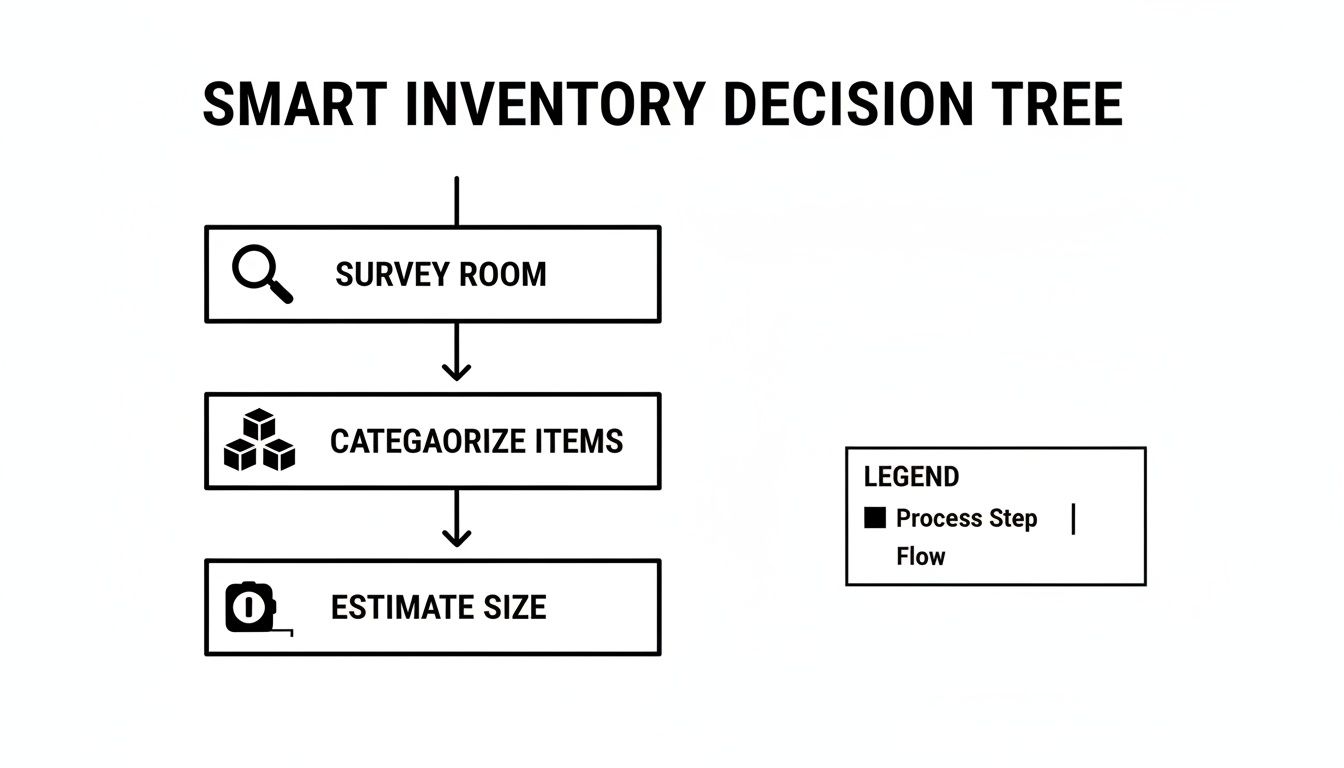
By methodically going through your rooms and grouping your items, you’ll get a much clearer, more accurate estimate of the space you really need.
It’s interesting to see how market trends reflect this. Did you know that in the UK self-storage market, a 25 sq ft unit is often the perfect size for city dwellers, like someone decluttering a small Bristol flat or Bath bedsit? The industry has a massive 64.3 million sq ft of space after a 7.2% year-on-year increase, yet average occupancy is a healthy 75.1%. This means plenty of smaller units are usually available right when people need them. You can read the full self-storage industry report for a deeper dive.
Real-World Scenarios: What Unit Size Fits Your Needs?
To make it even clearer, I've put together a quick comparison table based on the most common scenarios we see every day, for both home moves and business needs.
| Scenario | Typical Items | Recommended Unit Size (sq ft) | SimplyPro Solution |
|---|---|---|---|
| Student Summer Storage | Double bed, desk, chair, 20-25 boxes, TV, bicycle | 35 sq ft | Small "Locker" Unit |
| 1-2 Bedroom Flat Move | Sofa, double beds, wardrobes, white goods, 40-50 boxes | 75 sq ft | Medium "Single Garage" Unit |
| 3-4 Bedroom House Move | Multiple sofas, beds, all furniture, garden tools, 80+ boxes | 150 sq ft | Large "Double Garage" Unit |
| Small Business Stock | E-commerce inventory, marketing materials, 30-40 stock boxes | 50 sq ft | Medium "Shed" Unit |
| Office Relocation | Desks, chairs, filing cabinets, IT equipment, archive boxes | 100 sq ft | Large "Standard Garage" Unit |
Seeing these real-world examples side-by-side helps translate your personal inventory list into a tangible unit size, ensuring you book the right space from the start.
Real-World Scenarios: Finding Your Perfect Fit
Guides and charts are one thing, but nothing really answers the question, "what size storage unit do I need?" like seeing it in practice. Theory only gets you so far; it’s the real-life examples that make it all click.
So, let's walk through a few common situations we see every day with our customers in Bristol and Bath. These aren't just made-up examples—they're based on thousands of moves and storage jobs we’ve handled over the years. By seeing how these scenarios play out, you can get a much better feel for your own needs and make a confident, cost-effective choice.
The Young Professional Relocating a One-Bedroom Flat
First up, meet Alex. Alex is a young professional moving from a one-bedroom flat in Clifton to a new job in another city. There was a gap of a few weeks between moving out and getting the keys to the new place, so Alex needed a temporary home for everything.
The inventory was pretty standard for a modern one-bed: a double bed and mattress, a two-seater sofa, a small dining table with two chairs, a desk, an office chair, a TV, and about 30 boxes of books, clothes, and kitchen stuff. No bulky garden equipment or garage clutter to worry about.
After a quick look, we suggested a 35 sq ft unit. This gave Alex just enough room to stand the sofa on its end, place the mattress on its side, and stack all the boxes neatly without anything getting crushed. It was the perfect fit—not an inch of wasted space, which meant Alex wasn't paying for empty air.
The Family Staging Their Three-Bedroom House for Sale
Now, let's look at the Miller family. They were selling their three-bedroom house in the Bath suburbs, and their estate agent recommended a serious declutter to make the home look more spacious for viewings. They needed to store non-essential furniture, personal items, and general household overflow for a few months.
Their storage list was quite a bit longer:
- A spare double bed and a child’s single bed
- Several chests of drawers and bookcases
- Out-of-season clothing and sports gear (skis, camping equipment)
- A huge collection of kids' toys and books
- Around 50 boxes of photos, documents, and sentimental items
For the Millers, a 75 sq ft unit was the ideal solution. It was big enough to hold everything comfortably while still leaving a small walkway down the middle. That access was vital, as they knew they'd need to pop in and grab things occasionally. This choice let them present a beautifully staged home, which helped them get a quicker sale at a better price. The storage cost was a worthwhile investment.
Choosing a unit that allows for an access aisle is a game-changer for long-term storage. It saves you from having to empty half the unit just to find one specific box at the back.
This mid-size unit is a really versatile option for lots of families. If you're looking to store the contents of a two-bed household while house-hunting in Bath, a 50-75 sq ft unit is often spot on. The wider UK self-storage industry shows just how popular these are—it's a market with a turnover hitting £1.2 billion and rental returns up by 6%. Even with a slight dip in occupancy to 75.1%, these mid-sized units are always in demand for holding sofas, wardrobes, bikes, and dozens of boxes. You can see more on this in this insightful UK storage statistics report.
The Local Business Downsizing Its Office Space
Our final scenario involves a small marketing agency in central Bristol that was shifting to a hybrid work model. They didn't need their big office anymore but wanted to hang on to essential equipment, furniture, and archived documents without paying for a costly commercial lease.
Their inventory included:
- 10 desks and office chairs
- 4 large filing cabinets crammed with paperwork
- Server racks and other IT hardware
- 60+ archive boxes of old client files
- Promotional materials and event banners
For this kind of commercial job, a 100 sq ft unit was the right call. It easily accommodated all the furniture and boxes, with enough room left over to set up organised shelving units. We made sure they had ground-floor access, which made it simple for them to drop off or pick up files whenever they needed. By using professional storage, the business saved a fortune on rent while keeping their assets safe, organised, and ready for their new, more flexible way of working.
How To Pack And Stack Like A Pro To Maximise Your Space
Picking the right size unit is only half the battle. How you actually fill that space is what makes all the difference, and it's where you can really get your money's worth. A well-organised unit not only keeps your belongings safe but can often mean you can get away with a smaller, more affordable unit. We've seen it all over the years, so here are a few insider tips straight from our professional removal crews on how to pack and stack like you've been doing it for a lifetime.
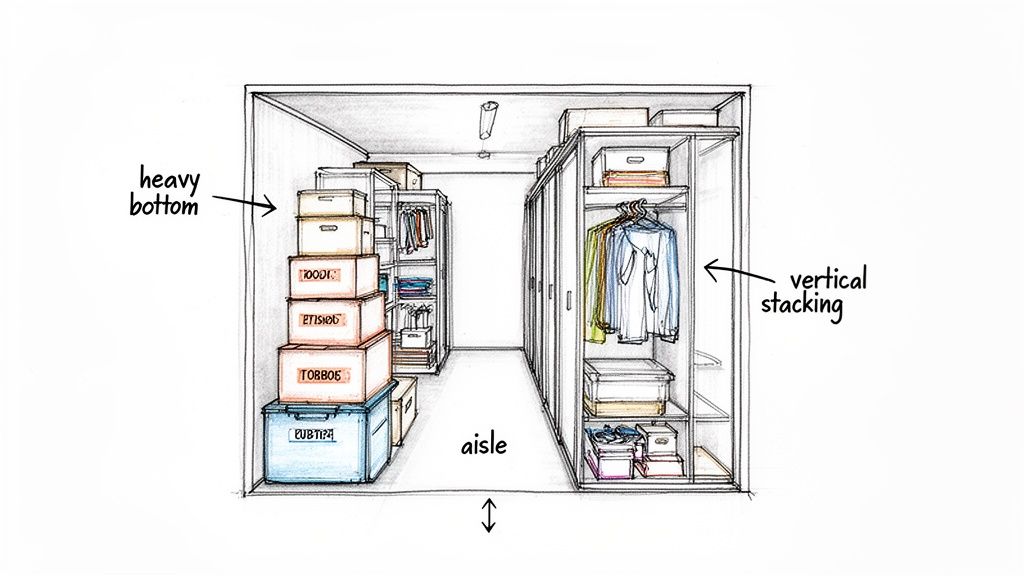
Honestly, the biggest mistake people make is only thinking horizontally. You're not just paying for the floor space; you're paying for the entire volume of the unit, right up to the ceiling. This is why mastering the art of vertical stacking is an absolute game-changer. It starts with using sturdy, similar-sized boxes that can be stacked high without caving in.
The Foundations Of Smart Stacking
Think of loading your unit like you're building a brick wall – the heaviest, most robust items have to form the base. This gives you a solid, stable foundation for everything else you need to pile on top.
- Heavy Items First: Get things like washing machines, chests of drawers, and boxes of books on the floor level. Try to distribute the weight evenly across the space.
- Medium-Weight Next: On top of that solid base, you can start stacking lighter boxes, small furniture pieces, and dismantled items.
- Lightest On Top: Anything fragile, soft furnishings like cushions, and items in bags should always be placed at the very top of your stacks.
Following this simple logic prevents crushing and damage, but it also makes sure you’re using every last cubic foot. A quick tip: label your boxes clearly on the top and at least one side. It will save you from having to unstack a tower of boxes just to find one thing.
Create An Aisle For Easy Access
It's so tempting to cram every last inch of the unit full, but trust us, you'll regret it later. We always tell our clients to leave a central aisle, even if it's a narrow one, that runs from the door right to the back.
A simple walkway transforms your unit from a cluttered box into an organised archive. It means you can access items at the back without having to completely empty the unit first—a lifesaver for medium or long-term storage.
This bit of forward-thinking is especially crucial for our business clients. For Bristol office moves, those larger 100-150 sq ft units become workhorses, holding desks, filing cabinets, and servers. According to recent SSA UK data, 24% of storage users are actually businesses, with industry revenue up 6%. When you need to grab an urgent file or a piece of equipment, that organised access is non-negotiable.
Use Every Nook And Cranny
Don't let empty space go to waste—especially the space inside your own furniture. Think of wardrobes, drawers, and even fridges (just prop the door open slightly to prevent mould) as bonus storage containers. They're perfect for stashing smaller, lighter things like clothes, bedding, or kitchen utensils.
Using the right supplies is also key to protecting your goods. To get you started, we’ve put together our expert recommendations in our guide to the best packing materials for moving. You might also find that tips like understanding cling film for better protection can be surprisingly helpful for keeping things organised and safe. A little extra care during packing ensures everything comes out of storage in the exact condition it went in.
Ready for a No-Fuss Bristol Storage Quote?
Once you've got a good idea of the storage unit size you need, the next step is getting a clear, competitive quote. This part of the process should be completely straightforward, giving you all the facts you need to make a solid decision without any sales pressure.
We've made getting a quote as easy as possible. You can skip the hassle of scheduling home visits with our clever mobile self-video survey. Just walk through your home with your smartphone and show us what you plan to store. It’s a quick, accurate, and modern way to get things sorted on your own time. Of course, if you'd rather see a friendly face, we're always happy to pop round for a traditional in-person survey.
How to Get Your Quote
Getting started couldn't be simpler. Whether you go for the video option or a home visit, our aim is to give you a transparent and detailed estimate. No hidden costs, no surprises on the day.
A quote should be more than just a number; it's the beginning of a trusted partnership. We're here to handle all the logistics—from professional packing and transport to secure storage—so you can focus on the important things during your move.
Ultimately, we put you in control. You choose the quoting method that works for you. For more details on our secure facilities or to book your survey, take a look at our comprehensive Bristol storage solutions. Let us handle the heavy lifting.
Your Storage Questions Answered
Even after planning everything down to the last box, a few lingering questions often come up. It's completely normal. Here are some straightforward answers to the queries we hear most often from our customers around Bristol and Bath, designed to give you that last bit of confidence before you book your unit.
Is It Better To Get A Slightly Bigger Unit, Just In Case?
It’s tempting to go a size up for "breathing room," but honestly, it’s usually more cost-effective to get your inventory right from the start. A few minutes measuring and listing what you have can save you a surprising amount of money over time. Our self-video survey tool is perfect for this, as it helps you build a really accurate picture of the space you actually need.
That said, if you’re genuinely stuck between two sizes, the larger option does make it easier to get to your things and allows for better air circulation. But for most people, a well-packed smaller unit does the job perfectly. We can always chat through your specific list of items and give you a steer on what would be best.
The most common mistake we see is people paying for "peace of mind" they don't actually need. A proper inventory is what gives you real confidence – and saves you cash every single month.
What Am I Not Allowed To Put Into Storage?
This is a big one. For everyone's safety and to keep our insurance valid, there are some things that simply can't be stored in our units. It's really important to know what these are before you start packing.
As a general rule, the list of prohibited items includes:
- Any kind of perishable food – it's a magnet for pests.
- Flammable or combustible materials, things like petrol, paint, gas canisters, or even aerosols.
- Explosives, which includes fireworks and ammunition.
- Illegal substances or any goods that have been obtained unlawfully.
- Living things, so no plants or animals.
If you’ve got something more specialised, like delicate IT gear or valuable artwork, just give us a heads-up. We'll make sure it's stored under the right conditions and fully covered by our comprehensive insurance policy.
How Do I Get To My Things Once They’re In The Unit?
It's a great question to ask upfront, as access arrangements can vary. Here at SimplyPro, we make sure you have flexible and straightforward access to your belongings. The best thing is to chat with us about how often you think you'll need to pop in before you finalise your booking.
For example, if you know you'll need to grab business files regularly or want access to seasonal bits like garden furniture, we can plan the layout of your unit with you. We’ll make sure those items are placed right at the front, so your visits are quick, easy, and completely hassle-free.
Do I Need To Sort Out Special Insurance For My Stuff?
Yes, absolutely. Having proper insurance cover isn't just a good idea; it's essential for your peace of mind. SimplyPro includes comprehensive insurance for all your goods, protecting them from the moment we pick them up, during transit, and for the entire time they're in our facility.
We'll run through the total value of your items with you to ensure you have the correct level of cover. It’s a crucial step that protects you from the unexpected, like fire or theft. We handle all the details, so it's one less thing for you to worry about.
Ready to figure out exactly what you need? Let the friendly team at SimplyPro Removal & Storage Ltd help you find the perfect, most cost-effective storage solution. Book your free self-video survey today!