


Moving home is a whirlwind of boxes, bookings, and big decisions. Amidst the chaos of packing and planning, one critical task often gets fragmented and overlooked: methodically updating your address. Forgetting just one key organisation can lead to serious consequences, from missed bills and late payment fees to identity theft risks and a lapse in essential services. This is why knowing exactly who to notify when you move is not just an administrative task, but a crucial step in safeguarding your finances, security, and peace of mind.
This comprehensive guide transforms that daunting task into a manageable, timed checklist. We'll detail every individual and organisation you need to contact, breaking down the process into clear stages: what to do four weeks before you move, what to handle in the final week, and who to contact right after you've unpacked. You will find actionable steps, UK-specific resources like the Royal Mail's Redirection service, and practical tips to ensure a seamless transition. Updating your physical address is also a good reminder to review your digital security; a move is an ideal time to assess things like how often should you change your passwords to protect your online accounts.
Let's get you organised so you can focus on settling into your new home, confident that every important letter and notification will follow you there without any hassle.
1. United States Postal Service (USPS)
Topping the list of who to notify when you move is the official postal service. In the UK, this is Royal Mail, but the principle is identical to the United States Postal Service (USPS) Change of Address system. This crucial first step ensures that any mail sent to your old address is automatically redirected to your new home, acting as a vital safety net for any notifications you might have missed.
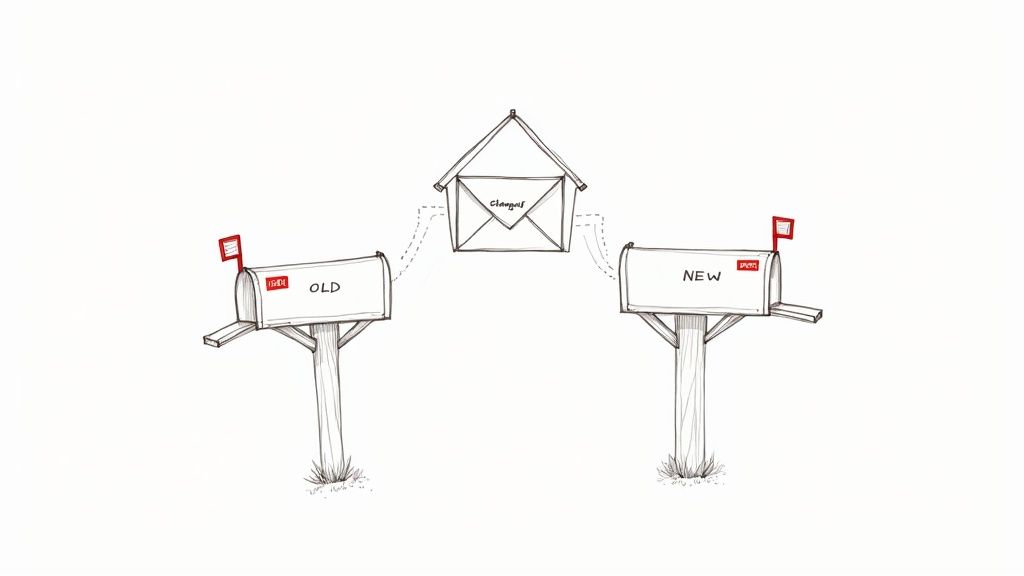
This service is indispensable for everyone, from families moving to a new neighbourhood in Bristol to businesses relocating their offices. It prevents sensitive documents, bills, and personal letters from falling into the wrong hands or being returned to the sender. While it’s a temporary solution, it buys you valuable time to update your details directly with each organisation.
How to Implement Mail Redirection
The process is straightforward and can typically be completed online in minutes.
- Timing is Key: Arrange your mail redirection at least two to four weeks before your moving day to ensure it activates on time.
- Online Application: The quickest method is to use the official Royal Mail Redirection service online. You will need proof of your old and new addresses.
- Confirmation: Once your application is processed, you will receive a confirmation letter. Keep this document safe for your records.
- Direct Updates: Remember, mail redirection is a temporary fix. You must still update your address directly with critical bodies like your bank, the DVLA, and healthcare providers.
Key Insight: Think of mail redirection as your primary defence against missed communications. It catches everything you haven't yet updated, from forgotten magazine subscriptions to unexpected letters from former employers, making it an essential part of any organised move. To stay on top of all tasks, review a comprehensive checklist to move out.
2. Banks and Financial Institutions
Next on your list of who to notify when you move are your financial institutions. This includes your high-street bank, building society, credit card providers, and mortgage lender. Your address is a primary security verification tool, used to authorise transactions, prevent fraud, and deliver sensitive documents like new cards, PINs, and statements. Failing to update it can lead to locked accounts or critical correspondence being sent to your old address.
This step is vital for anyone managing their finances, from a student in Bath with a single current account to a family in Bristol with multiple credit cards and a mortgage. An outdated address can cause delays in receiving replacement debit cards or even trigger a security alert, disrupting your access to funds when you need them most. Ensuring your bank has your correct details provides peace of mind and seamless financial management during your move.
How to Update Your Financial Details
Most banks offer simple online methods for updating your address, though some may require a branch visit for security.
- Timing is Key: Inform your bank and credit card companies at least one to two weeks before your move. This allows time for their systems to update and for any new cards to be ordered if necessary.
- Online Banking Portal: The fastest way is to log into your online banking or mobile app. Look for the 'personal details' or 'profile' section to change your address.
- Consolidate Updates: If you have multiple products with the same bank (e.g., a current account and a credit card), confirm if updating your address in one place applies to all accounts.
- Check Automated Payments: Review any direct debits or standing orders linked to your old address, such as council tax or local memberships, and update them accordingly.
Key Insight: Don't just update your address; review all contact information. A new address is a perfect opportunity to ensure your phone number and email are also current. This strengthens your account security and ensures you receive digital notifications and fraud alerts without delay, which is a critical part of managing your finances safely.
3. Employer/Human Resources Department
Just as crucial as government bodies, your employer is a high-priority contact on the list of who to notify when you move. Your HR department relies on accurate address details for a range of critical administrative functions, including payroll, tax documentation, benefits administration, and maintaining up-to-date emergency contact information.
Failing to update your employer can lead to significant issues, such as your P60 or P45 forms being sent to an old address, delays in receiving important communications about your pension or company benefits, and incorrect tax calculations. For any employee, from a part-time retail worker in Bath to a senior executive in Bristol, ensuring your employment records are correct is non-negotiable for financial and professional stability.
How to Update Your Employer
Most modern companies offer a streamlined process for updating personal details, but it is always best to confirm the change has been registered.
- Timing is Key: Inform your HR department or line manager at least two to four weeks before you move. This gives them ample time to update payroll and other systems.
- Use the Official Channel: Many companies use a self-service employee portal where you can update your address directly. If not, send a formal email or fill out the required paperwork.
- Verify the Change: Check that your new address appears correctly on your next payslip. This is the simplest way to confirm the update has been processed.
- Review Beneficiaries: Moving can be a good time to review and update the address details for any beneficiaries listed on your life assurance or pension policies.
Key Insight: Updating your employer is not just about where to send your post; it directly impacts your tax code, pension contributions, and critical benefit communications. A delayed or missed P60 can cause major headaches during tax season, making this a simple but vital task in any organised move.
4. Insurance Companies (Auto, Home, Renters)
Another critical group on the list of who to notify when you move is your insurance providers. Your address is a fundamental factor in calculating premiums for car, home, and contents insurance, as it directly relates to risk assessment. Failing to update this information can invalidate your policy, leaving you unprotected in the event of a claim.
This step is essential for maintaining continuous cover. For instance, relocating from a rural village to central Bristol could increase your car insurance premium due to higher traffic and theft rates. Conversely, moving to a neighbourhood with lower crime statistics might reduce your home insurance costs. Informing your insurers ensures your coverage is accurate and legally binding for your new circumstances.
How to Update Your Insurance Policies
Contacting your insurers should be done before your moving day to avoid any gaps in cover.
- Proactive Notification: Inform all your insurance providers of your new address and moving date at least two to three weeks in advance.
- Request Written Confirmation: Once you have updated your details, ask for a confirmation email or letter showing the policy changes for your records.
- Review and Adjust Cover: Your new home may have different features, like improved security systems or a higher rebuild cost. Use this opportunity to review your policy to ensure your level of cover is still appropriate.
- Check for Bundles: If you have separate providers, ask about potential discounts for bundling your car and home insurance together at your new address.
Key Insight: Updating your address is not just an administrative task; it’s a policy requirement. A new postcode can significantly alter your premiums, sometimes in your favour. It's also a good time to ensure your policy reflects the true value of your possessions, especially after acquiring or decluttering items during the move. For peace of mind, consider the benefits of specialist removals insurance to protect your goods in transit.
5. State/Local Government Agencies (DVLA and Vehicle Registration)
Just as crucial as updating your bank details is informing the relevant driving and vehicle licensing authorities. In the UK, this is the Driver and Vehicle Licensing Agency (DVLA). Failing to update the address on your driving licence and vehicle log book (V5C) can result in significant fines, so it’s a non-negotiable task on your moving checklist.
This step ensures that all official correspondence, including vehicle tax reminders, speeding notices, and licence renewal alerts, is sent directly to your new home. For anyone who drives, from commuters in Bristol to families taking weekend trips, keeping these records current is a legal requirement that prevents serious penalties and ensures you remain a lawful road user.
How to Update Your DVLA Details
The process is free, quick, and can be done entirely online, making it one of the easier updates on your list.
- Act Promptly: You must update your address with the DVLA as soon as you move. Don’t delay this, as there is no grace period.
- Online Service: Use the official GOV.UK service to change the address on both your driving licence and your vehicle’s V5C log book. You will need your driving licence number and V5C number.
- Prepare Your Documents: While the online service is efficient, have your current licence and V5C to hand before you begin to ensure all details are entered correctly.
- Update Both Documents: Remember to update the address on your driving licence and your vehicle registration (V5C) separately. These are two distinct processes, and both are legally required.
Key Insight: Updating your DVLA details is more than just an administrative task; it’s a legal obligation with financial consequences for non-compliance. Making this a priority on moving day ensures you avoid potential fines of up to £1,000 and helps keep your official records accurate and secure.
6. Utility Companies (Electric, Gas, Water, Internet)
A seamless transition of essential services is fundamental to a stress-free move, making utility companies a high-priority group of who to notify when you move. This involves arranging to disconnect services at your old property and activating them at your new one. Unlike some accounts, you will typically need to close your existing utility accounts and open new ones, even if you are staying with the same provider, as services are tied to the specific property.

Coordinating these switches prevents you from paying for utilities at an empty property or arriving at your new home to find no electricity, heating, or internet. Whether moving to a new flat in Bath or a larger family home, managing this process correctly ensures you are only billed for what you use and that your new home is comfortable and connected from day one.
How to Manage Utility Transfers
Planning ahead is crucial for a smooth handover of your gas, electricity, water, and broadband services.
- Advance Notice: Contact your current and new utility providers at least three to four weeks before your move. This gives them ample time to schedule the necessary disconnections and connections.
- Schedule Final Readings: Arrange for a final meter reading on your moving day. Take a time-stamped photo of the meters at your old property for your records before you leave.
- Activate New Services: Schedule the activation of services at your new home for your move-in day or the day before. It is particularly important for internet services, which can sometimes take longer to set up.
- Settle Final Bills: Ensure you receive and pay the final bill for your old address to formally close the account. Keep a record of the payment and account closure confirmation.
Key Insight: Don’t assume services will be active when you arrive. Proactively setting up accounts for your new home ensures you have heating, hot water, and Wi-Fi from the moment you get the keys. A detailed moving house checklist can help you track these crucial dates and communications.
7. Creditors and Credit Card Companies
Informing your credit card providers and other creditors is a vital security measure when moving. An incorrect billing address can lead to missed statements, late payment fees, and even a dip in your credit score. More critically, it creates a fraud risk, as sensitive financial documents could be delivered to your old address.
Updating your billing address is non-negotiable for anyone with a credit card, personal loan, car financing, or any other form of credit. This simple action ensures you continue to receive paper statements and that your new address is on file for security verification purposes. Failing to update this is a common oversight that can have significant financial consequences.
How to Update Your Creditors
Most financial institutions offer simple online portals to make this change quickly.
- Timing is Key: Notify all your creditors two to three weeks before you move. This gives them ample time to process the change before your next billing cycle.
- Use Online Portals: The fastest way to update your address is by logging into your account on the creditor's website or mobile app. Look for the "Profile" or "Settings" section.
- Keep Records: After updating your details, make a note of any confirmation numbers or save the confirmation emails for your records.
- Verify the Change: Check that your new address appears correctly on your next statement or transaction notification. This confirms the update was successful.
Key Insight: Your billing address is often used as a primary security check for online or phone transactions. Keeping it current not only ensures you get your statements but also prevents your cards from being declined due to a security mismatch, providing a crucial layer of fraud protection.
8. Healthcare Providers and Insurance (Medical, Dental, Vision)
Ensuring a seamless transition for your healthcare is a non-negotiable part of any move. This involves notifying your entire network of providers, including your GP, dentist, optician, and any specialists you see. Updating your details is vital for receiving appointment reminders, managing prescriptions, handling billing, and ensuring your records are accurate for emergency situations. This is another key organisation on the list of who to notify when you move.
This step is critical whether you're moving across Bristol and need to register with a new NHS surgery or simply moving down the street. A lapse in communication can lead to missed appointments, delays in prescription renewals, and crucial correspondence being sent to your old address. It also ensures your health insurance provider has the correct details to process claims and send policy updates.
How to Manage Your Healthcare Transition
A proactive approach prevents potential gaps in your medical care during the move.
- Timing is Key: Inform your current providers at least four weeks before your move. This gives them ample time to prepare your records for transfer if needed.
- Find New Providers: Before you move, research and register with a new GP, dental practice, and other necessary healthcare services in your new area. Your current GP can often advise on transferring medical records.
- Update Insurance Details: Contact your health, dental, and vision insurance providers to update your address. This can usually be done online or over the phone and prevents any disruption to your cover.
- Prescription Management: Speak to your current GP about getting an adequate supply of any regular medication to last during the transition. Arrange to have your prescriptions transferred to a pharmacy near your new home.
Key Insight: Request a physical or digital copy of your medical records before you move. Having this information on hand can be incredibly useful for your first appointment with a new doctor, providing them with a complete and immediate overview of your health history.
9. Government Benefits Agencies (Social Security, Veterans Affairs, Unemployment)
For those receiving government support, informing benefits agencies is a non-negotiable step in the moving process. Agencies like the Department for Work and Pensions (DWP), which manages State Pension, Universal Credit, and other benefits, require your new address to ensure payments continue without interruption and that you receive critical correspondence. This is a crucial notification for anyone who to notify when you move to prevent financial hardship.
Failing to update your details can lead to suspended payments, missed appointments, or delays in receiving important documents about your entitlements. Whether you receive a State Pension, disability benefits, or jobseeker's allowance, providing your new address in a timely manner ensures the continuity of this vital support system. It’s a simple action that safeguards your financial stability during the transition to a new home.
How to Update Your Details with Benefits Agencies
Each benefit may have a slightly different process, but the general approach is consistent and can often be managed online or over the phone.
- Act Promptly: Notify the relevant agency at least three to four weeks before your move to allow sufficient time for their systems to update.
- Use Official Channels: For benefits like Universal Credit, you can typically report a change of circumstances through your online account. For State Pension and other benefits, you may need to call the relevant pension centre or helpline.
- Have Information Ready: You will need your National Insurance number, your old address, and your new address to complete the update.
- Request Confirmation: Always ask for written or email confirmation that your address has been changed. Keep a record of the date you made the request and who you spoke to.
Key Insight: Benefit payments are often tied directly to your registered address for verification purposes. A delay in updating this information can trigger fraud prevention systems, leading to a temporary halt in payments. Updating your address proactively is the best way to ensure your financial support remains seamless and reliable throughout your move.
10. Subscription and Membership Services (Clubs, Streaming, Subscriptions)
In our modern, convenience-driven world, it's easy to overlook the myriad of subscription services and memberships we accumulate. From your local gym membership and monthly subscription boxes to streaming platforms like Netflix or Spotify, each one holds your address and billing details. Neglecting to update them is a common oversight when considering who to notify when you move, but it can lead to service interruptions, delivery errors, and billing complications.
This step is crucial for anyone with recurring payments or physical deliveries. A magazine subscription sent to your old address is lost money, while an outdated billing address on a streaming service could lead to a sudden and frustrating cancellation. Taking a moment to update these accounts ensures a seamless transition for your lifestyle and entertainment services.
How to Update Your Subscriptions and Memberships
A systematic approach is the most effective way to manage these updates without missing any.
- Create a Master List: Before you do anything else, compile a spreadsheet or list of every single subscription and membership you have. This includes everything from a Costco or other warehouse club membership to online software.
- Time Your Updates: Aim to update your details one to two weeks before your moving day. This is particularly important for services that deliver physical goods, like meal kits or beauty boxes.
- Use Online Portals: The vast majority of modern services allow you to update your address and billing information directly through your online account settings. This is the quickest and most reliable method.
- Cancel Unused Services: The moving process is the perfect opportunity to audit your recurring expenses. If you haven't been to that gym in months or a subscription box is piling up, cancel it before you move.
Key Insight: Treat your subscription audit as a financial health check. By reviewing every service, you not only ensure continuity after your move but also identify opportunities to save money by cutting unnecessary expenses. This small administrative task can have a surprisingly positive impact on your new household budget.
11. Education Institutions (Schools, Universities, Student Loan Providers)
When considering who to notify when you move, don't overlook educational bodies. For families with school-aged children, this means informing current and future schools to ensure a smooth transition and transfer of academic records. For university students or graduates, it involves updating your university registrar and any student finance organisations, like the Student Loans Company (SLC), to continue receiving important correspondence.
This step is critical for maintaining your academic and financial records. Failing to update your address could lead to missed communication about tuition fees, financial aid, graduation details, or even the delivery of your diploma. For those repaying student loans, an outdated address can result in missed statements and potential late payment fees, affecting your credit history.
How to Update Educational and Loan Providers
The process varies slightly depending on the institution, but the principle is the same.
- Timing is Key: Inform schools about a move at least four to six weeks in advance to allow time for record transfers. For student loans, update your details at least two weeks before your move.
- Online Portals: Most universities and student loan providers have online portals where you can update your personal information directly. This is the fastest and most efficient method.
- Official Communication: For school transfers, you will likely need to fill out official withdrawal and enrolment forms. Contact the school administrations directly for their specific procedures.
- Alumni Records: If you're a graduate, consider updating your alumni association details to stay connected and receive relevant communications and event invitations.
Key Insight: Updating educational institutions is about more than just mail. It's about ensuring continuity in your child's education, managing your financial obligations correctly, and protecting your official academic records. Keep a record of all communications for peace of mind.
12. Voter Registration and Election Officials
Updating your voter registration is a civic duty that is often overlooked during the chaos of a move, but it is essential for exercising your right to vote. When you relocate, especially to a new council or constituency, your previous registration becomes void. Notifying the electoral registration office of your new address ensures you are on the correct electoral roll, receive your polling card, and can participate in local and national elections without issue.

This step is critical for everyone, from homeowners moving across Bristol to students relocating for university. For students, updating your address with academic institutions and student loan providers is paramount, particularly when moving into a new student apartment in Cardiff. Failing to update your voter registration could mean you miss important postal votes or are turned away at the polling station on election day.
How to Update Your Voter Registration
The process is simple and can be done online in just a few minutes, ensuring your democratic voice is heard.
- Act Quickly: You should re-register as soon as you move into your new home. This is especially important if an election is imminent.
- Online Registration: The easiest way to update your details is through the official GOV.UK "Register to vote" service. You will need your National Insurance number.
- Check Your Council: If you move to a new local authority area, you must re-register with your new council. Registration does not move with you automatically.
- Confirmation: You will receive a letter from your local electoral registration office confirming that you have been added to the electoral register at your new address.
Key Insight: Your credit reference file is linked to your electoral roll status. Being correctly registered at your new address can positively impact your credit score, making it easier to apply for mortgages, loans, or mobile phone contracts in the future. It’s a small administrative task with significant financial implications.
12 Essential Contacts to Notify When You Move
| Item | Implementation complexity 🔄 | Resource requirements ⚡ | Expected outcomes 📊 | Ideal use cases ⭐ | Key advantages ⭐ | Tips 💡 |
|---|---|---|---|---|---|---|
| United States Postal Service (USPS) | Low — simple online/phone/in-person process (3–5 business days) | Low cost ($1.10 online) and minimal time | Redirects most mail for up to 12 months; limited package coverage | Relocations across states, temporary forwarding, military moves | Government-backed reliability; nationwide coverage | File ≥2 weeks before move; keep confirmation; notify critical senders directly |
| Banks and Financial Institutions | Moderate — per-account updates and ID verification often required | Moderate time; possible ID/docs; online or branch options | Updated statements, fraud prevention, accurate billing | Checking/savings, credit cards, mortgages, investment accounts | Protects accounts from fraud; ensures receipt of financial documents | Update 1–2 weeks prior; verify with test transaction; get confirmations |
| Employer / Human Resources | Low–Moderate — internal payroll/HR processing, may need approvals | Minimal: employee portal or HR forms; payroll coordination | Correct W‑2s, tax withholding, benefits and emergency contact updates | Employees changing residence for payroll/tax purposes | Ensures correct tax documents and benefits administration | Notify HR 2–4 weeks before; verify change in paystub; request confirmation |
| Insurance Companies (Auto, Home, Renters) | Moderate — policy reviews; may require underwriting or inspections | Time to review policies; possible premium recalculation and documents | Continuous coverage at new address; premiums may change | Moving home, vehicle registration changes, bundled policies | Prevents coverage gaps; opportunity for policy savings or adjustments | Notify all insurers before move; get written confirmation; review coverage amounts |
| State/Local Government Agencies (DMV) | High — legal requirements, forms, often in-person or appointment | ID documents, fees, possible new photos; appointment scheduling | Updated driver’s license and vehicle registration; avoids fines | State residency changes; vehicle owners needing legal compliance | Legally required; prevents penalties and maintains registration | Complete within state deadline (10–60 days); use online services or schedule appointments |
| Utility Companies (Electric, Gas, Water, Internet) | Moderate — close old accounts and set up new ones; coordinate timing | Deposits, meter readings, scheduling installers; multiple providers | Active utilities at move‑in; final bills and service continuity | All movers needing electricity, water, internet on move‑in day | Essential for livable home; scheduling flexibility and online setup | Contact 2–3 weeks before; schedule activation for move‑in; take meter photos |
| Creditors and Credit Card Companies | Moderate–High — many accounts to update; varied processes | Time to contact multiple creditors; online portals helpful | Correct billing addresses, maintained credit/security, timely statements | Consumers with multiple credit cards, loans, or medical debt | Prevents missed payments and identity theft; maintains account access | Create a creditors list; update 2–3 weeks prior; keep confirmation numbers |
| Healthcare Providers and Insurance | Moderate — records transfers and insurance notifications required | Time for medical records requests; insurance ID updates | Continued care, prescription refills, correct billing | Patients with ongoing treatments, prescriptions, or scheduled care | Ensures continuity of care and correct insurance handling | Notify 2–4 weeks prior; request records transfer; update pharmacy info |
| Government Benefits Agencies (SSA, VA, Unemployment) | Moderate — multiple agencies, some online but slower processing | Online portals or phone; forms and confirmations; possible waits | Continued benefits, correct tax/benefit correspondence | Benefit recipients (Social Security, VA, unemployment) | Prevents missed payments; maintains eligibility and documentation | Update 2–3 weeks before; use official portals; retain confirmations |
| Subscription & Membership Services | Low–Moderate — many platforms but typically simple online updates | Time to update multiple accounts; possible billing address changes | Continued deliveries, membership communications, correct billing | Subscription box users, clubs, streaming services | Keeps deliveries and renewals uninterrupted; easy online management | Maintain spreadsheet of services; update 1–2 weeks prior; cancel unused accounts |
| Education Institutions (Schools, Student Loans) | Moderate — registrar/servicer forms and bureaucratic timelines | Forms, portals, possible fees for transcripts/diplomas | Correct diploma/transcript delivery and loan communications | Students, alumni, federal/private loan borrowers | Ensures delivery of official documents and loan notices | Update immediately if diploma/loan pending; contact servicers 2 weeks prior |
| Voter Registration & Election Officials | Low–Moderate — deadlines vary by state; online or in-person options | Proof of residence may be required; state portals available | Correct voter rolls, ballot delivery, accurate polling location | Voters changing county/state or new residents | Protects voting rights; ensures ability to vote in new jurisdiction | Update immediately after moving; check state deadlines and verify registration online |
Settled In: Your Post-Move Notification Final Check
You’ve navigated the whirlwind of packing, lifting, and logistics, and now you’re standing in your new space. The journey, however, isn’t quite finished. By diligently working through the comprehensive checklist of who to notify when you move, you have laid the groundwork for a truly seamless transition. This final check is about consolidating that effort and ensuring a secure, hassle-free start to your new chapter.
Moving is more than just a change of physical address; it's a fundamental update to your life's administrative data. Each notification sent, whether to HMRC, the DVLA, or your bank, acts as a crucial link in a chain that protects your identity, maintains your financial health, and guarantees continuity of essential services. Forgetting a single entity can lead to frustrating and costly complications down the line, from missed council tax bills to lapsed insurance cover.
Key Takeaways for a Flawless Transition
Reflecting on the process, several core principles stand out. Timing is paramount. Notifying your utility providers and Royal Mail before your move date prevents service disruptions and ensures your post follows you from day one. In contrast, updating your address with financial institutions and government bodies can often wait until the move is complete, but should be done promptly within the first week.
Organisation is your greatest asset. Maintaining a master list, whether digital or physical, with contact details, account numbers, and confirmation notes transforms an overwhelming task into a manageable project. This isn't just about ticking boxes; it's about creating a verifiable record of your administrative diligence.
Pro-Tip: Keep your Royal Mail Redirection service active for at least six to twelve months. It acts as an invaluable safety net, catching any correspondence from organisations you may have overlooked and giving you a second chance to update your details without penalty.
Your Final Actionable Steps
With the bulk of notifications behind you, it's time for a final review. Spend a few weeks monitoring your post and digital communications.
- Audit Your Incoming Mail: Pay close attention to any mail forwarded by Royal Mail. Each redirected letter is a signal of an organisation you still need to update directly. Add them to your list and contact them immediately.
- Review Digital Statements: Log into your online banking, credit card, and subscription service accounts. Double-check that the address listed under your personal details is your new one. Sometimes an update can fail to save correctly.
- Secure Your Old Property: Ensure you have received final bills from all utility providers for your previous address, showing a zero balance. This confirmation is vital to prevent any lingering financial ties or erroneous charges being sent to collections.
Mastering the process of who to notify when you move provides more than just administrative peace of mind. It empowers you to take full control of your fresh start, freeing you from lingering worries about lost documents or security risks. You can fully immerse yourself in exploring your new Bristol neighbourhood or settling into your Bath home, confident that your personal and financial affairs are secure, organised, and pointing firmly towards your future.
Planning your next move in the South West? A seamless relocation starts long before you notify the first company; it begins with choosing the right partner. Let the experts at SimplyPro Removal & Storage Ltd handle the physical logistics with precision and care, so you can focus on the crucial administrative tasks. Contact SimplyPro Removal & Storage Ltd today for a personalised quote and experience a truly professional and stress-free move.