


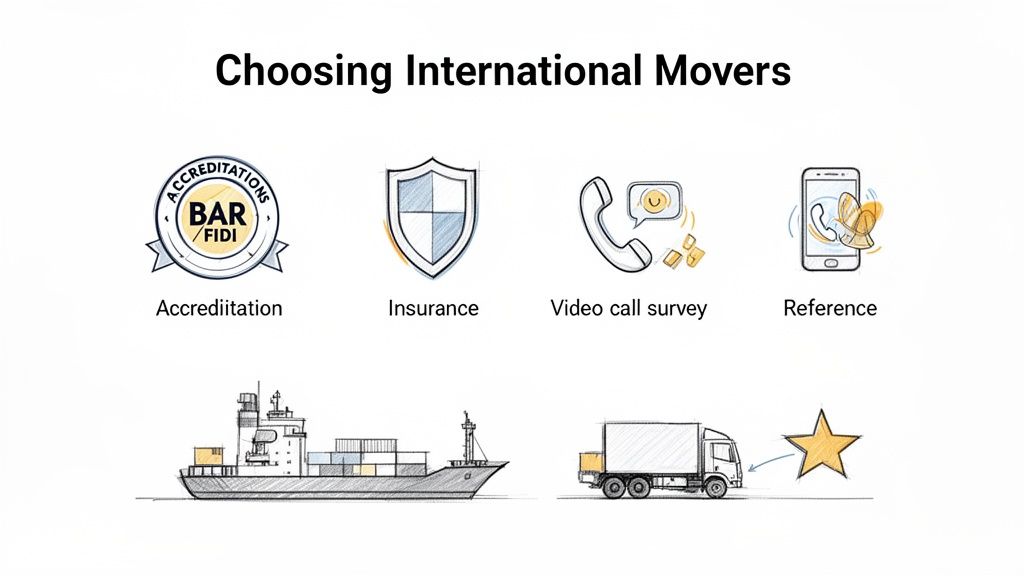
Picking the right international mover is about more than just finding someone to box up your life and ship it overseas. It’s about choosing a partner you can trust, one with proven credentials, clear-cut processes, and solid insurance. The best in the business are typically accredited by bodies like BAR Overseas and FIDI FAIM, which is your first sign that they meet tough industry standards from start to finish.
Your Essential Checklist for Choosing International Movers
Moving to another country is a huge undertaking, and your choice of mover can make or break the entire experience. Before you even think about comparing quotes, you need a solid checklist to sift the genuine professionals from the risky operators. Think of it as a pre-flight check for your move.
Getting this initial screening right saves you a world of headaches down the line. A reliable company will be upfront about its credentials and happy to talk you through its processes. If a company is vague or evasive, that’s your cue to walk away.
Verify Key Accreditations
This is the big one. Industry accreditations aren't just fancy badges for a website; they're your assurance of quality, financial security, and professionalism.
- BAR Overseas Member: The British Association of Removers (BAR) is the UK's most recognised trade association. A mover with BAR membership has to follow a strict code of practice. More importantly, it means your pre-payments are protected by the BAR Advanced Payment Guarantee Scheme, which is a massive safety net.
- FIDI FAIM Certified: The FIDI Global Alliance is essentially the 'gold standard' for international removals. To get FAIM (FIDI Accredited International Mover) status, a company must pass an incredibly tough, independent audit covering everything from their packing quality to their financial health.
If you find a mover with both BAR Overseas and FIDI FAIM accreditations, you're on the right track. It’s a clear signal that they’ve been thoroughly vetted and meet the highest global standards for service and security.
Confirm Non-Negotiable Service Standards
Accreditations are crucial, but there are a few other absolute must-haves for any international move. Make sure any company you consider ticks these boxes:
- Comprehensive Insurance: Your belongings are about to travel thousands of miles across oceans and continents. The mover must offer a clear, comprehensive insurance policy, not just basic liability cover. Don't be shy—ask them exactly how their claims process works.
- Transparent Survey Methods: An accurate quote starts with an accurate survey. Reputable firms will insist on a detailed in-person visit or a live video survey to calculate the exact volume of your shipment. Be wary of any company that relies solely on a vague online calculator.
- A Verifiable Track Record: You want a company that lives and breathes international moves, not one that just dabbles. The UK removal services industry hit a market size of £1.4 billion, showing that established, experienced firms are here to stay. This sector includes specialists like Bristol-based SimplyPro Removal & Storage Ltd, which has been handling local and international relocations for over two decades. You can read a full industry analysis on ibisworld.com to get a better sense of the market.
To help you keep track, here’s a quick-reference table summarising what to look for.
Key Credentials at a Glance
This table breaks down the most important credentials and features, making it easier to compare potential movers side-by-side.
| Credential / Feature | Why It Matters | What to Look For |
|---|---|---|
| BAR Overseas Membership | Ensures adherence to a UK-specific code of practice and provides financial protection for your advance payments. | The official BAR Overseas logo and membership number on their website and documents. |
| FIDI FAIM Certification | The highest global quality standard, audited independently. It covers financial stability, staff training, and operational excellence. | The official FIDI FAIM logo. You can also verify their status on the FIDI website. |
| Comprehensive Insurance | Protects your belongings against loss or damage during transit. Standard liability is not enough for an international move. | A clear, written insurance policy or certificate. Ask for the full terms and how to make a claim. |
| Detailed Volume Survey | An accurate survey prevents surprise costs later. It ensures your quote is based on the actual volume of your goods. | An offer of a free, no-obligation survey, either in-person or via a live video call. |
| Specialist Experience | International logistics are far more complex than domestic moves. A specialist understands customs, shipping, and regulations. | Case studies, testimonials, and clear evidence on their website that they focus on international relocations. |
Using this table as a checklist during your research will help you quickly identify the serious contenders and weed out the ones that don't make the grade.
Decoding the True Cost of Your International Move
Figuring out the real cost of moving abroad can feel like trying to nail down a moving target. The first quote you see is rarely the final number you'll pay. The total is built from several moving parts, and getting your head around them is the best way to budget properly and dodge any last-minute financial shocks.
The single biggest factor driving the cost is the sheer volume of your belongings, measured in cubic metres. It's simple, really: the more space your stuff takes up in a shipping container, the more it's going to cost. This is exactly why a professional survey, whether it's an in-person visit or a live video call, is an absolute must for getting an accurate quote.
Next up, your choice of transport mode makes a massive difference. This is where you'll have to weigh up speed against cost.
Sea Freight vs. Air Freight: The Lorry or the Learjet?
Think of it like this. To get a sofa from London to Edinburgh, you could send it with a logistics company on a lorry. It's reliable and gets the job done at a reasonable price, but it'll take a day or two. Or, you could theoretically charter a private jet. It would get there incredibly fast, but the cost would be astronomical.
- Sea Freight is your lorry. It’s the go-to, most economical choice for moving house internationally. Your belongings are carefully loaded into a large shipping container and set sail, a journey that can take several weeks. If you're working with a sensible budget and aren't in a desperate hurry, this is almost always the right call.
- Air Freight is your private jet. It’s lightning-fast, cutting transit time from weeks down to just a few days. But that speed comes with a hefty price tag, usually calculated by weight rather than volume. It's really only practical for small, essential shipments you need to get your hands on the moment you land.
For most people, a smart mix of the two is the perfect solution. You can ship the bulk of your home by sea and send a few boxes of absolute essentials by air to see you through until the main delivery arrives.
Beyond Volume and Transport
While the size of your move and how it travels form the core of your quote, a few other key things will nudge the final bill up or down. Knowing what these are is vital for comparing quotes from the best international moving companies the UK has to offer.
Your destination plays a huge part. The distance, local port handling fees, and the hoops you need to jump through for customs all vary massively. A move to Paris is a completely different logistical puzzle than a move to Sydney, which will have much longer shipping times and incredibly strict biosecurity rules.
The crucial thing to remember is that the cheapest quote is rarely the best value. A suspiciously low price might be hiding a nasty surprise, like excluding customs clearance fees, port charges, or even delivery to your new home. This can leave you stranded, trying to sort out complicated logistics and facing unexpected bills when you arrive.
The level of service you opt for will also affect the final price. Professional export packing, for example, is a highly specialised skill and, frankly, a smart investment to protect your possessions on a long and bumpy journey.
- Full Packing Service: The pros will wrap and pack everything, using materials and techniques designed to withstand the rigours of international shipping.
- Specialist Handling: If you're moving a grand piano, a fragile antique, or fine art, you'll need custom-built crates and expert handling, which naturally comes at an extra cost.
- Storage: Need to store your things for a while if your new home isn't quite ready? Most companies offer this at either end of the journey for an additional monthly fee.
Getting to grips with these variables is the key to a stress-free move. To see how these factors come together in the real world, check out our guide on the average cost of moving companies. It will give you a solid baseline of what to expect and empower you to ask the right questions.
Navigating International Customs and Regulations
Let's be honest, the moment you see the words "customs paperwork," a little bit of dread probably creeps in. It’s a world of strange forms, baffling terminology, and rules that seem designed to confuse. But here’s the good news: with a bit of preparation and the right moving partner, it's not nearly as scary as it sounds.
Think of your international mover as the seasoned captain of a ship, and you're the owner of the precious cargo. You know what's in the boxes, but they know how to navigate the treacherous waters of international bureaucracy. Their entire job is to chart the course, avoid the hidden reefs of red tape, and get your belongings safely to their new home port.
Your Mover Is Your Customs Agent
The best international movers don't just shift boxes; they act as your dedicated customs agent or broker. This is, without a doubt, one of the most critical services they provide. They’re the ones preparing and submitting the mountain of documentation on your behalf, ensuring every last detail lines up with both UK export laws and the import rules of your destination country.
A truly experienced mover has seen it all. They know the ins and outs of Australia’s notoriously strict biosecurity checks, the specific forms required for a smooth entry into the USA, and the nuances of a Canadian import. They'll be the ones talking to port authorities and customs officials, a process that would be an absolute nightmare for anyone to tackle alone.
The Paperwork You’ll Need to Provide
While your mover handles the complex submissions, they’ll need some key documents from you to get the ball rolling. Getting this organised early is the single best thing you can do for a stress-free customs experience.
- A Detailed Inventory List: This is non-negotiable. Every box needs a number and a clear list of what's inside. "Kitchen stuff" won't cut it and is a major red flag for customs. Be specific: "8 dinner plates, cutlery set, 6 wine glasses."
- Proof of Identity: You'll need good, clear copies of the photo page of your passport for every family member who is moving.
- Visa or Residency Permit: Customs officials need to see proof that you have the right to import household goods, so a copy of your visa or residency permit is essential.
- The Bill of Lading: This is a crucial legal document that acts as a receipt for your shipment. Your mover will prepare it for you, but you’ll need to check and sign it.
Your moving company should give you a comprehensive checklist of everything they need from you. Getting a head start on gathering these documents will prevent frustrating and costly delays down the line.
Common Customs Bottlenecks and How to Avoid Them
Even with perfect paperwork, things can get held up. A good mover anticipates the common pitfalls and helps you sidestep them from the very beginning.
One of the biggest issues is restricted or prohibited items. Every country has its own list of things you simply can't bring in, from certain foods and plants to soil-contaminated garden tools. Your mover should give you clear guidance on what to leave behind. Trying to ship a prohibited item, even by accident, can get your entire container flagged for inspection, leading to huge delays and fines.
Another classic mistake is undervaluing your goods. It might seem tempting to declare a low value to dodge potential import taxes, but customs officials are experts at spotting this. If a value looks too good to be true, they'll investigate, which means more inspections, penalties, and delays. Honesty is always the best approach here.
This process flow shows how the core elements of your move—volume, transport, and destination—build on each other and directly influence the customs journey.
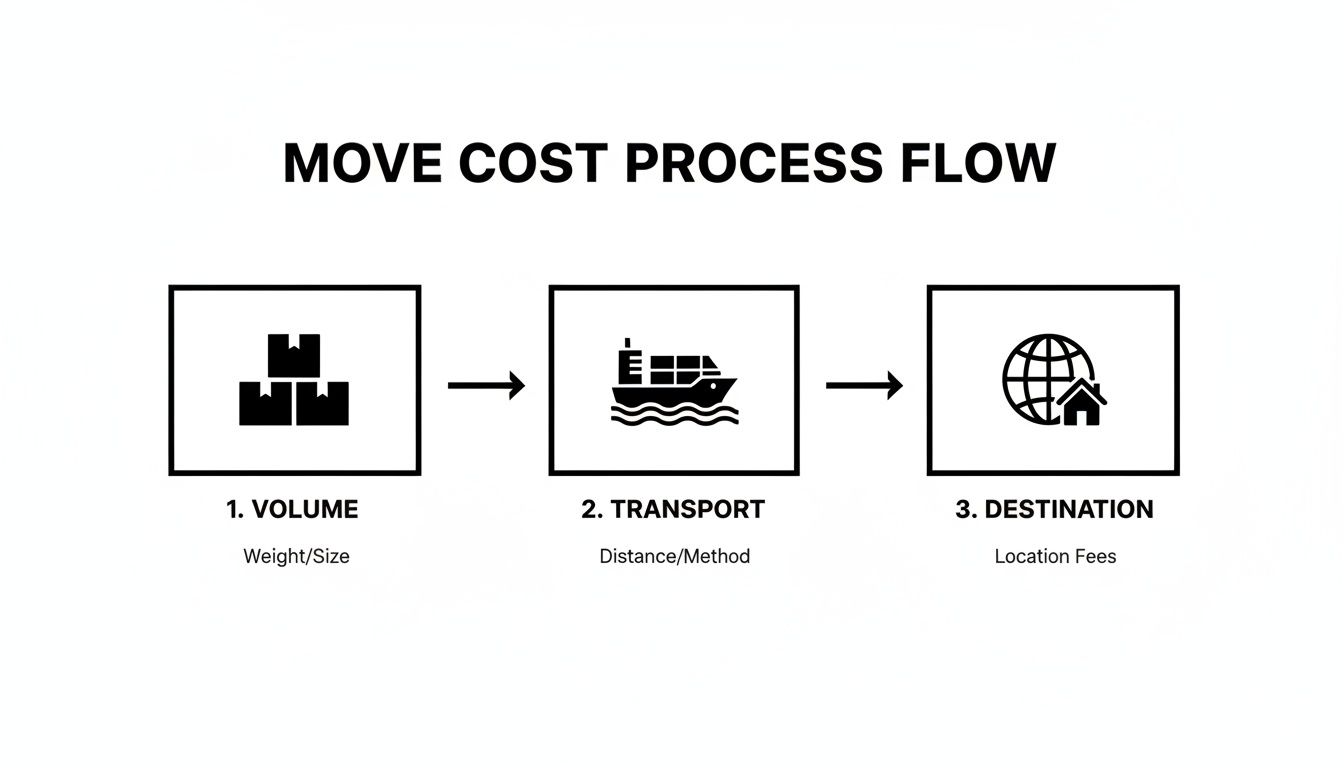
As you can see, each stage adds a layer of complexity that must be accurately documented for a smooth customs clearance. This isn't just a challenge for individuals; businesses are navigating this too. In fact, corporate demand for international relocation in the UK has jumped by 8%, even in a shaky economy.
What's more, a recent survey found that 47% of UK firms are looking to expand internationally—more than double the figure from 2023. This is only going to increase the demand for true cross-border logistics experts.
Ultimately, getting through customs smoothly comes down to meticulous preparation and having a real expert in your corner. Staying informed is key, and while your mover is your best resource, you can also find general guidance on essential international travel regulations.
Protecting Your Belongings for a Global Journey
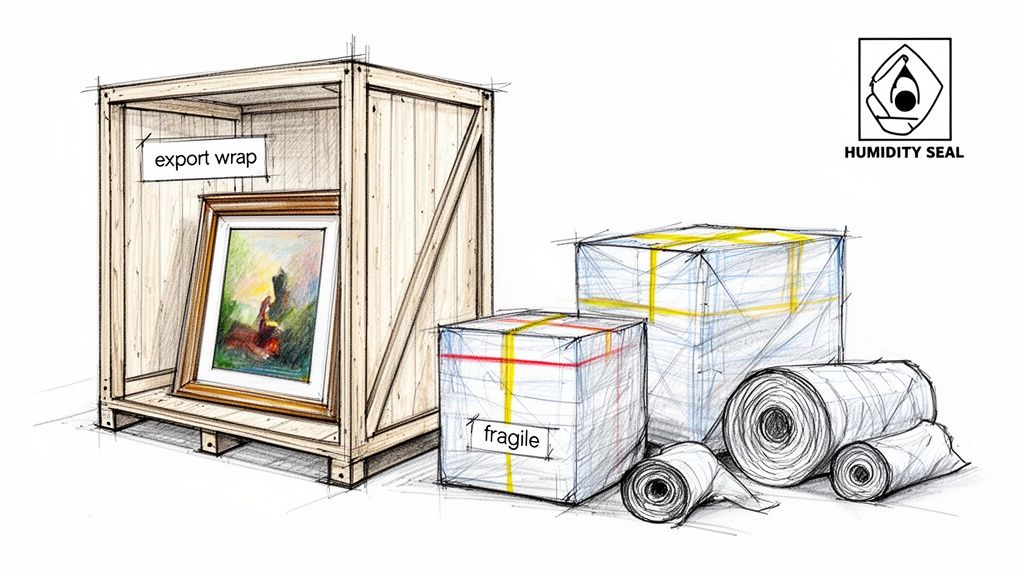
Sending your life's possessions across the world isn’t like moving down the M4. A local move is a short sprint; an international shipment is an endurance marathon. Your belongings will spend weeks at sea, deal with wild temperature swings, and be handled by cranes and crews multiple times. This is where professional packing becomes your first and most important line of defence.
The methods used by top-tier international movers are a world away from just throwing things in boxes with a bit of bubble wrap. It's a proper science, designed to protect your goods against a very specific set of risks.
The Art of Export Wrapping
The key phrase you'll hear is "export wrapping". Think of it as body armour for your furniture. The thin blankets used for local jobs simply won't cut it. Export wrapping uses multiple layers of specialised, heavy-duty materials built to withstand the punishing reality of a long sea voyage.
The whole process is about creating a protective cocoon around each item, guarding it against the three biggest threats of global transit:
- Impact and Vibration: From a container being lifted by a crane to the constant hum and roll of a cargo ship, your items are always on the move. Proper export wrapping uses thick, often waterproof, padded materials to absorb these shocks and vibrations.
- Moisture and Humidity: A shipping container isn't climate-controlled. Temperature swings cause condensation – "container rain" – which is a death sentence for wood furniture and electronics. Professional materials have built-in moisture barriers to prevent mould, mildew, and water damage.
- Pressure Changes: Your items will be stacked high. The wrapping needs to be strong enough to stop things from being crushed or warped under the immense weight of everything else in the container.
In short, standard domestic packing materials are not fit for purpose and will likely fail during an international journey. Paying for professional export wrapping isn't an upsell; it's a non-negotiable part of making sure your belongings arrive in one piece.
Specialist Items Demand Specialist Care
Wrapping a sofa correctly is one thing, but what about your grandmother's antique mirror, a piece of valuable art, or that awkwardly shaped sculpture? This is where the real expertise comes in.
A professional international mover won’t just wrap a delicate painting. They’ll build a custom wooden crate for it. These crates are padded internally and built to be a rigid, almost indestructible shell, neutralising any bumps or knocks from the outside world. The same goes for things like grand pianos or sensitive equipment.
The UK's removal sector is a serious industry, with around 3,249 businesses employing people trained in these exact techniques. Their skill in handling risk, especially for delicate IT equipment or high-value items, is what you're paying for.
To Pack or Not to Pack
It’s always tempting to save a bit of cash by packing some boxes yourself. And for things like clothes, books, or bedding, that’s usually fine. But there’s a massive catch you need to be aware of: insurance.
Most insurance policies provided by moving companies will not cover any damage to items in boxes you packed yourself (often called "PBO" or "Packed By Owner" boxes). If something inside breaks, the insurer can easily argue it was due to poor packing, and your claim will be denied.
When the professionals do the packing, they also create a detailed inventory and officially take on the liability. This makes any potential insurance claim much more straightforward. Before you even think about taping up a box, you should clarify the terms of your removals insurance policy.
If you are packing personal bits and pieces, particularly valuables, check out guides like Protecting Your Jewelry, Shoes & Handbags During a Move for some useful tips. And one final, crucial rule: your passports, essential documents, jewellery, and vital medications should always, always travel with you, not in the shipping container.
How to Compare Quotes and Choose Your Moving Partner
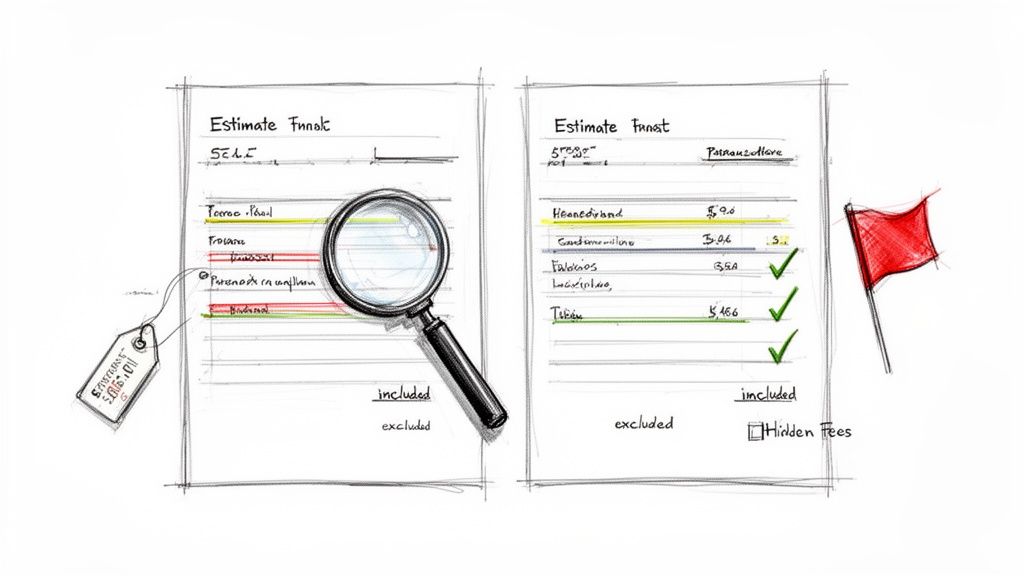
So, you’ve gathered three or four quotes. Great. Now the real work begins. Getting the estimates is the easy part; the real skill is learning to read them properly. It's the one thing that separates a smooth move from a nightmare of hidden costs.
The biggest mistake you can make is just scanning to the bottom and picking the cheapest price. That final figure can be incredibly deceptive. Think of a quote not as a price tag, but as a detailed service contract. A trustworthy international mover provides a clear, itemised breakdown, but it's still up to you to understand what you're actually paying for.
Look Beyond the Bottom Line
Two quotes might look miles apart on price, but a closer look often reveals they’re for completely different services. That’s why you absolutely must compare them on a like-for-like basis.
Start with the estimated volume of your shipment, which is usually shown in cubic metres (m³). Is one company’s estimate way lower than the others? That’s a massive red flag. Underestimating the volume is a classic trick to present a lower initial price, but you’ll be hit with surprise charges when the real volume is measured on moving day. A professional survey should give you pretty consistent volume estimates across the board.
Next, what kind of service are they quoting for? Is it door-to-door or door-to-port? The difference is huge.
- Door-to-Door: This is the full package. The price should cover everything from the crew packing up your UK home to clearing customs and delivering everything to your new address overseas.
- Door-to-Port: This service stops the second your container lands at the destination port. From there, it’s all on you – arranging customs clearance, paying local port fees, and finding a local crew to get your belongings home. It always looks cheaper upfront, but it rarely is by the end.
A quote that seems too good to be true almost always is. It’s the number one sign of a rogue mover. They’ve likely left out essentials like customs fees, port charges, or final delivery, leaving you to foot a much larger, unexpected bill when you’re most vulnerable.
Scrutinise the Inclusions and Exclusions
Once you’ve got the basics straight, it's time to dig into the details. The best way to do this is with a simple comparison table. This forces you to look at the same line items for each company and instantly shows you where the quotes don't match up.
Here is a simple checklist you can use to compare the key service details side-by-side.
International Move Quote Comparison Checklist
| Service Feature | Company A Details | Company B Details | Company C Details |
|---|---|---|---|
| Estimated Volume (m³) | |||
| Service Type | Door-to-Door / Port? | Door-to-Door / Port? | Door-to-Door / Port? |
| Insurance Cover Value | |||
| Export Wrapping Included? | Yes / No | Yes / No | Yes / No |
| Origin Fees Included? | Yes / No | Yes / No | Yes / No |
| Destination Fees Included? | Yes / No | Yes / No | Yes / No |
| Customs Clearance Included? | Yes / No | Yes / No | Yes / No |
Using a table like this makes it crystal clear what's covered and, more importantly, what isn't.
The Critical Questions to Ask
Before you even think about signing a contract, get on the phone and ask each company some direct questions. Their answers will tell you everything you need to know.
- Is this a binding quote, or could the final price change? If so, under what exact circumstances?
- Can you explain the insurance cover in detail? What’s the process if I need to make a claim?
- Are there any other potential charges I should know about? Think about things like shuttle vans for tricky access or storage fees if there’s a delay.
- Who is your partner agent at the destination? Are they also properly accredited and professional?
- What happens if there are shipping delays? How will you keep me updated?
Choosing your mover is a big decision, and it’s about more than just cost. You can learn more about what a high-quality, comprehensive service involves from a dedicated international removal company. In the end, your choice should come down to transparency, professionalism, and the confidence that you won't be hit with nasty surprises.
Planning Your Move from Bristol and the South West
So, you've got the big picture now—a solid framework for spotting the best international moving companies the UK has to offer. But for those of us in Bristol, Bath, and the wider South West, the next step is to bring that knowledge closer to home. It’s time to find a local expert who truly gets the lay of the land.
Choosing a mover with a strong local presence makes a world of difference. Think of it like this: a satellite map shows you the globe, but only a local guide knows the winding country lanes, the city-centre traffic hotspots, and the access quirks of a listed Bath townhouse. A Bristol-based team inherently understands these challenges.
This kind of on-the-ground knowledge is vital from the get-go.
The Advantage of a Local Survey
Video surveys are handy, no doubt, but for sheer accuracy, nothing tops having an expert walk through your home. A local specialist, like SimplyPro Removal & Storage Ltd, can pop over and see exactly what needs moving, getting a real feel for the volume and nature of your belongings.
This hands-on approach takes the guesswork out of quoting, preventing nasty shocks on moving day. It’s also the perfect chance for a surveyor to spot items needing a bit of extra TLC—a fragile grandfather clock or a valuable painting—and factor that into the plan from day one.
A local survey isn't just about measuring sofas; it's about starting a relationship. It's the confidence you get from looking your move manager in the eye, knowing they've seen your home and understand exactly what you need.
Your Next Steps to a Smooth Relocation
Getting the ball rolling on your international move from the South West is simpler than you might think. The goal is to turn your research into action with a team that can handle every last detail, starting right here at your front door.
Here’s how to kick things off:
- Get a No-Obligation Quote: The first practical step is to get a clear, detailed estimate. A company rooted in the area can give you a far more accurate figure because they know the local logistics inside out.
- Schedule a Proper Chat: Use this as your chance to ask everything. Worried about shipping the car? Confused about customs? Need to arrange storage before you fly? A good consultation will put your mind at ease.
- Build Your Bespoke Move Plan: You'll work directly with a move coordinator to map out a timeline and service package that fits your schedule and budget like a glove.
Working with a trusted local team like SimplyPro Removal & Storage Ltd gives you that peace of mind that every single detail is being handled by professionals—from the careful packing in your Bristol home to the seamless delivery at your new one, wherever in the world that may be.
Your International Moving Questions, Answered
Moving to a new country naturally comes with a long list of questions. To give you a bit more clarity and confidence, let's walk through some of the most common queries we hear from people planning a move from the UK. Getting these details straight from the start can make the whole process much smoother.
How Far in Advance Should I Book My Mover?
When it comes to an international move, time is your best friend. My advice is always to start reaching out to moving companies at least three to six months before you plan to leave. It might sound like a long time, but it flies by.
This gives you a comfortable window to do your homework, gather a few detailed quotes without feeling pressured, and really weigh your options. It's especially important if you're moving during peak season, like the summer holidays, when the best companies get booked up fast. Locking in your dates early not only guarantees your spot but often gets you a better price and saves you a world of stress.
What’s the Difference Between Door-to-Door and Door-to-Port?
This is a crucial one to get your head around because it massively impacts the price you see on a quote and what you're actually responsible for.
- Door-to-Door Service: Think of this as the complete, hands-off package. The movers handle everything from packing up your home in the UK, getting it to the port, managing the sea or air freight, clearing customs on the other side, and delivering everything right to your new home.
- Door-to-Port Service: Here, the moving company’s job is done once your shipment arrives at the port in your destination country. From that point on, it’s up to you. You'll have to navigate customs clearance yourself, pay any local port charges, and find another company to collect your belongings and deliver them to your house.
A door-to-port quote will almost always look cheaper at first glance. But once you add up the local handling fees, taxes, and the sheer hassle of organising the final leg yourself, the all-inclusive door-to-door option often works out to be the simpler and more financially predictable choice.
Can I Take My Car with My Household Goods?
Yes, you absolutely can. Most reputable international movers offer vehicle shipping, and the standard way to do it is to load and secure your car inside the same shipping container as your boxes and furniture.
However, be warned: importing a car is rarely straightforward. The regulations can be incredibly strict and differ wildly from country to country. You need to raise this with your mover right from the very first conversation. They can walk you through the specific paperwork required, warn you about import taxes, and let you know if your car will need to pass any local safety or emissions tests. Getting this wrong can lead to huge delays and unexpected bills with customs officials when you arrive.
Planning your move from the Bristol or Bath area? The team at SimplyPro Removal & Storage Ltd has over two decades of experience managing seamless international relocations. Get your free, no-obligation quote today and let our local expertise guide you home, wherever that may be. Find out more at https://www.simplyremovalsbristol.co.uk.