


Key Takeaways
- The Severn crossings are free: tolls on both the Prince of Wales Bridge (M4) and the original Severn Bridge (M48) were scrapped on 17 December 2018, so there’s no toll to pay in either direction.
- Heavy lorries can’t use the M48 Severn Bridge for now: since 27 May 2025, goods vehicles over 7.5 tonnes have been sent over the M4 Prince of Wales Bridge instead. National Highways plans to bring in a new system to let them back in January 2027.
- Two councils, two sets of rules: Bristol City Council deals with parking at the Bristol end and Cardiff Council (or the Vale of Glamorgan if you’re heading to Penarth) deals with the Welsh end. Apply to both early.
- Buying in Wales means Land Transaction Tax, not Stamp Duty: Wales has its own property tax with its own bands. Renting is different too, as tenancies are now called occupation contracts.
- Access shapes the day: Victorian terraces in Roath and Cathays, apartment blocks in Cardiff Bay and narrow streets in Bristol all affect which vehicle, how many movers and how long the move takes.
Bristol and Cardiff sit on opposite banks of the Severn Estuary, close enough that plenty of people work in one city and live in the other. That makes a Bristol to Cardiff move feel like a local job, and in many ways it is. But you’re crossing a national border, using one of two very different bridges, and dealing with Welsh councils, Welsh property tax and Welsh tenancy law at the other end.
This guide walks through the practical side of moving from Bristol to Cardiff: which bridge to use and why that’s changed recently, when to move, how parking works at each end, how to pack and plan for a cross-border day, the paperwork differences in Wales and what actually shapes the cost. We’ve been moving homes around Bristol and the surrounding area for more than 22 years, and we regularly make the run over the bridge into South Wales, so most of what’s below comes from moves we’ve done ourselves.
Why a Bristol to Cardiff Move Needs Its Own Plan
It’s easy to think of Cardiff as “just over the bridge”. On a good day, that’s exactly how the move feels. On a bad day, a closed lane, a match at the stadium or a missing parking suspension can turn a straightforward move into a long one. The difference between those two days is usually planning.
You’re crossing a border, not just a river
Wales has its own government and makes its own laws in areas like housing, property tax and local roads. For most people moving house, the change is invisible on the day itself, but it shows up in the paperwork before and after. If you’re buying, your solicitor will deal with Land Transaction Tax instead of Stamp Duty Land Tax. If you’re renting, your contract will look different from the assured shorthold tenancy you may be used to in Bristol. We cover both further down.
Two councils, two sets of street rules
Everything that happens on the street outside your old and new homes is controlled locally. At the Bristol end, that’s Bristol City Council (or South Gloucestershire Council if you live in places like Filton, Bradley Stoke or Kingswood). At the Cardiff end, it’s Cardiff Council. If your new home is in Penarth, Dinas Powys or Barry, it’s actually the Vale of Glamorgan Council, and if you’re heading to somewhere like Caerphilly or Pontypridd, it’s a different council again. Each has its own process for parking suspensions and permits, so it’s worth checking exactly which council covers your new street before you start.
Close enough for one day, far enough to need a plan
Most Bristol to Cardiff house moves are completed in a single day: load in Bristol in the morning, cross the bridge, unload in Cardiff in the afternoon. That’s one of the big advantages of this move. But it only works if the loading starts on time, the van can park at both ends and the drive isn’t held up. If any of those slip, the unload starts to run into the evening, and that’s when keys, lifts and building rules at the Cardiff end start to matter.

Choosing Your Route Over the Severn
There are two motorway bridges between Bristol and South Wales. Which one your removal vehicle uses depends partly on where you’re starting from, partly on traffic on the day, and, at the moment, partly on how heavy the vehicle is.
The M4 and the Prince of Wales Bridge
The Prince of Wales Bridge carries the M4 between England and Wales and is the most direct motorway route from Bristol to Cardiff. From north and east Bristol, the usual way on is via the M32 or the Almondsbury interchange, then west along the M4. From Avonmouth and parts of west Bristol, many drivers use the M5 and M49 to join the M4 near the bridge. Once you’re over, the M4 runs past Newport and on to the Cardiff junctions.
It’s the busier of the two crossings and the one most heavy traffic uses, so it’s the route where incidents and roadworks tend to cause the biggest knock-on delays. We always check live traffic before setting off rather than relying on habit.
The M48 Severn Bridge and the 7.5 tonne weight limit
The original Severn Bridge carries the M48 between Aust and Chepstow. It’s handy for moves to and from Chepstow and Monmouthshire, and it’s a useful alternative when the M4 is jammed. However, National Highways found that the bridge’s main cables have deteriorated, and on 27 May 2025 it introduced a 7.5 tonne weight restriction for heavy goods vehicles on the M48 Severn Bridge. All HGVs over 7.5 tonnes now have to use the M4 Prince of Wales Bridge instead.
National Highways says it plans to introduce a new system in January 2027 that will use traffic signals on the slip roads to spread heavy vehicles out across the bridge, which will allow them back on. Until then, the restriction stays. You can check the latest position on the National Highways M48 Severn Bridge weight restriction page.
What does that mean for your move? Long-wheelbase vans and Luton vans are well under the limit, and a vehicle that isn’t over 7.5 tonnes isn’t affected by this particular restriction. Anything heavier must use the M4 bridge. In practice, most Bristol to Cardiff moves use the M4 anyway, but if you’re hiring a large vehicle yourself, it’s worth knowing the rule so you don’t plan your route over the wrong bridge.
Good to know: The M48 Severn Bridge can also close in high winds, and the Prince of Wales Bridge has occasional planned overnight closures. If there’s an unplanned closure of the M4 bridge, its official diversion for HGVs over 7.5 tonnes runs via the M5 and M50, which it puts at roughly 100 miles. That’s rare, but it’s one reason we check the bridges before every Welsh move.
No tolls in either direction
Some people still budget for a toll out of habit. You don’t need to. The UK Government abolished the tolls on both the Prince of Wales Bridge and the original Severn Bridge on 17 December 2018, ending more than half a century of charging, as set out in the GOV.UK announcement on the toll-free Severn crossings. Crossing in a car, van or removal lorry is now free.
Bilingual signs on the Welsh side
Once you’re over the bridge, road signs are in both Welsh and English. It’s a small thing, but if you’re driving your own car behind the removal vehicle for the first time, it helps to know your junction number and the English name of the road in advance, so you’re not trying to read a two-language sign at motorway speed.
Picking the Right Day and Time
The day and start time you choose can make more difference to a Bristol to Cardiff move than almost anything else. The drive itself is short, so a delay at either end or on the motorway takes up a big share of the day.
Rush hour on both sides of the bridge
Lots of people commute between Bristol, Newport and Cardiff, and the M4, M5 and M32 all get busy at peak times. Where we can, we plan to load in Bristol after the worst of the morning traffic has cleared and to cross the bridge in the middle of the day, so we arrive in Cardiff with plenty of daylight left for unloading. If you’re completing on a sale, talk to your solicitor early about what time keys are likely to be released, because that often decides the timing more than traffic does.
Match days and big events in Cardiff
Cardiff city centre hosts big rugby, football and concert events, especially around the Principality Stadium, and on those days roads close and traffic builds across the city. If your new home is anywhere near the centre, Pontcanna, Canton or Grangetown, check the events calendar before you fix a date. A quiet Tuesday is a very different experience from a Saturday afternoon when a major match is on.
Fridays, month-ends and school holidays
Friday is the most popular day for completions, and the end of the month is busy too, because that’s when a lot of rental contracts start and finish. Midweek moves are usually easier to book and often run more smoothly. If you have school-age children, moving in a school holiday can make the move itself easier, but those weeks book up early, so ask about dates as soon as you have a rough idea.
Student moves
Cardiff and Bristol both have large universities, so the start and end of term bring a wave of moves in student areas like Cathays in Cardiff and Redland or Cotham in Bristol. If you’re moving into or out of a student-heavy street at those times, expect more vans and less parking. We’ve covered this in more detail in our separate guide to student moves in Bristol.
Parking and Access at Both Ends
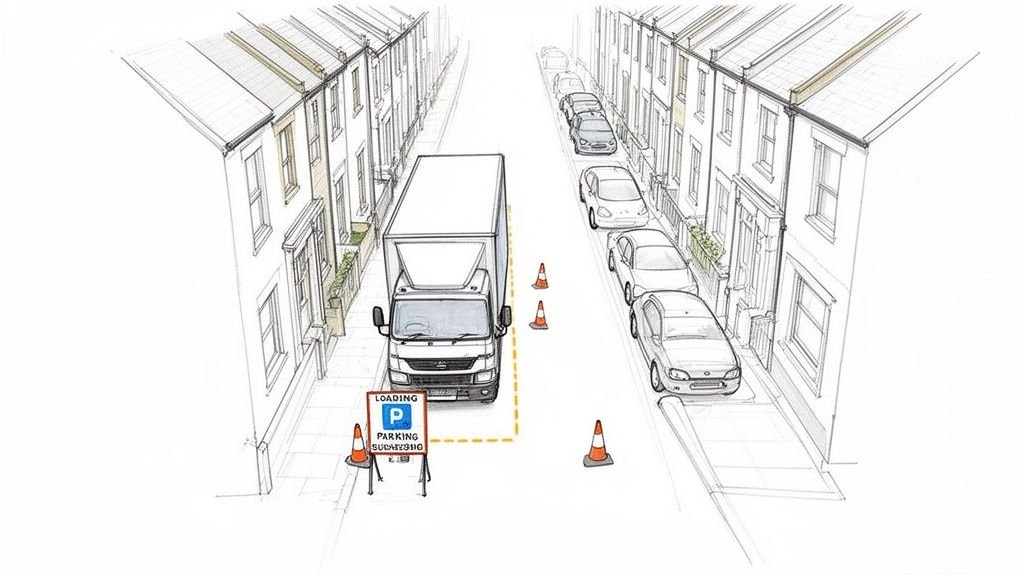
Parking is the single most common cause of stress on a Bristol to Cardiff moving day. A removal vehicle that has to park two streets away adds a lot of carrying time, and a vehicle that can’t stop at all can hold the whole move up.
The Bristol end: suspending a parking bay
If you live on a street with residents’ bays, pay and display bays or limited waiting bays, you can apply to Bristol City Council to suspend a bay. Domestic removals are one of the reasons the council lists. According to the Bristol City Council parking suspension page, it costs £38 per day to suspend a designated bay for one vehicle up to 5 metres long, and you must allow 3 working days for the application to be processed. The council also says it won’t contact you to confirm approval; it only gets in touch if it needs more information.
A removal lorry is usually longer than 5 metres, so you may need more than one bay. Our detailed guide to removal van parking in Bristol explains how to work out how much space you need and what to do on streets without marked bays.
The Cardiff end: check with the right council
Cardiff Council runs its own parking services, including resident permit areas and controlled parking zones. If you need space reserved outside your new home, contact the council’s parking team through its website and check the current process, notice period and fee before you fix your moving date. Don’t assume a removal van can stop in a resident bay or a suspended bay without permission. If your new home is in Penarth or elsewhere in the Vale of Glamorgan, apply to the Vale of Glamorgan Council instead.
Victorian terraces in Roath, Cathays and Canton
Large parts of Roath, Cathays, Splott, Canton and Grangetown are long rows of Victorian and Edwardian terraces, much like Bedminster, Easton or Bishopston in Bristol. They’re lovely homes, but they come with the same challenges: cars parked nose to tail on both sides, narrow pavements, front doors that open straight onto the street and tight staircases inside. A smaller vehicle that can park right outside is often quicker than a big lorry parked at the end of the road.
Apartment blocks in Cardiff Bay and the city centre
If you’re moving into a flat in Cardiff Bay or a city centre block, the building’s management company usually controls access. Ask them early about loading bays, booking the lift, protecting the lift and corridors, and any time slots for moves. Many blocks only allow moves during set hours. We cover the same issues for Bristol in our guide to moving into a Harbourside or city centre flat, and almost all of it applies in Cardiff too.
Bristol and Cardiff parking at a glance
| What to check | Bristol end | Cardiff end |
|---|---|---|
| Which council? | Bristol City Council (South Gloucestershire Council for areas like Filton, Bradley Stoke and Kingswood) | Cardiff Council (Vale of Glamorgan Council for Penarth, Dinas Powys and Barry) |
| Reserving a bay | Apply online to suspend a residents’, shared-use, pay and display or limited waiting bay | Contact Cardiff Council parking services and check the current process |
| Published cost | £38 per day for one bay up to 5 metres | Check the council’s website for the current fee |
| Notice needed | Allow 3 working days for processing | Check with the council and apply as early as you can |
| Typical access issues | Victorian terraces, hills, narrow streets, city centre flats | Terraced streets in Roath, Cathays and Canton; apartment blocks in Cardiff Bay |
| Who to speak to in a block of flats | Building or management company | Building or management company |
Tip: Take a photo of the street outside your new Cardiff home at roughly the time of day you’ll be moving. It shows us where we can park, how far we’ll be carrying and whether there are steps, gates or a steep path, and it takes you two minutes.
Packing and Planning a Cross-Border Move
Because a Bristol to Cardiff move normally happens in one day, there’s no overnight stop to catch up. Everything needs to be packed, labelled and ready before the crew arrives, so loading can start straight away.
A simple packing timeline
Start with the things you don’t use every day: the loft, the garage, spare bedrooms, books and out-of-season clothes. Aim to have those done two to three weeks before the move. In the last week, pack the kitchen except for the basics, then the bedrooms, and leave the bathroom and a few kitchen items until the night before. If time is tight or you’d rather not do it yourself, our removal packaging service can supply materials or help with the packing.
Label for the new house, not the old one
Label each box with the room it’s going to in Cardiff, not the room it came from. If your new home has a different layout, for example a through-lounge in a Roath terrace instead of a separate dining room, decide in advance where things will go. It makes the unload much quicker because the crew can take each box straight to the right room.
Your first-night box
Pack one box, or a bag in your car, with everything you’ll need on the first night in Cardiff: kettle, mugs, tea or coffee, phone chargers, toilet roll, basic tools, bedding, towels, medication, a change of clothes and any important documents. Keep it with you rather than on the van, so you can get to it even if the unload runs late.
Dismantling furniture
Beds, wardrobes and large tables often have to come apart to get down narrow Bristol staircases and up equally narrow ones in Cardiff. Our crews take care of dismantling and reassembly and bring blankets, straps and sack trucks to protect your furniture on the way. Keep screws and fittings in labelled bags taped to the item they belong to, so nothing gets lost between the two cities.
Buying or Renting in Wales: What Changes
The move itself is the same on both sides of the bridge, but some of the rules about buying and renting a home are different in Wales. None of this is something your removal company handles, but knowing about it helps you plan dates and budgets.
Land Transaction Tax instead of Stamp Duty
If you’re buying a home in Wales, you pay Land Transaction Tax (LTT), which is managed by the Welsh Revenue Authority, instead of Stamp Duty Land Tax. The bands are different from England’s. According to the GOV.WALES Land Transaction Tax rates and bands page, for a main residential purchase with an effective date on or after 10 October 2022, the rate is 0% on the portion up to £225,000, 6% on the portion from £225,000 to £400,000, 7.5% from £400,000 to £750,000, 10% from £750,000 to £1.5 million and 12% above that.
Higher rates can apply if you already own a home and aren’t replacing your main residence. Your solicitor or conveyancer will usually submit the return and pay the tax for you, but it’s worth checking the figures with them early so the cost doesn’t come as a surprise. The Welsh Revenue Authority also has a calculator on the same page.
Renting: occupation contracts and contract-holders
If you’re renting in Cardiff, the rules changed on 1 December 2022 when the Renting Homes (Wales) Act 2016 came into force. Tenants are now called “contract-holders” and tenancy agreements have been replaced with “occupation contracts”. The Welsh Government’s Renting Homes guide explains that contract-holders receive a written contract setting out their rights and responsibilities, and that the “no fault” notice period went up from two to six months.
From a moving point of view, the main thing is to read your occupation contract before moving day. Check the start date, whether there’s an inventory appointment and whether the landlord or agent has any rules about moving in, such as times, parking or protecting communal areas.
Council tax, bins and the boring-but-important list
Once you’ve moved, register for council tax with your new council in Wales and tell Bristol City Council that you’ve left. Bin collections and recycling rules are set locally, so check which day your new street’s bins go out and what goes in which container. Update your address with your bank, employer, insurers, the DVLA and your GP, and register with a new GP surgery in Cardiff if you’ve moved out of your old practice’s area.
Good to know: If your Bristol sale and Cardiff purchase don’t complete on the same day, you don’t have to move twice in a panic. You can load in Bristol, put your belongings into storage and deliver them to Cardiff when you get the keys.
What Shapes the Cost of a Bristol to Cardiff Move
We don’t publish set prices, because no two moves are the same. A one-bedroom flat in Clifton going to a ground-floor flat in Canton is a very different job from a four-bedroom house in Stoke Bishop going to a townhouse in Penarth. Here’s what really decides the cost.
How much you’re moving
Volume is the biggest factor. It decides the size of the vehicle, how many movers you need and how long loading and unloading take. Clearing out before you move is one of the easiest ways to keep things manageable. If you’ve got furniture, appliances or garden junk you won’t need in Cardiff, our house clearance and rubbish removal service can take it away before moving day.
Access at both ends
Stairs, lifts, long walks from the van to the door, narrow streets and parking all affect how long the job takes. A top-floor flat with no lift takes far longer than a ground-floor flat with parking outside. That’s why we ask about both properties, not just the one you’re leaving.
The vehicle and crew
We use long-wheelbase vans, Luton vans and 7.5 tonne lorries, and we match the vehicle to the job. A large vehicle can carry more in one trip, but a smaller one may be able to park closer on a tight terraced street. The right choice depends on your volume and access, and we’ll explain why we’ve suggested a particular vehicle and crew size.
Packing, dismantling and storage
Extras like packing, packing materials, dismantling and reassembly, piano moves and storage all add to the job. Some people want a full packing service, others want us to bring boxes and do the heavy lifting only. Both are fine; it’s about what suits you.
| Factor | Why it matters | How you can help |
|---|---|---|
| Volume | Decides vehicle size, crew size and loading time | Declutter before the survey so we quote for what you’re actually taking |
| Access | Stairs, lifts and long carries add time at each end | Tell us about steps, lifts, gates and parking at both addresses |
| Parking | Parking further away means more carrying | Apply for bay suspensions or permission early |
| Timing | Late key release or traffic can stretch the day | Ask your solicitor or agent about key times and avoid event days |
| Extras | Packing, dismantling, storage and specialist items take time and materials | Decide early which extras you want so they’re included in the quote |
Storage, Split Moves and Moving in Stages
Not every Bristol to Cardiff move happens in one neat day. Chains get delayed, rental start dates don’t line up with sale dates, and some people move to Cardiff for work before the rest of the family follows. Storage can bridge the gap.
When completion dates don’t match
If you have to leave your Bristol home before you can get into your Cardiff one, we can load your belongings, take them into our storage and deliver them to Cardiff once you have the keys. Our storage in Bristol is monitored by 24/7 CCTV, and because the same team handles the move and the storage, nothing has to be passed between different companies.
Moving in stages
Some people take a few essentials to a Cardiff rental first and bring the rest later, once they’ve found a permanent home. That can work well, but it helps to plan which items go first and which stay in storage, so you’re not unpacking boxes in the wrong place. Make a simple list and label the boxes for each stage.
Moving onward to Newport or the Valleys
If your new home is in Newport, Caerphilly or further into South Wales rather than Cardiff itself, much of this guide still applies: the same bridges, the same Welsh rules and the same need to check the local council. Have a look at our page on removals in Newport if that’s where you’re heading.
Frequently Asked Questions
How long does a move from Bristol to Cardiff take?
Most Bristol to Cardiff house moves are done in a single day. How long it takes depends on how much you’re moving, access at both ends, parking and traffic on the day. We’ll give you a realistic plan once we’ve seen what’s being moved.
Do I have to pay a toll to cross the Severn Bridge?
No. Tolls on both the Prince of Wales Bridge and the original Severn Bridge were abolished on 17 December 2018, so crossing is free for cars, vans and lorries.
Can a removal lorry use the M48 Severn Bridge?
Since 27 May 2025, goods vehicles over 7.5 tonnes haven’t been allowed on the M48 Severn Bridge and have to use the M4 Prince of Wales Bridge instead. National Highways plans to bring in a new system in January 2027 to let heavier vehicles back on. Vans and vehicles that aren’t over 7.5 tonnes aren’t affected by that restriction.
Do I need a parking suspension in Cardiff?
If there’s nowhere safe and legal for the removal vehicle to park close to your new home, it’s worth asking Cardiff Council (or the Vale of Glamorgan Council for Penarth) about reserving space. Check the current process, notice and fee on the council’s website and apply before you fix the date.
Is Stamp Duty different in Wales?
Yes. In Wales you pay Land Transaction Tax instead of Stamp Duty Land Tax, with different bands. For a main home, the current rate is 0% on the portion up to £225,000. Your solicitor will normally handle the return and payment.
What’s the best day to move from Bristol to Cardiff?
Midweek days outside school holidays are usually the easiest to book and the least busy on the roads. Avoid big event days in Cardiff city centre if you can, and remember that Fridays and month-ends are popular for completions and new tenancies.
Can you store my things if my Cardiff home isn’t ready?
Yes. We can collect from Bristol, keep your belongings in our 24/7 CCTV-monitored storage and deliver to Cardiff when you’re ready, subject to availability.
How do I get a quote for a Bristol to Cardiff move?
The quickest way is a video quote. Film each room, cupboards, the loft and the route out to the street, then send it to us on WhatsApp through our video quote page. Tell us both addresses, your preferred dates and anything we should know about access in Cardiff.
Get a Clear Quote for Your Bristol to Cardiff Move
A smooth Bristol to Cardiff move comes down to a few things: choosing the right bridge and the right time to cross it, sorting parking with both councils early, knowing how Welsh property tax and tenancy rules affect your dates, and planning properly for the terraces, flats and streets at the Cardiff end. Get those right and the short hop over the Severn really can be the easy part. For more about how we work in South Wales, take a look at our removals in Cardiff page.
Simply Removals Bristol has more than 22 years’ experience moving homes from Bristol and the surrounding area. We’re fully insured, we use long-wheelbase vans, Luton vans and 7.5 tonne lorries, and our crews bring blankets, straps and sack trucks and handle dismantling and reassembly. Weekend and last-minute moves are possible, subject to availability. Send us a video quote request with your dates and both addresses, and we’ll help you plan a move that works on both sides of the bridge.