

Yes, you absolutely can get cash paid for house clearance. It’s a common misconception that clearing a property is always a cost you have to bear. In reality, if the contents have enough value, the tables can turn completely.
When the resale value of items like quality furniture, antiques, or collectibles outweighs the cost of the labour, transport, and disposal, a professional clearance company will actually pay you the difference.
How Cash Paid for House Clearance Really Works
Many people think of a house clearance as simply a removal service for unwanted clutter. But it's often much more of a two-way transaction, especially here in the Bristol and Bath area where there's a healthy appetite for pre-loved goods. It's not just about hauling junk to the tip; it's a genuine opportunity to unlock the hidden value in a property's contents.
The way we, and other reputable companies, operate is quite straightforward. First, we assess everything in the property to provide a clear quote for the clearance service itself. This fee covers our team's time, the running costs of our vehicles, and any fees for responsible waste disposal.
The crucial next step, and where the magic happens, is that we simultaneously value any items we know can be sold on.
The Net Cost Model Explained
The final bill—or payment to you—is all down to what we call the 'net cost' model. It's a simple calculation where we subtract the value of your items from our clearance fee.
Here’s how that plays out in practice:
- You pay a reduced fee: Let's say your items are valued at £200 and the standard clearance cost is £500. You'd only pay the £300 difference.
- The clearance is free: If the contents are worth £500 and the clearance cost is also £500, the job costs you nothing. Your valuables have covered our fee entirely.
- We pay you: This is the best-case scenario. If your items are appraised at £800 and the clearance is £500, we'll pay you the £300 surplus. This is how you get cash paid for house clearance.
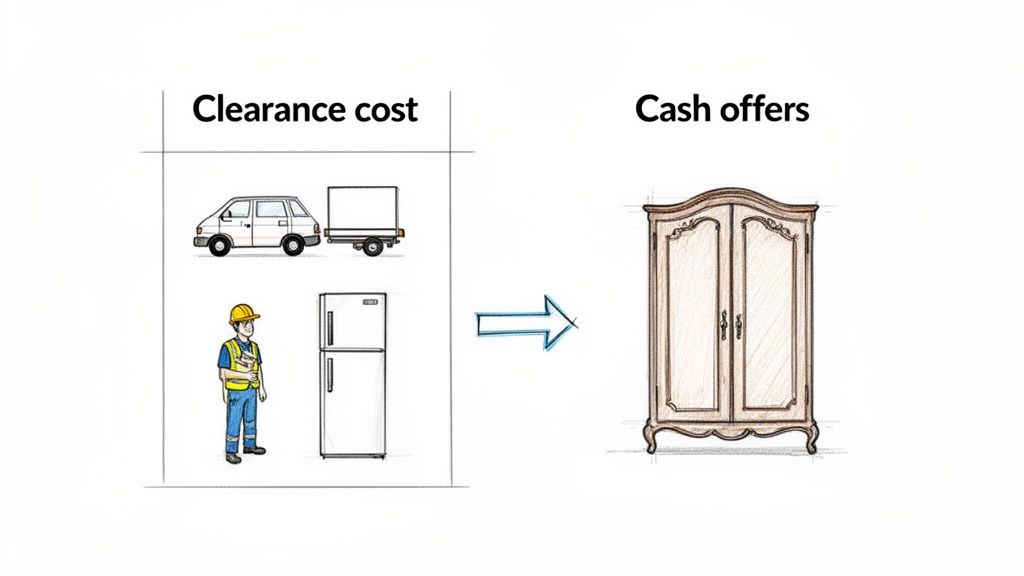
This simple flowchart shows exactly how it works.
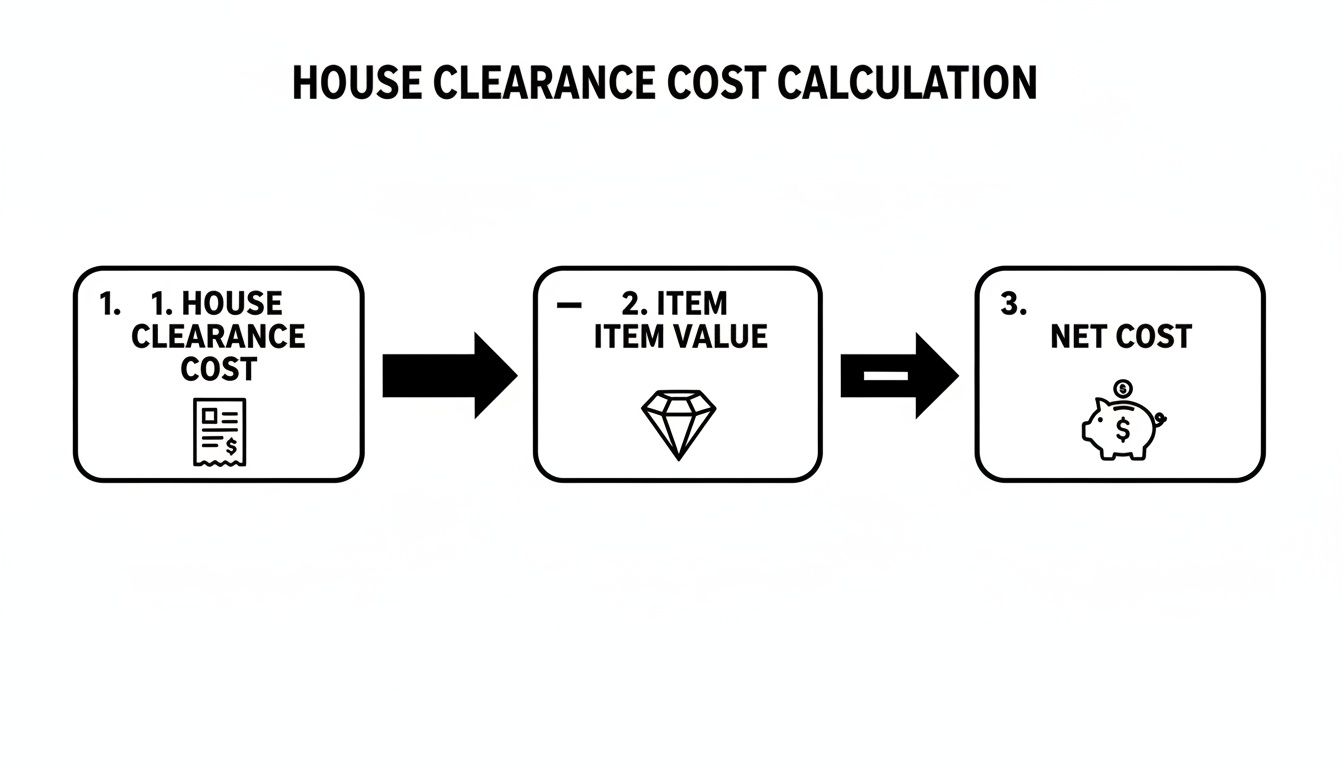
As you can see, the value of your goods directly offsets the service fees, with the potential to put money right back into your pocket. Understanding this from the start helps you set realistic expectations and appreciate the financial upside of using a professional team.
For a more detailed look at the services involved, feel free to check out our complete guide on house clearance and rubbish removal in Bristol.
Finding and Protecting Your Most Valuable Items
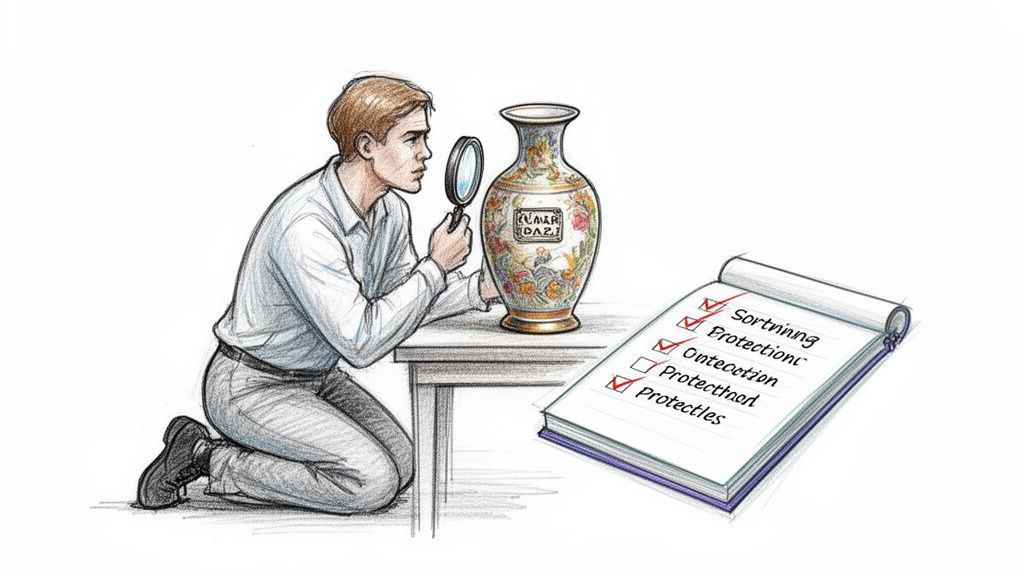
Before the clearance team even steps through the door, it’s well worth your time to do a bit of sorting. Think of it as a treasure hunt. A little detective work at this stage can make a real difference to your final payout, ensuring you get the maximum cash paid for house clearance.
It’s easy to focus on the big-ticket items, like a solid oak dining table, but some of the most surprising value often lies in smaller, easily overlooked objects tucked away in drawers or cupboards.
Your main job here is to create a simple inventory. You don't need a fancy spreadsheet; a notebook and pen will work perfectly. The goal is to separate the items you suspect have resale value from the general household clutter that needs to go.
Identifying Potential Treasures
Learning to spot the signs of value is a skill you can pick up surprisingly quickly. You’re essentially looking for clues that an item isn't just old, but genuinely collectible, antique, or from a desirable designer.
Here are a few pointers on what to keep an eye out for:
- Maker's Marks: Always check the underside of ceramics, pottery, and glassware. Look for stamps, signatures, or logos. Names like Royal Doulton, Wedgwood, or Beswick are consistently popular.
- Signatures on Artwork: Have a good look at the front and back of any paintings or prints for a signature. Even if the artist isn't a household name, it helps to establish the piece's history.
- First-Edition Books: Open up the first few pages and check the copyright page for phrases like "First Edition" or a number line that starts with a "1". The condition of the dust jacket is a massive factor here, too.
- Hallmarks on Metal: Genuine silver and gold items will have tiny, stamped hallmarks indicating their purity and origin. A quick search online can often help you decode what they mean.
It’s not uncommon to stumble across all sorts during a clearance. For instance, if you find a collection of old coins, you might want to research the best places to sell old coins to get an independent feel for what they might be worth.
The Importance of Original Condition
This might sound odd, but please, resist the temptation to clean or "fix up" old items yourself. Aggressively polishing antique silver can actually strip away its patina – that subtle ageing process collectors love.
In the same way, trying to repaint or repair vintage furniture can completely tank its value. Professionals and dealers much prefer items in their original, untouched state. The authenticity is a huge part of the appeal.
Key takeaway: Let the experts handle any restoration. An experienced appraiser can see past a layer of dust to recognise an item's true potential, but a clumsy repair can permanently ruin its value.
Setting these potential treasures aside doesn't just protect them; it also makes the professional valuation much more straightforward. When our team arrives on-site, having a designated area for valuables helps us give you a faster, more accurate appraisal. This little bit of prep work means you can feel confident in the process and helps us put a fair offer on the table.
Finally, it’s always sensible to ensure any items being handled are properly covered. You can learn more about the importance of professional insurance for removals to see how it protects your assets.
Understanding the Professional Valuation Process
When an expert appraises the contents of a home, they're doing far more than just giving things a quick once-over. A professional valuation is a careful blend of experience, up-to-the-minute market knowledge, and a real feel for what buyers are looking for right now. This is the crucial step that determines if you’ll get cash paid for house clearance.
A reputable clearance specialist, especially one working across Bristol and Bath, has their finger on the pulse of local demand. They assess several key factors to arrive at an item's immediate trade value, which isn't the same as what you might see on an insurance document or a shop's price tag.
How an Appraiser Determines Value
A valuer’s assessment is about more than just the object in front of them. They’re constantly weighing up an item’s desirability against the very real, practical costs of getting it sold.
Here’s a look at what’s on their checklist:
- Condition: This is always the starting point. They'll be looking for chips, cracks, scratches, signs of woodworm, or clumsy repairs. Believe it or not, original condition, even with a bit of honest wear, is almost always better than a shoddy restoration job.
- Rarity and Provenance: Is this a one-off or one of thousands? Is it a limited edition or made by a highly sought-after name? Any paperwork, receipts, or history (its provenance) that can prove an item's backstory can add significantly to its value.
- Current Market Demand: Tastes change, and the collectibles market is no different. What was all the rage ten years ago might be gathering dust today. A good valuer knows exactly what's selling well, whether that’s mid-century furniture, vintage hi-fi equipment, or a particular style of art.
If you're trying to spot items that might have hidden value before the experts arrive, looking at specialised guides can be a great help. For instance, something like a practical guide to valuing watches gives you a fantastic insight into what the professionals look for in specific niches.
Auction Value vs. an Immediate Cash Offer
It’s really important to get your head around the difference between what an item might fetch at a specialist auction and the cash offer from a clearance company. They are two completely different numbers, and for very good reasons.
An auction estimate represents the potential top-end value, but that's a figure you might only see after weeks or even months of marketing. Plus, it comes with hefty seller’s fees and, crucially, no guarantee of a sale.
An immediate cash offer from a clearance company is a trade price. It reflects an item's value after factoring in the costs the company has to cover—collection, storage, transport, and the time it takes to find the right buyer. The benefit to you is instant payment and zero hassle.
A great analogy is selling a car. You’ll get one price if you part-exchange it at a dealership for a quick, guaranteed sale. You’ll likely get a higher price selling it privately, but then you have to deal with all the advertising, viewings, and paperwork yourself. The cash offer is the dealership option: fast, efficient, and certain.
Grasping this difference helps you see the quote you receive in the right light. It’s not about an item's theoretical worth in a perfect world; it's about its practical value in a commercial process. This transparency is key to a fair deal, ensuring you feel confident in the final figure.
So, What Happens on Clearance Day?
Once you’ve shaken hands on a deal and set the date, you can sit back and let the professionals take over. It’s a far cry from just chucking things in a van; a proper house clearance is a well-oiled machine, designed to empty a property efficiently, safely, and by the book.
You can expect the team to arrive on time, ready to go. They'll usually start with a quick walk-through of the property with you, just to confirm what’s staying, what’s going, and to eyeball any tricky items like a piano or a bulky wardrobe that might need a bit of extra muscle. From there, they’ll get to work, systematically clearing room by room.
The “Clearance Hierarchy” in Action
A good clearance company doesn’t just see a pile of "stuff". They see potential value, opportunities for charity, and materials for recycling. They follow a clear pecking order to make sure as little as possible ends up in a landfill.
Here’s how it usually plays out:
- Valuables First: The items you’re getting paid for are the top priority. These are carefully packed and loaded onto the van first to keep them safe and sound.
- Donations and Recycling: Next up are the items destined for a new life elsewhere. This could be anything from clothes and bric-a-brac for a charity shop to furniture that’s still got some life in it. Metals, glass, wood, and paper are also separated out for recycling.
- The Rest: Only what’s genuinely left over at the end of this process is considered general waste. This responsible approach isn't just good for the planet; it’s a legal requirement.
This isn’t just about being tidy. It’s about saving you an incredible amount of back-breaking work and, crucially, making sure you’re on the right side of the law when it comes to waste disposal.
The Legal Bits and Your Peace of Mind
Hiring a professional team is about more than just convenience – it's about covering your back. Any reputable company you work with must be fully insured and hold an Upper Tier Waste Carrier Licence from the Environment Agency. Don’t be afraid to ask to see it; if they can't produce one, walk away.
At the end of the job, you must be given a Waste Transfer Note. This is a critical piece of paper. It’s your legal proof that everything from the property was handed over to a licensed carrier for correct disposal. Without it, if your waste is found fly-tipped somewhere, you could be the one facing a hefty fine.
This professional service does, of course, come at a cost. In the UK, you can expect to pay anywhere from £125 to £345 plus VAT, depending on the size of the van required. Data from Bark.com shows how these prices can vary, which really underlines the value of getting a fixed quote upfront, especially in a competitive market like Bristol and Bath. For a closer look at the numbers, you can read a full breakdown of house clearance pricing.
Once the property is completely empty, a good crew will always do a final sweep-up, leaving the floors tidy and making sure no stray items have been left behind. The final step is for you to sign off on the work and receive that all-important Waste Transfer Note. It’s a seamless end to the process, giving you total peace of mind that the job’s been done right.
Balancing Clearance Costs Against Cash Offers
This is where the rubber meets the road. Getting a real sense of the numbers is often the most important part of the process, and it’s where a professional service truly shows its worth. The question I hear most often from people in Bristol and Bath is simple: "How does the final bill actually work?"
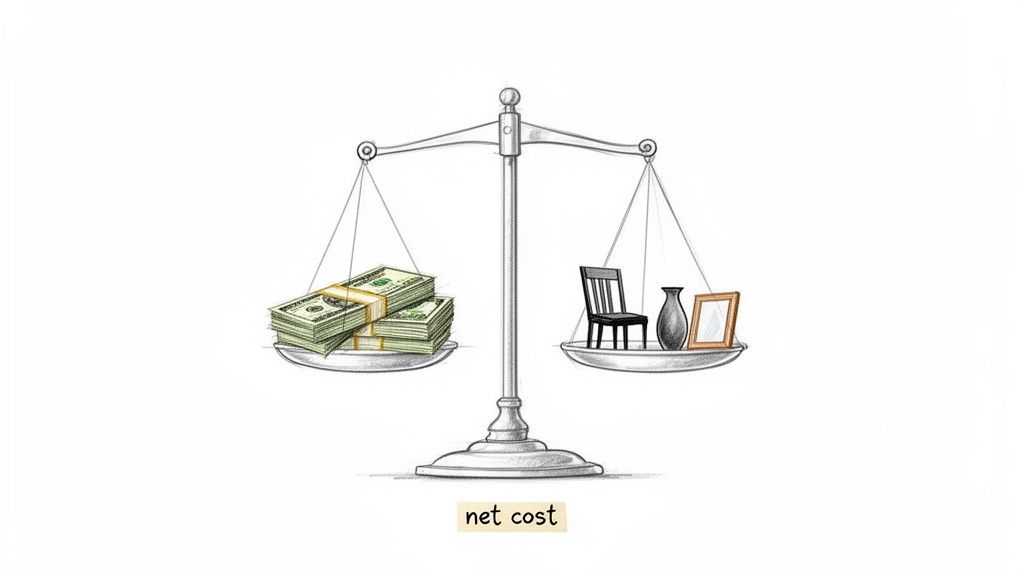
It's all about weighing the initial clearance cost against the cash we can offer for the contents. Think of it as a set of scales.
The initial quote we give you is based on a few straightforward things: the size of your property, the sheer volume of stuff that needs to be moved, and how many of our team it will take to do the job efficiently. A packed four-bedroom house in Clifton will naturally have a higher baseline cost than a small flat in Southville.
We also have to factor in specific disposal fees for certain items. You can't just toss things like fridges, old mattresses, or CRT televisions into a skip—there are strict environmental rules, and these items have their own recycling costs, which are included in that initial figure.
Calculating Your Baseline Expense
First, let's get a handle on the potential costs. House clearance pricing across the UK can be all over the place, but there are some reliable averages.
Clearing out a standard three-bedroom house, for example, typically falls somewhere between £800-£1,200. A smaller one-bedroom flat might be in the £300-£500 range. These figures are a solid starting point for homeowners in our area.
Think of this number as your baseline. It's the cost before we start finding hidden gems. Every valuable item we identify and make an offer on will chip away at this figure. In the best-case scenarios, it can wipe it out completely and even put money back in your pocket.
How Cash Offers Transform the Final Bill
Here's the magic. Once we have that baseline cost, any cash we offer you for furniture, antiques, art, or collectibles is simply subtracted from it. It’s a simple bit of maths that can make a massive difference to your bottom line.
Let me give you a real-world example from a job we did recently.
We were clearing a one-bedroom flat in Bristol with a quoted clearance cost of £400. Tucked away in the living room was a solid G Plan teak sideboard from the 1960s. We know the market for mid-century furniture is strong, so we offered the client £450 for it right there and then.
The calculation was easy: £400 (clearance cost) – £450 (item value) = -£50.
Not only did that single sideboard cover the entire cost of the clearance, but we actually handed the client £50 in cash. An expected expense turned into a small profit, all thanks to one piece of furniture. That's the real power of this approach.
The same principle applies no matter the size of the job. A collection of Royal Doulton figurines might pay for clearing the loft, or a quality Persian rug could offset the cost of clearing the entire ground floor. Our goal is always to find the maximum value hiding in the property to reduce, or even reverse, your final bill. If you're curious about the wider costs involved in moving home, you might find our article on understanding average removal costs a helpful read for extra context.
Got Questions About House Clearance Payouts? We've Got Answers
When you're arranging a house clearance, it's natural to have a few questions about how the money side of things works. We get it. To make things clearer, here are some straight-talking answers to the queries we hear most often from our customers across Bristol and Bath.
Let's cut straight to the chase and cover what you really need to know.
How Quickly Do I Actually Get Paid?
This is usually the first thing on everyone's mind, and for good reason. The great news is that the process is incredibly quick. Any decent house clearance company will settle up with you on the day of the job itself—often before the team has even finished clearing the last room.
You'll typically be paid in one of two ways:
- Bank Transfer (BACS): This is the most common method. It's secure, instant, and gives you a clear digital record of the payment.
- Cash in Hand: For smaller sums, some firms might offer cash on the day.
The key is to ask about their payment process when you book. That way, there are no surprises, and you know exactly when and how the money will arrive.
What Happens If You Find More Valuables During the Clearance?
It happens more often than you'd think. A hidden gem gets uncovered from an old chest of drawers or a dusty attic box that was missed during the initial walkthrough. A truly professional, ethical company won't just pocket it. They'll stop what they're doing and tell you immediately.
Our promise is simple: total transparency. If our team uncovers an item of significant value mid-clearance, we pause the job to discuss it with you right there and then. We’ll re-evaluate our offer on the spot to make sure you get a fair price for the new find.
This honesty is the sign of a clearance service you can trust. It protects you and keeps the entire process fair, no matter what turns up on the day.
Does My Location Affect the Offer?
Yes, but maybe not how you'd expect. While your postcode isn't the main issue, regional pricing differences across the UK are very real. The good news for people in Bristol and Bath is that rates here are generally much more competitive than in London, where an equivalent clearance could set you back an extra £200-£400. With national averages for a van load sitting between £125-£345, our local pricing gives you a much better starting point. You can explore a full analysis of house clearance costs to see just how much location matters.
The biggest factor on the day, however, is pure logistics. A ground-floor house with a driveway is always going to be easier—and therefore a little cheaper to clear—than a fifth-floor flat with no lift and only on-street parking. These practical details are built into the initial quote, which directly influences your final cash payout.
At SimplyPro Removal & Storage Ltd, we believe in making cash-for-clearance simple, honest, and fair. If you're in the Bristol or Bath area and want a valuation you can rely on, our team is ready to help. Get your free quote now.