


If you're wondering what to budget for a garden clearance, a good starting point is around £52.50 per hour or £210 per load. These figures give you a solid baseline, but the final price will really hinge on the size of your garden and just how much stuff needs to be hauled away.
What Is the Average Garden Clearance Cost in the UK?
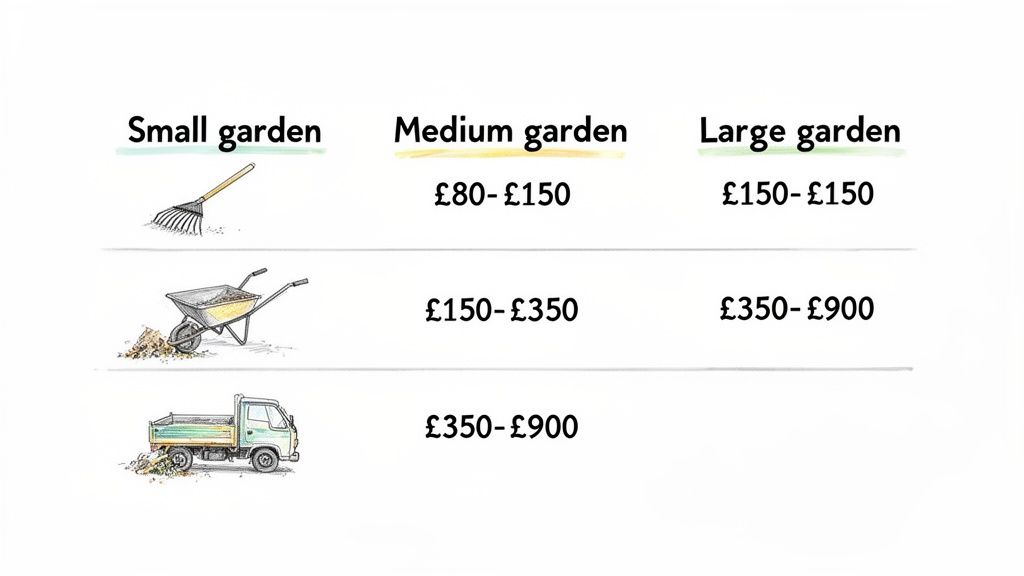
Think of pricing a garden clearance a bit like ordering a meal. A quick tidy-up is like a starter – straightforward and relatively inexpensive. But if you’re tackling a completely overgrown jungle with heavy-duty waste, that’s more like a three-course feast. It requires far more time, effort, and resources, and the bill will naturally reflect that.
To put some real numbers on it, the UK average hovers around £52.50 per hour or £210 per load. This makes it a really practical option for homeowners in Bristol and Bath who want to reclaim their outdoor space. It’s especially handy if you’re coordinating other jobs at the same time, like moving house. Getting a handle on these costs alongside typical moving expenses can make budgeting a whole lot smoother. You can learn more by checking out our guide on average removal costs.
Breaking Down the Numbers
How you're charged can vary, as different professionals have their preferred methods. Some will give you a simple hourly rate, which is perfect for smaller, more defined jobs. Others prefer to charge by the cubic yard or "per load," which makes more sense for bigger projects where it’s tough to accurately guess the time involved.
To give you a clearer idea, here are some typical price brackets:
- Small Clearance: Think a few bags of green waste, a hedge trim, and a general tidy. You're likely looking at somewhere between £100 – £200.
- Medium Clearance: This might involve clearing out an overgrown flowerbed, getting rid of old pot plants, and bagging up a fair amount of cuttings. Costs for this typically fall in the £200 – £400 range.
- Large Clearance: For the big jobs – clearing an entire garden, dismantling an old shed, or disposing of soil and rubble – the price can easily be £400+.
One piece of advice I always give is to get a fixed quote, not just an estimate. This way, you avoid any nasty surprises on the final bill and can be confident that the price covers all labour, transport, and disposal fees.
The table below gives a handy overview of what you can expect to get for your money, helping you match your needs to your budget.
Typical Garden Clearance Costs at a Glance
This table breaks down the common pricing structures you'll encounter and what they usually include.
| Pricing Model | Average UK Cost | What It Typically Covers |
|---|---|---|
| Per Hour | £40 – £60 | Labour for specific tasks like weeding, pruning, or bagging waste. Best for smaller, defined jobs. |
| Half-Day Rate | £150 – £250 | Several hours of work, suitable for clearing a moderately overgrown small-to-medium garden. |
| Full-Day Rate | £300 – £500+ | A comprehensive clearance of a large garden, including waste removal and a thorough tidy-up. |
| Per Load | £180 – £350 | Price based on the volume of waste removed, often using a standard van or lorry load as a measure. |
Remember, these are just averages. A firm quote from a local company will always give you the most accurate figure for your specific job.
What Really Influences Your Garden Clearance Quote
Ever wondered why you can get two wildly different quotes for the same garden? It’s not random guesswork. Every contractor has a kind of 'price recipe' they follow, and a few key ingredients determine the final bill. Once you know what they are, you can see your garden through their eyes and understand exactly where the costs are coming from.
The biggest factor, hands down, is the volume and type of waste. A few bags of green cuttings? That's straightforward and relatively cheap to get rid of. But the price will jump significantly if you're dealing with heavy stuff like soil, old paving slabs, bricks, or the remains of a dismantled shed. This isn't just because they're heavy and awkward; they cost a lot more to dispose of at a commercial recycling centre.
Access and How Much Graft is Involved
Think about how easy it is to get to your garden. A house with a wide side gate and a driveway right next to it is the dream scenario. The team can park their van close by and use wheelbarrows to shift everything quickly, which keeps labour time to a minimum.
Now, contrast that with a terraced house where the only way out is through your hallway. Or a garden with steep steps. Suddenly, the job becomes a logistical puzzle. Carrying heavy bags through a house is slow, careful work, and it all adds to the labour costs on your quote.
The state of the garden itself is just as important. A lawn that’s just a bit overgrown is one thing. A jungle of tangled brambles, thorny bushes, and deep-rooted weeds is another beast entirely. Tackling that requires more time, more physical effort, and often specialist kit like heavy-duty strimmers – all things that will be factored into the price.
It all boils down to one simple thing: time is money. Anything that slows the team down, from poor access to dense vegetation or having to break things apart, will bump up the final cost.
Where You Live and Disposal Fees
Finally, your postcode matters. Disposal fees aren't the same everywhere in the UK. On top of that, companies based in areas with higher running costs, like central Bristol or Bath, will naturally have slightly higher rates. That’s just standard for any local service business.
Getting to grips with these details is the best way to avoid surprises. For a bit more background on how waste removal is priced in general, this guide to understanding junk removal pricing is a great read. Any decent company will be happy to walk you through their quote and explain exactly how they've calculated the cost for your specific garden.
How to Figure Out What Your Garden Clearance Might Cost
It's one thing to know the general price ranges, but it’s another thing entirely to nail down a figure for your own garden. So, how do you bridge that gap? The simplest way is to look at how the key factors—waste, access, and the level of overgrowth—come together in real-world jobs.
By comparing your garden to a few typical scenarios, you can get a much clearer, more realistic idea of what to expect on a quote. Let's break down a few examples to see how a professional would approach the pricing.
This diagram shows how those core elements directly shape the final cost.
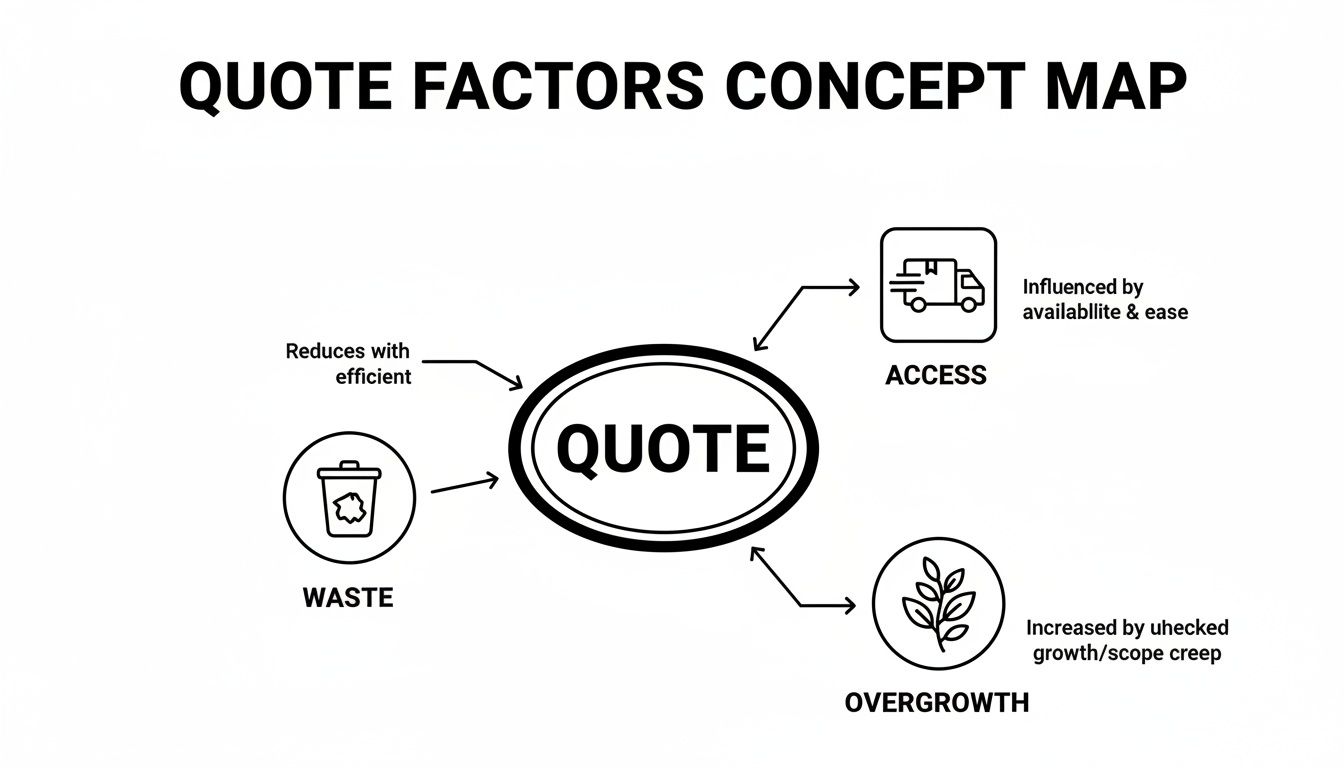
As you can see, everything comes back to the time it takes and what needs to be disposed of. These are the two biggest drivers behind any garden clearance quote.
Sample Garden Clearance Quote Scenarios
To put this all into perspective, let's explore a few sample cost breakdowns. These examples should help you estimate your own expenses by showing how different jobs stack up.
| Scenario | Key Tasks | Estimated Time | Example Cost Range |
|---|---|---|---|
| 1. Small Tidy-Up | Mowing a small lawn, trimming a bush, and removing around 10 bags of green waste and old plant pots. | 2-3 hours (two-person team) | £150 – £250 |
| 2. Medium Overhaul | Clearing dense brambles, cutting back large shrubs, and dismantling a rotten wooden planter. | 4-5 hours / half-day (two-person team) | £250 – £400 |
| 3. Large & Complex Job | Removing a fallen tree branch, dismantling a metal shed, and clearing soil/rubble from a collapsed wall. | 1+ full day (two or three-person team) | £500 – £850+ |
Seeing these scenarios laid out makes it easier to place your own project on the scale. The difference between a simple tidy-up and a complex overhaul really comes down to the labour intensity and the type of waste involved.
A Closer Look at the Scenarios
Scenario 1: The Small Tidy-Up
Imagine a small, terraced house garden in Bristol with a side gate for easy access. The job is straightforward: mow the lawn, trim an overgrown bush, and bag up about 10 bags of green waste and a few old pots.
A two-person team could have this done in 2-3 hours. Because access is good and the waste is light (just green waste), the cost stays low, typically landing somewhere between £150 and £250.
Scenario 2: The Medium Overhaul
Now picture a medium-sized suburban garden that's been left to its own devices for a year. It’s choked with brambles, several large shrubs need a serious cut-back, and there’s a rotten old wooden planter to dismantle.
This is more labour-intensive work. A two-person team would likely need 4-5 hours (a solid half-day). The price reflects this extra effort and the mixed waste (wood and green matter), pushing the quote into the £250 to £400 range.
Scenario 3: The Large, Complex Clearance
This is the big one. Think of a large, overgrown garden where the only way in is through the house. The job involves cutting up a large fallen tree branch, taking apart an old metal shed, and clearing away soil and rubble from a collapsed wall.
This is a complicated project. Access is a nightmare, specialist cutting tools are needed, and the waste is a heavy mix of metal, soil, and rubble, all of which are expensive to dispose of. This will take a team of two or three a full day, maybe more. The cost here could easily be £500 to £850, or even higher depending on the specifics. For jobs involving significant tree work, a specialised tree removal cost calculator can give you a more accurate idea of those particular costs.
By figuring out which of these scenarios feels closest to your own garden situation, you'll have a much more realistic ballpark figure in mind. This really helps when you start talking to contractors, as you’ll have a solid grasp of the work involved and what a fair price looks like.
DIY Garden Clearance vs Hiring a Professional
Deciding whether to roll up your sleeves and clear the garden yourself or call in the professionals is a classic dilemma. On paper, doing it yourself looks like the budget-friendly option. But once you factor in all the hidden costs and hassle, the real price of going it alone starts to become much clearer.
The appeal of a DIY job is undeniable. You get to work at your own pace and, crucially, you don't pay for labour. The thing is, other expenses have a nasty habit of creeping in. You’ll almost certainly need to hire a skip, which can set you back anywhere from £150 to over £300 depending on the size. You might also need to rent specialist kit like a powerful strimmer, a wood chipper, or a rotavator, and those costs add up quickly.
Then you’ve got the sheer logistics to think about. How many trips to the local tip will it take? All that driving eats into your fuel and your weekend. Let’s be honest, your time is valuable. A job that a professional crew could knock out in a few hours might end up swallowing your entire bank holiday weekend.
The Value of a Professional Service
Hiring a professional team completely changes the game. Yes, there's an upfront cost, but what you’re really buying is speed, safety, and a whole lot of peace of mind. These teams turn up with all the right commercial-grade equipment for the job, from chainsaws for that stubborn old tree to heavy-duty barrows that won't buckle under the weight.
But the biggest advantage isn't just the gear—it's the experience. A skilled team knows exactly how to tackle an overgrown garden. They can draw up a plan and get the job done in a fraction of the time it would take a novice, saving you a world of stress and a sore back.
They’re also fully insured, which is a huge relief. If an accident happens on your property, you're covered. On top of that, they handle all the waste disposal legally and responsibly, so you don't have to worry about fines or the nightmare of fly-tipping. This all-in-one service often proves to be the most cost-effective and sensible choice in the long run. Whether it's garden waste or clutter from inside the house, you can explore professional house clearance and rubbish removal services in Bristol for a complete clear-out.
Comparing Your Options Side-by-Side
To help you weigh it all up, here’s a straightforward breakdown of the two paths.
| Aspect | DIY Garden Clearance | Professional Service |
|---|---|---|
| Cost | Seems cheaper initially, but hidden costs (tool hire, skip fees, fuel) quickly add up. | You get a fixed, all-inclusive quote, so there are no surprises. |
| Time | Can easily take several days or weekends, depending on the garden's state. | Usually finished in a single day, often in just a few hours. |
| Equipment | You have to buy, borrow, or rent every tool you need for the job. | The team arrives with a full set of professional-grade tools. |
| Safety | A higher risk of injury, especially if you're not used to heavy-duty equipment. | Trained and insured professionals handle all the risky tasks safely. |
| Disposal | You're legally responsible for getting rid of all the waste correctly. | All waste is removed and disposed of legally, with the right paperwork. |
Ultimately, the best choice really boils down to the scale of your project, your budget, and how much you value your time and energy.
Your Legal Duty of Care for Garden Waste
When you hire someone to clear your garden, it’s easy to assume your responsibility ends once the waste is loaded onto their van. But that’s a common and potentially costly mistake. In the UK, you have a legal ‘duty of care’ to make sure your waste is disposed of correctly, even after you’ve paid someone else to take it.
This means if the person you hired ends up fly-tipping your old hedge trimmings and patio slabs, you could be the one facing a hefty fine. It doesn’t matter if you paid them in good faith; the law says the responsibility for checking they are a legitimate operator is yours. Think of it as a simple check that protects your wallet and the local environment.
The Non-Negotiable Waste Carrier Licence
So, how do you cover yourself? It's surprisingly simple: you must ask to see their Waste Carrier Licence. Anyone who transports and disposes of waste for a living—whether it's a single sack of weeds or a truckload of soil—is legally required to be registered with the Environment Agency.
This licence is their official proof that they know how to handle waste responsibly and follow the correct procedures. It's like a driving licence for waste removal. You wouldn't let an unlicensed driver take your car, so you shouldn't let an unlicensed carrier take your rubbish.
It is a criminal offence for someone to transport waste without being registered. Asking for their registration number isn't being difficult—it's a critical step in fulfilling your duty of care and avoiding a potential fine of up to £5,000.
How to Verify a Licence in Seconds
Checking if a contractor is licensed is incredibly quick and gives you total peace of mind. All you need to do is ask for their registration number and look it up on the Environment Agency’s public register.
- Ask for the number: Any reputable professional will have this on hand and will be happy to share it.
- Go online: A quick search for the "Environment Agency public register for waste carriers" will take you straight there.
- Enter the details: You can search by their business name or the registration number they provided.
The whole process takes less than a minute. It confirms that your contractor is operating above board, ensuring your garden clearance cost includes responsible disposal and protecting you from any nasty legal surprises later on.
Practical Ways to Lower Your Clearance Costs
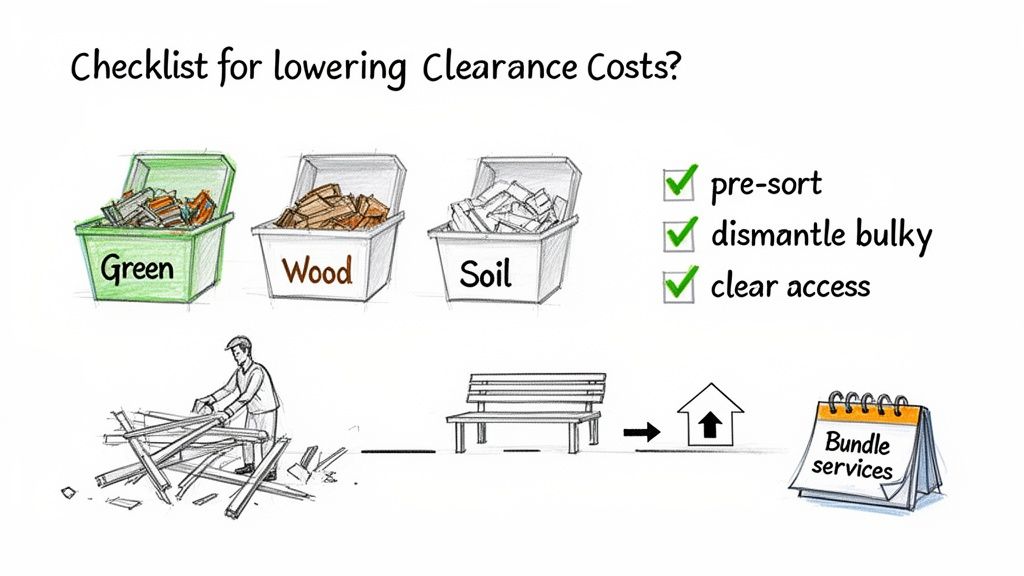
Keeping your garden clearance costs down doesn't have to mean doing all the heavy lifting yourself. With a bit of smart prep before the professionals turn up, you can make a real dent in the final bill. It’s all about making their job as quick and straightforward as possible.
A great place to start is by pre-sorting the waste yourself. Just like you do with your household recycling, try creating separate piles for different materials. Group green waste like grass cuttings and leaves in one area, wood like old fence panels and branches in another, and inert waste like soil and rubble in a third. This simple step saves the team from having to do it on your time, which means they can get straight to loading.
It also sounds obvious, but making sure there's a clear, easy path from the garden to their van can save a surprising amount of time.
Dismantle and Bundle for Bigger Savings
If you’ve got any bulky items and you feel up to it, dismantling them beforehand is another top tip. Breaking down an old shed, a wobbly climbing frame, or a large patio set makes the pieces much easier to handle and load. If you're wondering where to start, you can learn more about how to dispose of unwanted furniture effectively.
The bottom line is pretty simple: the less time the clearance team has to spend on your property, the less it's going to cost you. Every minute you save them through preparation is money that stays in your pocket.
Finally, think about bundling services. If you’ve also got a garage or a loft that needs clearing, ask about getting it all done in one go. Companies are often happy to offer a better overall price for a bigger job, giving you more value and a bit of leverage when you're discussing the quote.
A Few Final Questions About Garden Clearance
Even after you've got a quote and a plan, a few practical questions might still be buzzing around your head. Thinking about how the day itself will work helps make sure everything goes off without a hitch.
How Long Will It Actually Take?
This is a classic "how long is a piece of string?" question. A really simple job, like us grabbing a few bags of green waste you've already piled up, could be done and dusted in 1-2 hours. But for a medium-sized garden that's gotten a bit wild, you're probably looking at a half-day job, so around 4-5 hours.
If the project is a big one—say, clearing a large, neglected plot that involves taking down an old shed or shifting tons of soil—it's wise to block out a full day. Some really major clear-outs can even stretch into a second day. Any good contractor will give you a solid time estimate when they quote you.
What Happens to All My Garden Rubbish?
You’ll be glad to hear it doesn’t just get dumped. Any professional, reputable company has a legal and ethical duty to dispose of waste correctly. We take everything to a licensed commercial recycling centre.
Once it arrives, the waste gets properly sorted. Green stuff like leaves and branches is turned into compost, wood gets chipped for biofuel or landscaping, and even soil and rubble are screened and recycled for use in construction. The goal is always to keep as much as possible out of landfill.
Do I Need to Be Home on the Day?
Not necessarily. As long as the team can get into the garden easily—through a side gate, for example—and the instructions are crystal clear, you don't usually need to hang around all day.
That said, it’s always a good idea to be there at the very beginning to walk the team through the plan one last time. Popping back at the end to check you're happy with the work before they leave is also a smart move.
What If It's Pouring with Rain?
This is Britain, after all! Most garden clearance work can go ahead perfectly fine in a bit of light rain; professionals are used to it and come prepared.
However, safety comes first. If the weather turns nasty—think torrential downpours, gale-force winds, or storms—it can become dangerous, especially if the job involves chainsaws or dismantling structures. In that case, your contractor will get in touch to reschedule for the next available dry day.
Ready to get your garden back without breaking a sweat? The team at SimplyPro Removal & Storage Ltd provides professional, reliable garden clearance across Bristol and Bath. Let us do the heavy lifting for you. Get in touch for a free, no-obligation quote today and find out more at https://www.simplyremovalsbristol.co.uk.