


Moving your life overseas is a huge undertaking, and the logistics of international removals from the UK can feel daunting. It's a process that involves choosing the best way to ship your belongings, tackling customs paperwork, and finding a removals company you can trust. A bit of careful planning is all it takes to make sure everything arrives safely at your new home.
Your Roadmap for International Removals from the UK
Relocating to another country is an incredible adventure, but let's be honest, the practical side of it can feel like a massive puzzle. Think of this guide as your roadmap, designed to give you clarity and confidence as you plan your move. We’ll walk you through everything, from getting that first quote right through to the moment your things are delivered.
This is your starting point for understanding the big decisions you'll need to make. You'll have to weigh up shipping options, get to grips with customs, figure out the costs, and, crucially, choose a reliable removals partner. The image below boils the whole process down to three key stages.
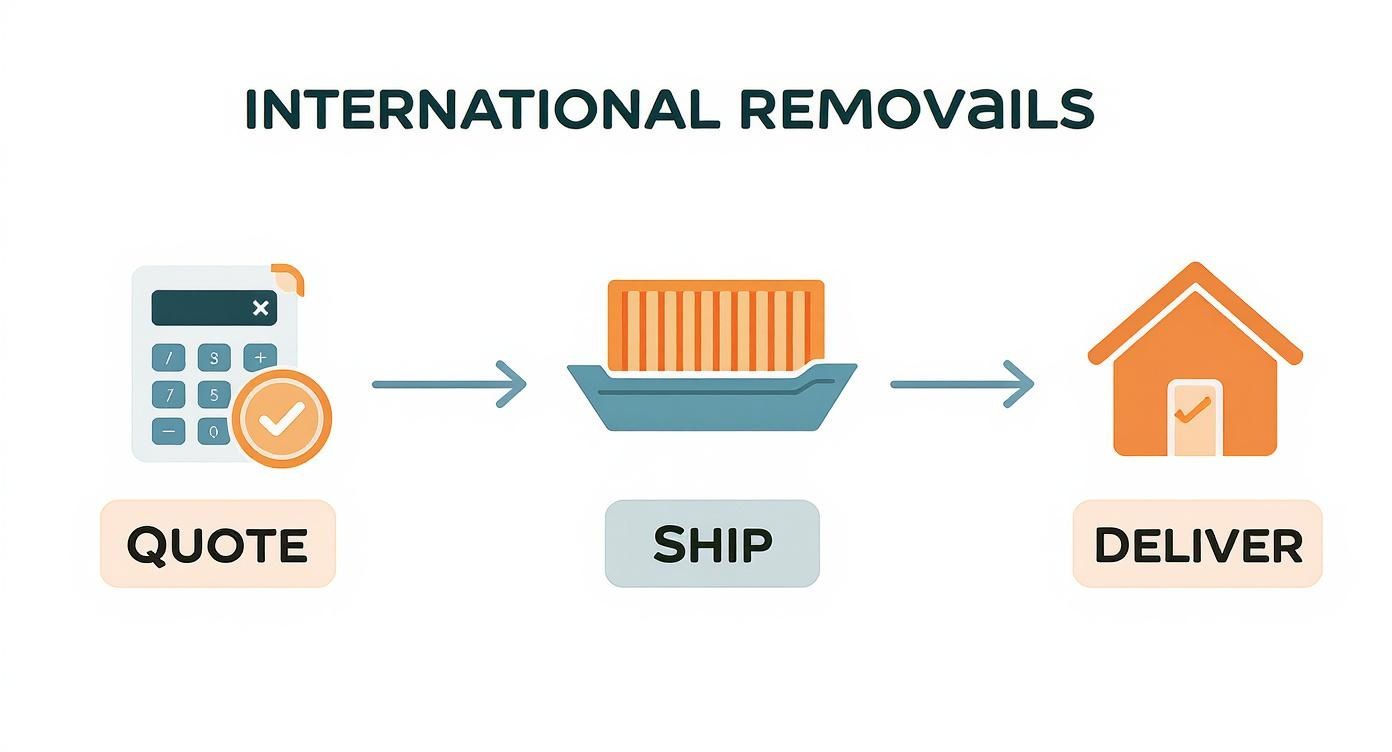
As you can see, every successful move starts with a solid quote, moves into the actual shipping, and finishes with your belongings arriving safely. Our aim here is to make each of these steps clear, giving you the knowledge you need to manage your move like a pro.
Comparing Your Main Transport Options
Getting your head around the main transport options is the best place to start your planning. Each one strikes a different balance between speed, cost, and how much you can send, which will directly impact your budget and moving timeline. The right choice really comes down to what's most important to you – whether that's getting your essentials there quickly or moving your entire home as cheaply as possible.
Quick Comparison of International Shipping Methods
To help you see the differences clearly, here's a simple breakdown of your main choices.
| Shipment Method | Average Transit Time | Cost Level | Best For |
|---|---|---|---|
| Sea Freight | 4-12 weeks | Low to Medium | Full house moves, large furniture, and budget-conscious relocations where time is not the primary factor. |
| Air Freight | 1-2 weeks | High | Urgent shipments, essential items needed upon arrival, or smaller moves where speed is the main priority. |
| Road Freight (Europe) | 1-7 days | Medium | Moves to mainland Europe, offering a direct and relatively quick door-to-door service for all shipment sizes. |
This quick comparison should give you a good initial feel for which option might work best for your situation.
Planning a move is more than just packing boxes; it's about relocating your entire life. This includes every member of your family, pets included. The logistics for animals require special attention to detail well in advance of your moving date.
When mapping out your international move, don't forget to create a detailed plan for your furry friends. It's a good idea to consult a comprehensive guide on how to travel with pets to make sure you've covered all the bases, from vet checks to their care during transit. A little extra prep goes a long way in ensuring they have a safe and comfortable journey.
Choosing Your Shipping Method: Sea Freight vs. Air Freight
One of the first big decisions you'll make for your international move is how to get everything from A to B. It nearly always comes down to a choice between sea freight and air freight, which is really a classic trade-off: do you prioritise cost or speed? It’s a bit like choosing between a long, leisurely train journey and a quick flight – both get you there, but they serve very different needs.
Sea freight is the reliable, cost-effective workhorse of the international moving world. For most full house moves, where you're watching the budget and aren't in a desperate hurry, this is the way to go. Consider this: over 90% of global trade travels by sea, which tells you everything you need to know about its efficiency for shifting large volumes. For your move, this translates into a much lower price tag, especially when you're shipping heavy furniture, appliances, or even a car.
On the other hand, think of air freight as the express courier of removals. It's fast – seriously fast – but it comes with a premium price to match. This is your best bet for those essential items you simply can’t be without when you land. If you’re starting a new job right away, flying over a couple of boxes with work clothes, vital documents, and a few personal comforts can make all the difference in those first few weeks.
Understanding Your Sea Freight Options
Once you've decided on sea freight, you'll have another choice to make, this time based on how much stuff you actually have. The volume of your goods is a major factor in the final cost of your move.
- Full Container Load (FCL): This is like having your own private removal lorry. You book an entire steel container – usually 20ft or 40ft – for your exclusive use. It's the most secure option because your container is sealed at your UK home and isn't opened again until it reaches your new one. It also tends to be a bit quicker than the alternative.
- Less than Container Load (LCL): Don't have enough to fill a whole container? No problem. LCL is essentially a shared service. Your belongings are professionally packed and then loaded into a container alongside shipments from other people heading to the same part of the world. It’s a brilliant, economical choice for smaller moves, though it can take a little longer as there's more logistics involved in consolidating everything.
Deciding between FCL and LCL really just comes down to a quick calculation of volume. Any good removals company will walk you through the measurements and help you figure out which one makes the most financial sense for you.
Air Freight: When Speed is Everything
While sea freight is the default for most large-scale international removals UK customers plan, air freight has some powerful advantages. The big one, of course, is speed. A sea shipment from the UK to Australia might take 8-12 weeks door-to-door. By air, your things could be with you in as little as 1-2 weeks.
The cost of air freight is calculated using 'chargeable weight,' a figure that looks at both the actual weight and the size (volume) of your boxes. This is exactly why it’s best reserved for essentials, not your three-piece suite.
A common strategy we see is a hybrid approach. A family might ship the bulk of their home by sea but decide to air freight a few key boxes. These often contain kids' favourite toys, essential kitchen gadgets, and important work documents. This lets them start settling in properly without waiting months for the main event.
Whichever way you go, proper packing is non-negotiable. Using the right packing materials for moving is what keeps your belongings safe and sound on their long journey, whether they’re crossing an ocean or flying high above it. Blending the economy of the sea with the speed of the air often creates the most practical and stress-free moving plan.
Getting to Grips with Customs and International Paperwork
Let's be honest, for most people moving abroad, the word "customs" conjures up images of endless red tape and stern-faced officials. It's easily the most daunting part of the whole process. But it doesn't have to be.
Think of your customs paperwork as a passport for your belongings. It’s simply a clear, honest declaration telling the destination country exactly what you're bringing in. Getting this right is the key to a smooth journey for your shipment. Any mistakes or missing documents can cause frustrating delays, surprise fees, or in the worst-case scenario, your shipment being turned away.
This is where a good international removals company really earns its keep. They’re not just movers; they're your expert guides through this maze, handling the complicated bits so you don’t have to.

Your Essential Customs Document Checklist
Every country has its own quirks, but there's a core set of documents you'll need almost everywhere. Your removals specialist will give you the exact forms for your destination, but getting these key items together early on will make everything much quicker.
- Detailed Inventory / Packing List: This is the big one. It’s a box-by-box, itemised list of everything you're sending. If you’ve chosen a professional packing service, our crew will create this for you as they go.
- Copies of Your Passport: You'll need a clear copy of the photo page for everyone in the family who is moving.
- Visa or Residence Permit: A copy of your visa is crucial. It proves to the authorities that you have the legal right to import your household goods.
- Customs Declaration Form: This is the official government form for your destination. Your removal company will provide the correct one and walk you through how to fill it out properly.
Having these organised and ready to go will save you a last-minute scramble. Your move coordinator will also flag if anything else is needed, like a marriage certificate or proof of employment.
Understanding Prohibited and Restricted Items
Every country has very firm rules about what can and cannot cross its borders. Not paying attention here is one of the fastest ways to run into serious trouble. It's vital to know the difference between the two main categories.
Prohibited items are a complete no-go. They are strictly forbidden, with no exceptions. Trying to ship these can lead to fines, your entire container being seized, or even legal trouble.
Restricted items, on the other hand, are things you might be able to bring in, but you’ll need to meet specific conditions, get the right permits, or pay duties and taxes.
"Forgetting to declare something, or trying to sneak in a prohibited item, is the number one cause of customs delays. Trust me, it's always better to be upfront—customs officials have a knack for finding things."
To avoid any headaches, the best rule of thumb is: "if in doubt, leave it out." Your removal company will have a detailed list for your specific destination, but here are a few universal examples to give you an idea.
-
Common Prohibited Items:
- Firearms, ammunition, and explosives
- Illegal drugs
- Certain animal and plant products (to prevent the spread of pests or diseases)
- Counterfeit or pirated goods
-
Common Restricted Items:
- Alcohol and tobacco (always subject to strict limits and hefty taxes)
- Brand new items (anything less than 6-12 months old might attract import duty)
- Prescription medicines (often require a signed doctor's letter)
- Cars and motorbikes (these have their own complex import permits and compliance checks)
If you're unsure about anything at all, just ask your move manager. A quick chat can save you a world of hassle later. When it comes to customs, honesty and being thorough are your best friends.
Working Out the Cost of Your International Move
Trying to pin down the cost of an international move can feel a bit like guesswork. The final figure on your quote isn’t just pulled out of thin air; it’s a careful calculation based on several key factors. Getting your head around these is the first step to building a realistic budget and avoiding any nasty shocks later on.
First and foremost, the biggest driver of your cost is the volume of your belongings. In international shipping, space is the most valuable commodity. We measure everything in cubic feet or cubic metres, and quite simply, the more stuff you have, the more you'll pay. This is precisely why an accurate survey—whether it's an in-person visit or a quick video call on your mobile—is absolutely essential for getting a quote you can trust.
Naturally, your destination plays a massive part too. Moving your life to Paris is going to be a different financial ballgame than shipping everything to Perth. The distance your goods have to travel, the routes they take, and the complexity of the customs process at the other end all get factored into the equation.

The Core Cost Drivers You Need to Know
Beyond the sheer volume and distance, a few other crucial variables will shape your final bill. Understanding these will put you in a much better position to compare quotes like for like.
- Shipping Method: As we've already touched on, sea freight is always the more budget-friendly option compared to air freight. Flying your goods is much faster, but you're paying a premium for that speed and convenience.
- Service Level: Are you after a full-service, door-to-door experience where our team handles all the packing and unpacking? Or would you prefer a more basic port-to-port shipment, leaving you to manage more of the logistics yourself? The level of service you choose has a direct impact on the price.
- Access: Think about the practicalities. Are you moving from a top-floor flat with no lift, or from a house with a perfect, wide driveway? Tricky access at either your current home or your new one can sometimes mean extra costs for the additional manpower or special equipment needed.
These are the fundamental building blocks of any international removals quote. Any transparent moving company will happily walk you through a breakdown, showing you how each element contributes to the total.
Looking Beyond the Quote: The Hidden Costs
A good quote should be all-inclusive, but it’s always smart to be aware of potential extra costs that might pop up, usually related to charges at your destination or choices you make during the process.
The best way to manage your budget is to ask potential removal companies for a detailed, itemised quote. A reputable mover will be happy to explain every single charge, ensuring you understand exactly what you are paying for.
Here are a few common "extras" to keep on your radar:
- Insurance: While basic liability is included, it's often minimal. We always recommend comprehensive marine insurance to fully protect the value of your possessions during transit.
- Customs Duties & Taxes: If you’re shipping brand-new items still in their boxes, or restricted goods like wine and spirits, you’ll almost certainly face import taxes when they arrive.
- Port Fees & Quarantine: Some countries, particularly Australia and New Zealand, have incredibly strict biosecurity and quarantine inspections, which can come with additional fees.
Knowing about these potential costs from the start means you can ask the right questions and plan your budget properly. To get a better sense of what to expect, our guide on the UK moving cost calculator for 2025 offers some great insights into planning for relocation expenses.
It's also worth noting that demand for these services is influenced by bigger-picture trends. We're seeing a noticeable rise in people moving abroad from the UK, partly due to policy changes and shifts in higher education. This evolving landscape has a direct effect on the removals industry, shaping migration patterns and demand. You can watch an analysis of these UK migration trends to get a feel for what's happening on a national level.
How to Choose the Right UK Removal Company
Think of your removal company as the single most important partner in your move abroad. They’re not just a transport service; they’re the people you’re trusting with everything you own. Getting this choice right is the biggest step you can take towards a smooth, stress-free move, turning what could be a logistical nightmare into a well-managed project.
Let's be honest, searching for an international removals UK company can feel a bit daunting. There are so many out there. But a few tell-tale signs can quickly help you sort the seasoned pros from the cowboys. Your goal is to find a partner who doesn't just shift boxes, but who brings genuine expertise, security, and that all-important peace of mind.
The UK is a place of constant movement. People arrive, and people leave. This constant flow, which includes many non-EU nationals here for work or study, creates a steady demand for professional international movers. If you're curious about the bigger picture, the Office for National Statistics website offers some fascinating insights into the UK’s migration trends.
Look for Professional Accreditations
Before you even think about getting a quote, do a quick check for professional credentials. These aren't just fancy logos; they are a mark of quality. Think of them as your first line of defence, a clear sign that a company meets strict industry standards for service, financial health, and how they run their operations.
- British Association of Removers (BAR): This is the big one in the UK. Members of BAR are regularly inspected and have to follow a strict Code of Practice. The real kicker? They offer an Advance Payment Guarantee, which protects the money you pay upfront if the company runs into financial trouble.
- FIDI Global Alliance: If you see the FIDI Accredited International Mover (FAIM) badge, you’re dealing with a world-class mover. This is the gold standard for international removals. To get it, companies have to pass a tough, independent audit covering everything from their services and facilities to their staff training.
These accreditations give you real protection and a proper process to follow if things don't go to plan.
The Power of Multiple Itemised Quotes
Rule number one: never go with the first quote you get. The best practice in the industry is to get at least three detailed, itemised quotes from different accredited companies. This is the only way to properly compare what you’re getting for your money and ensure you find that sweet spot between good value and quality service.
A vague, one-line price is a massive red flag. A professional quote will break everything down for you – packing materials, labour, freight charges, insurance, and any fees you might face at your destination. This kind of transparency is the hallmark of a company you can trust. Seeing how a professional international removal company structures its services will give you a good benchmark for what to expect.
Embrace Modern Quoting Technology
The days of waiting around for a surveyor to visit your home are fading fast. Many of the best companies now offer mobile self-video surveys, and they are brilliant.
You simply use your smartphone to walk a surveyor through your home on a live video call. It’s incredibly convenient, quick, and just as accurate as an in-person visit for getting a fixed-price quote, all without the hassle of scheduling appointments.
This tech also means you can get accurate quotes from specialist movers all over the country, not just the ones on your doorstep, giving you a much wider choice.
Critical Questions to Ask Potential Movers
Once you have a few quotes in hand, it’s time to dig a bit deeper. A company's answers to these questions will tell you a lot about their experience and whether they genuinely care about their customers.
- Experience with Your Destination: "How many moves to [your destination country] have you handled in the past year?"
- Container Options: "Will my things be shipped in their own dedicated container (FCL), or will they be part of a shared load (LCL)?"
- Insurance Coverage: "Could you walk me through your insurance options? And what’s the process if something gets damaged?"
- Destination Partners: "Who is your partner agent at our destination? Are they accredited too?"
- Tracking and Communication: "How will you keep me in the loop about where my shipment is?"
Asking these simple questions puts you in control, helping you choose a partner with the proven expertise to handle your move with the care it deserves.
Your International Removals Questions Answered

When you're planning a move of this size, it’s completely normal to have a long list of questions. To help, we’ve gathered some of the most common queries we hear from our customers moving abroad from the UK.
Think of this as the final piece of the puzzle. Our aim here is to give you clear, straightforward answers that will iron out any last-minute uncertainties and give you the confidence to move forward.
How Long Does International Shipping from the UK Take?
This is usually the first question on everyone's mind, but there’s no single, simple answer. It really all comes down to where you’re going and which shipping method you’ve chosen.
Transit times can vary hugely. For instance, sending a sea freight container to a far-flung destination like Australia or New Zealand can take anywhere from 8-12 weeks, door to door. A move to the USA is often a bit quicker, typically in the region of 4-8 weeks.
On the other hand, air freight is much faster, with most shipments landing within 1-2 weeks. If you’re just hopping over to the continent, European road freight is the quickest option by far, often taking only a few days. Your removals company will always give you a much more precise schedule based on your specific route.
What Is the Best Way to Pack for an International Move?
Honestly, for any international move, we strongly recommend letting the professionals handle the packing. Your belongings are about to go on a very long journey and will be handled multiple times, so they need the best possible protection.
Our crews use industry-standard, heavy-duty materials designed specifically for the bumps and knocks of international shipping. Not only does this keep your possessions safe, but it also means a detailed inventory is created as we go – a document that's absolutely vital for getting through customs smoothly.
If you do decide to pack some non-fragile items yourself, our advice is to only use new, strong, double-walled boxes. Don't be shy with cushioning material like bubble wrap and packing paper; fill any gaps to stop things from shifting around in transit.
Do I Need International Removals Insurance?
Yes, absolutely. While any reputable mover is incredibly careful, taking out specific marine or shipment insurance is essential for your own peace of mind. Standard liability cover is often very limited and probably won't cover the full replacement value of your goods if something goes wrong.
This specialist insurance protects your belongings against unforeseen events during their long journey, like damage from rough seas or, in a worst-case scenario, total loss. Your removals company will be able to offer different insurance options, so make sure you review the policy, understand exactly what’s covered, and check the coverage limits.
An international move is a huge undertaking, and a clear, itemised quote is non-negotiable. This level of detail is crucial for budgeting properly and making sure there are no nasty surprises down the line.
When you start comparing quotes, it’s vital to look closely at the details. Seeing what’s included in a well-structured moving company estimate template can help you understand what to look for and what to ask.
Can I Ship My Car from the UK?
Yes, you can. Most specialists in international removals UK to worldwide destinations can arrange vehicle shipping. It's a bit of a different ball game to shipping your household goods, as it involves separate customs regulations and requires its own set of paperwork.
You’ll need to provide the vehicle's registration document (the V5C) and make sure the car meets the import standards of your new country. Cars are usually loaded securely inside a steel container, sometimes alongside your other belongings, to keep them safe on their journey.
Ready to get your move abroad underway? The team at SimplyPro Removal & Storage Ltd has the experience and know-how to manage every detail of your international relocation from Bristol or Bath. Get in touch today for a fast, accurate, and no-obligation video quote by visiting https://www.simplyremovalsbristol.co.uk.