


Moving your life across the Atlantic might seem like a huge undertaking, but it all boils down to a few key first steps. To ship from UK to USA, you’ll need to start with a detailed inventory, decide between sea and air freight, and get your initial documents in order. Honestly, a solid plan is the best tool you have for making this transition go smoothly.
Your First Steps for Shipping From the UK to the USA
Relocating from the UK to the USA is a major project, and the decisions you make right at the start will really shape how the whole process unfolds. Getting these early stages right can save you a world of headaches, unexpected costs, and delays later on.
The absolute cornerstone of any international move is a proper inventory. This isn't just a rough list scribbled on a notepad; it’s a detailed account of every single thing you plan on shipping. It’s vital for a few reasons: it helps calculate the volume of your shipment (which is a huge factor in the cost), and it's non-negotiable for both customs and insurance.
Create a Detailed Inventory
The best way to tackle this is to go room by room. List everything, from your big-ticket items like sofas and beds right down to the smaller personal things. Be specific. Don't just write "kitchen stuff"; instead, put "12-piece dinner set, stand mixer, set of four saucepans." This detail helps your chosen international removal company give you a truly accurate quote and keeps the customs officials happy.
This is also the perfect time to have a good declutter. International shipping costs are all about volume, so every item you decide to sell, donate, or leave behind is money back in your pocket.
Key Takeaway: Your inventory is the single most important document you'll create for this move. It dictates your quote, streamlines customs, and is your proof if you ever need to make an insurance claim. It’s worth taking the time to get it right.
Initial Document Gathering
You don't need every piece of paper from day one, but it’s a smart move to start collecting the essentials early on. This will save you a frantic last-minute search later.
For now, focus on locating these key documents:
- Passports and Visas: Make sure they are valid for every member of the family and easy to get to.
- Birth and Marriage Certificates: Keep these vital records safe and with you, not packed away in a shipping container.
- A Detailed Packing List/Inventory: This is the list you've just started creating.
If you’re moving with four-legged family members, you'll need to do some extra prep. You can find some excellent advice in a pet owner's guide on how to travel with pets. Getting their paperwork sorted is just as important. Having all this organised from the get-go makes the next steps, like getting quotes, much more straightforward.
Choosing Your Shipping Method: Air Freight vs Sea Freight
One of the biggest decisions you'll face when planning your move from the UK to the USA is how to get your belongings across the pond. This choice really comes down to a classic trade-off: speed versus cost. The two main players are air freight and sea freight, and each serves a very different purpose.
Figuring out which is right for you often boils down to a simple question: how soon do you need your things? If you're starting a new job and need your office setup and essential clothes immediately, air freight is your go-to. But if you're moving your entire life in boxes and have some time to play with, sea freight will be much kinder to your wallet.
This flowchart gives you a bird's-eye view of the process, helping you map out the journey from initial inventory to getting your documents in order.
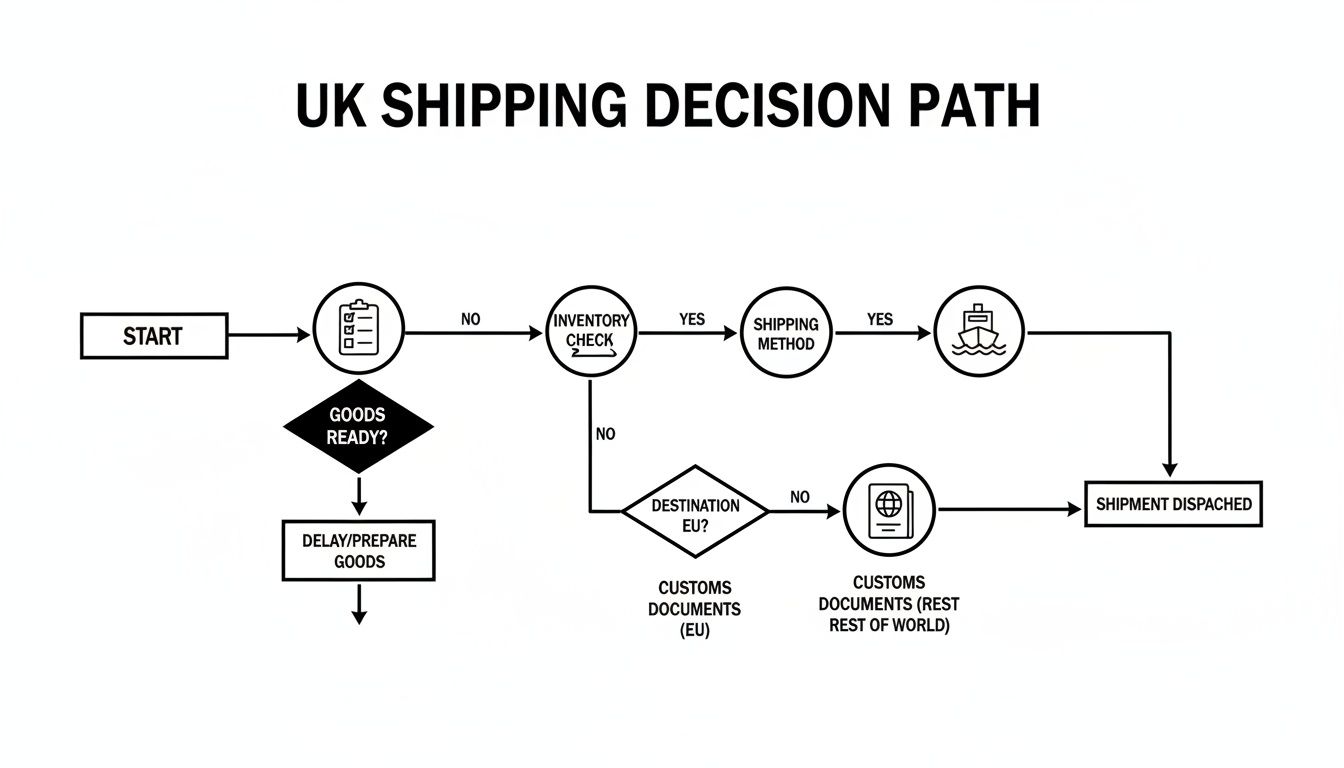
As you can see, the size of your shipment and how urgently you need it are the first things that will point you in the right direction.
Air Freight: When Speed Is Your Priority
If you need something to arrive fast, nothing beats air freight. It’s the express courier service for your personal effects and the perfect solution for smaller, time-sensitive shipments.
A common scenario we see is a professional relocating for a new role. They might fly over a few boxes with their computer, work files, and a core wardrobe. This allows them to hit the ground running while the rest of their home contents follows on a ship.
- The Upside: It's incredibly fast. You can expect your things to arrive door-to-door in just 2–3 weeks.
- The Downside: The speed comes at a premium. It’s significantly more expensive, and costs are calculated by volumetric weight. This means large, light items (like a duvet or pillows) can be surprisingly costly to fly.
Sea Freight: The Sensible Choice for Larger Moves
Sea freight is the backbone of the international removals industry, and for good reason. For anything more than a handful of boxes, it’s vastly more economical than flying. If you're moving the contents of a flat or a whole house, this is almost always the way to go.
The trade-off, of course, is time. A sea shipment takes a good while longer, typically 6–10 weeks from your UK door to your new US address. That window covers everything: professional packing, transport to the UK port, the ocean crossing itself, customs clearance in the States, and the final delivery.
Expert Insight: Don't be put off by the longer transit time for sea freight. A bit of forward planning goes a long way. Pack a couple of extra suitcases with essentials to see you through the first month or so. It's a simple strategy that can save you a huge amount on your total moving budget.
The shipping lanes between the UK and the US are well-established and incredibly busy. In 2023 alone, the Office for National Statistics (ONS) reported that the UK exported £60.4 billion in goods to the United States. While most of that is commercial cargo, it shows just how robust the logistics network is. For personal shipments over 500 kg, the economies of scale really kick in. For a deeper dive, you can read the full report on UK trade with the United States 2023.
To help you weigh your options, here’s a straightforward comparison of the two methods.
Comparing Air Freight vs Sea Freight for Your UK to USA Move
| Factor | Air Freight | Sea Freight |
|---|---|---|
| Speed | Fast: Typically 2–3 weeks door-to-door. | Slower: Typically 6–10 weeks door-to-door. |
| Cost | High: Best for small, urgent shipments. Priced by weight and volume. | Low: Far more economical for larger shipments (e.g., a whole flat or house). |
| Best For | Essential items, small moves, or when you have a tight deadline. | Full household moves, furniture, bulky items, and budget-conscious moves. |
| Carbon Footprint | Higher environmental impact. | Significantly lower carbon footprint per item. |
Ultimately, the right choice depends entirely on what you're shipping and when you need it.
Full Container vs. Shared Container
If you decide on sea freight, you have one more choice to make. It all depends on how much stuff you have.
- Full Container Load (FCL): This is where you hire an entire 20ft or 40ft steel container just for your things. It’s the best option for a large family home. Your container is sealed at your residence and isn’t opened again until it clears customs at your destination, making it slightly quicker and more secure.
- Less than Container Load (LCL): If you don't have enough to fill a whole container, your belongings are grouped with other people's shipments heading to the same area. This is a brilliant, cost-effective solution for smaller moves, like the contents of a one-bedroom flat, because you only pay for the space you actually use.
The best way forward is to chat with a moving specialist. They can provide detailed quotes for both air and sea freight, giving you the concrete numbers you need to make the best decision for your move.
Navigating US Customs and Required Documentation
Let's be honest, the thought of getting all your belongings through US customs can be a bit daunting. It often feels like the most bureaucratic hurdle in the entire move. But with a bit of prep, it's a perfectly manageable process. Think of it as the final checkpoint before your new life in the States begins.
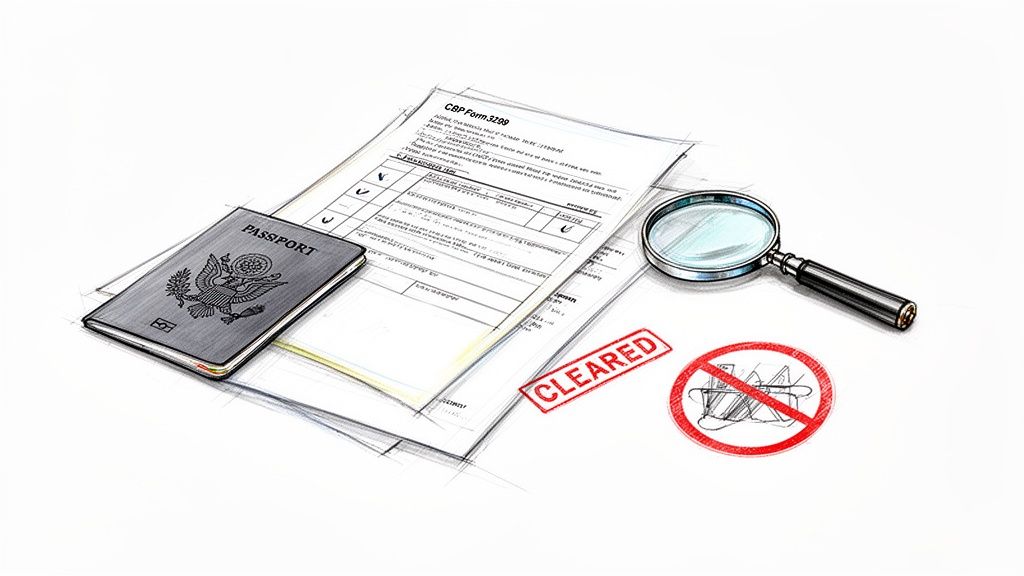
The system is actually set up to handle household moves pretty efficiently. The key, though, is accuracy. A simple mistake on a form can trigger frustrating—and often expensive—delays. This is one of those times when being meticulous really pays off.
Your Essential Document Checklist
U.S. Customs and Border Protection (CBP) has a very specific list of paperwork they need to see. Your international moving company will walk you through it, but it’s a smart move to get these documents together well ahead of time. No one needs that last-minute scramble.
Here’s a rundown of the core documents you'll need to have ready:
- CBP Form 3299 (Declaration for Free Entry of Unaccompanied Articles): This is the big one. It's your official declaration that everything you’re shipping is for your personal use and that you've owned it for at least a year. Get this right, and your shipment should be duty-free.
- A Detailed Packing List / Inventory: Every single box needs an entry on this list, describing what's inside and its approximate value. Vague descriptions like "kitchen stuff" are a red flag for customs. Be specific: "8-piece Denby dinner set," "Dualit toaster," "assorted cutlery."
- Copy of Your Passport Picture Page: A clear, legible copy to confirm who you are.
- Copy of Your US Visa: This is your proof that you're legally entitled to live in the United States.
- I-94 Arrival/Departure Record: You won't have this until you physically arrive. It's an electronic record of your entry that you can retrieve online from the CBP website.
Filling these forms out correctly is your best defence against hold-ups. While a good moving company will double-check everything, the ultimate responsibility for accuracy is yours.
Prohibited and Restricted Items: What Not to Pack
This part is non-negotiable. Trying to ship prohibited items—even by accident—is a recipe for disaster. Your entire shipment could be seized, inspected, and even destroyed, and you'll be the one footing the bill.
The US has incredibly strict rules, mainly to protect its agriculture and public safety. You have to be diligent about what you're putting in those boxes.
Items Strictly Prohibited from Entry
This isn't a complete list, but it covers the common culprits that cause the biggest headaches for people moving from the UK:
- Most Food Products: This means no fresh fruit, veg, meat, or dairy. Say goodbye to that lovely wedge of Stilton.
- Soil, Plants, and Seeds: These are a huge no-go as they can carry pests and diseases.
- Firearms and Ammunition: This is a whole different ball game. Importing firearms requires special permits and is a highly complex process.
- Certain Animal Products: Things made from ivory, certain leathers, or other endangered species are illegal.
A Real-World Scenario: We once handled a move for a family heading to California who packed a few bags of their favourite British sweets and a Christmas pudding. The pudding, which contained suet (an animal fat), got their shipment flagged for an agricultural inspection. It caused a two-week delay and landed them with extra inspection fees—all for a single pudding.
Beyond the outright-banned items, you have "restricted" goods. This includes things like alcohol or certain medications. You might be able to bring them, but they’ll likely need special permits and could be subject to duty. Always declare them clearly.
The good news is that customs procedures are well-oiled machines, especially between the UK and the US. With total trade in goods and services between the two countries reaching £331.2 billion, a smooth clearance process is essential.
The sheer complexity of these regulations is why so many people rely on specialists. Understanding the role of a customs broker is key; they are the experts who make this process seamless. Your international removal company will almost certainly work with a broker on your behalf, ensuring every 'i' is dotted and every 't' is crossed so your belongings clear customs without a hitch.
How to Pack for an International Move
The way you pack your belongings can genuinely be the difference between them arriving in perfect condition or in a thousand pieces. When you ship from the UK to the USA, your boxes are going on a long journey involving lorries, ports, cranes, and a multi-week sea voyage. Getting the packing right isn't just a chore; it's the best insurance policy you can have for your possessions.
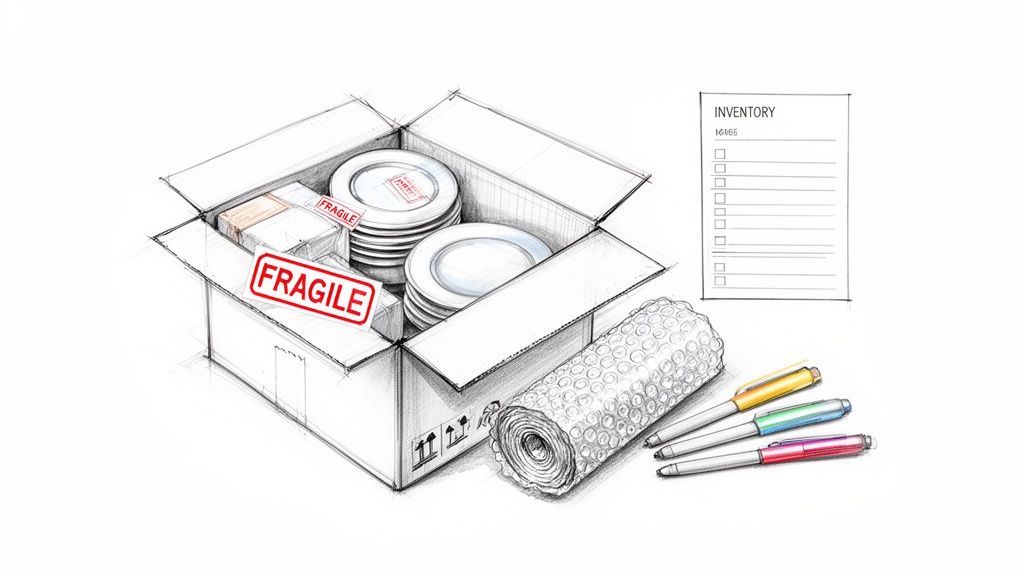
The foundation of a solid pack is using the right materials. This isn't the time for flimsy, single-walled boxes you've saved from the supermarket. For an international move, you need sturdy, double-walled cardboard boxes that can withstand the weight and pressure of being stacked high in a shipping container.
Essential Packing Materials and Techniques
Before you start, get all your supplies in one place. Scrambling for tape or paper mid-pack is a surefire way to get frustrated and do a rushed job. Here’s a quick checklist of the absolute essentials:
- Strong Packing Tape: Don't skimp on this. Get a quality brand and use the 'H-tape' method—sealing down the middle seam and then across both edges on the top and bottom of every single box.
- Packing Paper or Bubble Wrap: Clean packing paper (unprinted newsprint is perfect) is your go-to for wrapping everyday items. Save the bubble wrap for your most fragile possessions, like glassware, ornaments, and electronics.
- Marker Pens: For clear, bold labelling that you can read from a distance.
A golden rule of packing is to always place heavier items at the bottom of the box, with lighter ones on top. Crucially, fill any empty spaces with crumpled packing paper or other soft materials to stop things from shifting around. A box that isn't packed tightly is a box that's likely to get crushed.
Protecting Your Fragile Items
Fragile items demand special attention. Your delicate glassware, plates, and electronics need to be properly insulated from the inevitable shocks and bumps of transit. Think of it as creating a protective cocoon inside the box.
When packing plates, wrap each one individually in paper and stand them on their edge inside the box. Never lay them flat, as this makes them far more vulnerable to cracking under pressure. For glasses and mugs, wrap each one and place them rim-down, stuffing crumpled paper into the gaps between them.
For electronics, the original boxes are always best. If you don't have them anymore, find a sturdy box and wrap the item completely in bubble wrap, making sure to fill all the surrounding voids so it can’t move an inch.
Expert Tip: Create a detailed inventory as you pack. Number each box and keep a corresponding list of its general contents (e.g., Box #12 – Kitchen – Pots & Pans). This isn't just vital for customs clearance; it will make the process of unpacking at your new home in the USA infinitely easier.
Handling Bulky and Specialist Items
So, what about the big stuff? Your sofa, antique wardrobe, or piano clearly won't fit in a box. These items require specialist preparation to ensure they arrive without scratches, dents, or more serious damage.
Furniture should be wrapped in professional-grade moving blankets, then secured with plastic shrink-wrap to keep the blankets in place and protect against dust and moisture. For anything with delicate legs or intricate details, like an antique table, custom crating might be the only safe option. This involves building a bespoke wooden frame around the piece for rigid, foolproof protection. For a more in-depth guide, you can learn more about how to pack for moving in our dedicated article.
Should You Use a Professional Packing Service?
While DIY packing can save you money upfront, it's worth weighing up the benefits of bringing in the professionals. For one, it saves an incredible amount of time and physical effort. A trained crew can pack an entire house in a day or two—a task that could easily take you weeks of evenings and weekends.
More importantly, it has huge implications for your insurance. Most removal insurance policies will not cover damage to the contents of boxes packed by the owner (often listed as "PBO"), as the quality of the packing can't be verified. If a professional team packs for you, their work is fully insured against damage in transit, offering you complete peace of mind. For high-value or sentimental items, this alone often makes the service well worth the cost.
Getting to Grips with Costs, Insurance, and Accurate Quotes
Budgeting is, without a doubt, one of the most critical parts of planning your move. When you need to ship from UK to USA, getting a handle on the costs early on will save you a world of stress. The final price tag isn't just plucked from thin air; it’s a detailed calculation based on what it will actually take to get your life from here to there.
The biggest single factor that will sway your quote is the volume of your shipment. It's simple, really: the more space your belongings occupy in a container, the more it's going to cost. This is exactly why a detailed inventory is so essential – it gives us the hard data needed to calculate the cubic feet or metres your goods will fill. While weight does play a part, for sea freight, volume is king.
Of course, your chosen shipping method—air versus sea—will have a massive impact on the price. As we've touched on, air freight is the fast, premium option, whereas sea freight is the far more budget-friendly route for most household moves. Finally, where you're heading in the US matters. Getting your things to a major port city like New York is one thing; transporting them all the way inland to Denver requires a whole extra leg of the journey on the road, which adds to the cost.
Breaking Down Your Moving Quote
When you get a quote, you need to be able to see exactly what you’re paying for. A professional moving company will always provide a clear, itemised breakdown of the door-to-door service.
Here’s what a typical quote should cover:
- Picking up all your items from your UK address.
- Professional export packing and wrapping.
- Loading everything into the shipping container and getting it to the UK port.
- All UK port handling fees and export customs formalities.
- The actual sea or air freight journey to the destination US port.
- Clearing US customs and paying US port handling fees.
- The final delivery to your new home in the USA.
Be sure to ask about things that might not be included in that initial figure. These can include customs duties or taxes (especially on new items), storage fees if your plans change, or charges for tricky access at your new place. Always ask your moving company for the full picture.
It's reassuring to know the UK-US shipping route is one of the most efficient in the world. In a recent period, the United Kingdom exported a staggering US$71.77 billion worth of goods to the United States. This sheer volume means the logistics networks are incredibly reliable, which is fantastic news when you're trusting them with your personal belongings. You can see the full scale of UK-US trade for yourself.
Protecting Your Possessions with Marine Insurance
No matter how carefully things are packed, an international move always has its risks. From choppy seas to an unexpected jolt during handling, things can happen. This is why marine insurance isn't just an add-on; it's an absolute essential. Think of it as your financial safety net, giving you genuine peace of mind that your belongings are protected.
Most international movers will offer a comprehensive, "all-risk" marine insurance policy. This is the gold standard, covering your goods against loss or damage from almost any external cause during transit. To get this cover, you’ll need to complete a valued inventory list. This is simply a document where you declare the replacement value of each item at your destination. This step is crucial for making sure any potential claim is settled fairly.
A Word of Advice from Experience: Never be tempted to undervalue your goods just to save a few pounds on the insurance premium. If something goes wrong and you have to make a claim, the payout is capped at the value you declared. You could be left seriously out of pocket trying to replace an item in the US.
It’s also important to remember that who packs your items can affect your cover. As we mentioned earlier, boxes you pack yourself ("PBO" – packed by owner) are often only covered for total loss, not for any damage to the contents. For a deeper dive into this, take a look at our guide on insurance for removals.
How to Get a Quote You Can Trust
The accuracy of your moving quote boils down to one thing: how well the moving company can assess the volume of your shipment. Thankfully, the days of having to schedule a time-consuming home visit as the only option are long gone.
Today, there are two main ways to get a firm quote:
- Mobile Self-Video Survey: This is now the most popular and convenient method. You use your smartphone to walk us through your home on a video call, pointing out everything you want to ship. It's fast, flexible, and surprisingly precise. You can do it whenever works for you.
- In-Person Survey: For very large or complex moves—perhaps involving valuable antiques, fine art, or homes with difficult access—the traditional approach of having a surveyor visit in person might still be best.
Both methods have the same goal: to give you a fixed, transparent quote with no nasty surprises. By giving us a crystal-clear view of what you're moving, we can give you the most accurate price possible and help you keep your budget right on track.
Got Questions About Shipping to the USA? We’ve Got Answers.
Even with the best-laid plans, it’s completely normal to have a few questions swirling around when you’re about to ship from UK to USA. It’s a huge life event, and getting the details right really matters. To help put your mind at ease, we’ve put together answers to some of the most frequent questions we hear from people making the same move.
Think of this as a final sanity check, designed to clear up any lingering doubts before you start your new chapter across the pond.
How Long Will It Actually Take for My Belongings to Arrive?
This is usually the first thing people ask, and honestly, it all comes down to whether you choose to ship by sea or by air. The time difference is pretty stark, so it’s a big part of your planning.
If you go with sea freight, which is what most people choose for a full house move, you’ll want to plan for a door-to-door timeline of about 6 to 10 weeks. That window covers everything: our crew collecting and professionally packing your things in the UK, the trip to the port, the sea voyage itself, getting through US customs, and the final delivery to your new home.
On the flip side, air freight is your express option. If you've got essential items you need to get your hands on quickly, this is the way to go. The whole door-to-door journey is much faster, typically taking around 2 to 3 weeks. Just remember that things like your final destination (a coastal city will be quicker than a rural town in the Midwest) and busy shipping seasons can nudge these timelines a bit.
Will I Have to Pay Import Duty on My Household Goods?
This is a massive worry for many, but I’ve got good news for you. For most people moving their personal home and belongings, the process is surprisingly straightforward.
The vast majority of your personal effects and household goods can be imported into the USA completely duty-free, as long as you've owned and used them for at least a year.
Here's the key: To get this duty-free status, you need to fill out and submit the U.S. Customs and Border Protection (CBP) Form 3299, the "Declaration for Free Entry of Unaccompanied Articles." This is basically your official statement telling them the items are yours and you aren't planning to sell them.
Now, there are a few exceptions. Anything you've owned for less than a year is usually considered new and will likely have import duties applied. Also, certain things like alcohol and tobacco will almost always be taxed, no matter how long they've been in your wine rack. This is exactly why a detailed, honest inventory is your best friend for a smooth ride through customs.
What's the Best Way to Get an Accurate Quote?
Getting a quote you can bank on is crucial for budgeting your move. The only way to get a truly accurate price is to have the precise volume of your goods calculated by a professional. It takes the guesswork out of the equation and saves you from nasty surprises later on.
These days, the most popular and convenient way to do this is with a mobile self-video survey.
It’s simple and works like this:
- Book a slot: You pick a time for a video call that works for you.
- Grab your phone: A moving consultant will guide you through your home via a video call.
- Give us the tour: You just walk around, pointing your camera at all the furniture, boxes, and bits and pieces you want to ship.
- Get your quote: From that tour, we can calculate the exact volume and give you a detailed, fixed-price quote.
This whole process is quick, incredibly accurate, and means you don’t have to take time off work for an in-person visit. That said, for very large or complex moves, a traditional in-person survey is still a brilliant option to make sure we don’t miss a single thing.
Can I Just Pack My Own Boxes?
You absolutely can pack your own boxes – in the industry, we call them "PBOs," or "Packed By Owner." But, and this is a big but, you need to think carefully about the insurance implications.
If you decide to self-pack, most marine insurance policies will only cover your boxes for total loss. That means you’re covered if the whole box vanishes, but not if the contents inside get damaged. The logic is simple: the insurer has no way of knowing how well things were packed or what condition they were in before the box was sealed.
When our professional crew packs for you, their work is fully insured against both loss and damage, giving you much better protection. Plus, our packers are experts at loading a shipping container to maximise space and minimise movement, which drastically reduces the risk of breakages. If you do decide to pack yourself, please use proper double-walled boxes and keep a detailed list of what's in each one.
Planning a move from the UK to the USA is a massive undertaking, but you don’t have to figure it all out alone. With over 22 years of experience, the team at SimplyPro Removal & Storage Ltd is here to make your international relocation as smooth and stress-free as possible. From professional packing to navigating customs, we handle every detail. Get your free, accurate quote today and start your journey with confidence.